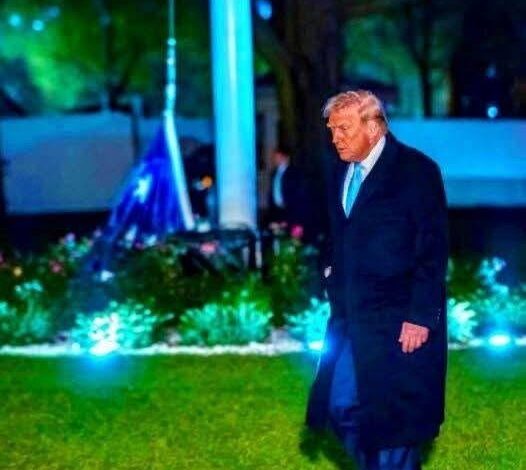
By the time the sun rose the next morning, the object itself had already stopped mattering.
Whatever he had been holding in that blurry photograph — a device, a symbol, a harmless object, something dangerous, or perhaps nothing significant at all — had become secondary almost immediately. The real event was no longer the image. It was the explosion of interpretation surrounding it. Within hours, millions of people had rushed online to complete the story themselves, each person filling the gaps with whatever fears, suspicions, loyalties, or fantasies they already carried inside them.
The photograph acted less like evidence and more like fuel.
Some viewers looked at the image and instantly saw threat. To them, every shadow confirmed hidden violence waiting beneath the surface. Others saw resistance, rebellion, proof that powerful institutions were lying yet again. Some treated the object as symbolic, a stand-in for broader political anxieties that had been simmering for years beneath public discourse. And then there were those who claimed not to care at all — but even their indifference somehow became folded into the larger argument, interpreted as complicity, exhaustion, denial, or quiet support depending on who was watching.
Almost overnight, the image stopped belonging to reality.
It became mythology.
Social media accelerated the transformation with terrifying efficiency. Strangers who knew nothing about the actual circumstances surrounding the photograph spoke with complete certainty about what it “obviously” meant. Threads stretched into thousands of comments deep, each one layering speculation atop speculation until the original moment became nearly impossible to separate from the stories built around it.
Every pixel was analyzed like sacred evidence.
People zoomed into reflections in windows.
Into shadows.
Into the positioning of fingers.
Into wrinkles in clothing.
Entire communities convinced themselves hidden truths were buried inside blurry screenshots and compressed images. Amateur investigators created diagrams. Influencers uploaded hour-long breakdowns. Algorithms rewarded outrage and certainty far more aggressively than caution or ambiguity, pushing the loudest interpretations to millions before facts had any chance to catch up.
And because modern attention moves so quickly, hesitation itself started to look suspicious.
If someone said, “We don’t actually know what happened yet,” they were accused of protecting someone.
If they asked for patience, they were accused of cowardice.
If they questioned viral narratives, they were treated as enemies by whichever side had already emotionally invested itself in a particular version of the story.
The speed was dizzying.
Within hours, television panels were discussing the image as though its meaning had already been legally proven. Commentators spoke in confident tones despite relying on fragments, rumors, and online speculation recycled so many times it no longer resembled anything verifiable. One guest would suggest a theory; another would respond to it as though it were already fact. By the end of the segment, millions of viewers walked away believing they had witnessed evidence instead of performance.
Speculation slowly transformed into collective memory before reality ever had a chance to intervene.
That may have been the most unsettling part.
Not the object itself.
Not the man holding it.
But how hungry everyone seemed to be for a story dramatic enough to satisfy whatever emotion they had already arrived carrying.
For some people, the image confirmed that society was collapsing into violence and instability.
For others, it proved institutions were manipulating fear for political control.
Some saw confirmation of conspiracies they had believed for years.
Others saw justification for fears they barely understood themselves.
The photograph became a mirror more than a document.
People weren’t reacting to what was actually visible.
They were reacting to themselves.
To their private anxieties.
Their resentment.
Their loneliness.
Their distrust.
Their desire to belong to a side that felt morally certain in a world growing increasingly chaotic and confusing.
That is why the online arguments became so emotionally intense so quickly. People were no longer debating a single moment captured in an image. They were defending entire worldviews attached to that image. To challenge someone’s interpretation felt, to them, like challenging their identity itself.
And modern platforms are built precisely to intensify that instinct.
The more emotional the reaction, the further it spreads.
The more extreme the certainty, the more attention it receives.
Nuance disappears first.
Context follows shortly after.
Soon the conversation no longer resembles investigation at all. It becomes performance, tribal warfare disguised as truth-seeking.
Even people trying sincerely to understand what happened found themselves pulled into the machinery of escalation. The endless flood of updates, screenshots, theories, reactions, and counter-reactions created the illusion that truth was emerging through sheer volume of information. But often the opposite was happening. The louder the conversation became, the harder it grew to distinguish reality from projection.
By afternoon, entirely different versions of the same event existed simultaneously online.
In one version, the man was a hero.
In another, a criminal.
In another, a victim.
In another, a warning sign of societal collapse.
And each version came supported by carefully selected clips, screenshots, emotional testimonies, and algorithmically amplified certainty.
The actual truth became almost irrelevant compared to the emotional satisfaction of believing a particular narrative.
That realization carried something deeply unsettling about modern life itself.
Technology has given humanity unprecedented access to information, yet it has also made it easier than ever to construct personalized realities shaped less by evidence than by emotional appetite. People no longer simply consume stories. They participate in manufacturing them collectively and instantaneously.
The process feels democratic.
But often it becomes dangerously detached from patience, humility, or doubt.
And doubt, increasingly, is treated as weakness.
By nightfall, journalists, influencers, politicians, and ordinary users had all become part of the same giant narrative machine, feeding interpretations into an endless cycle where attention mattered more than accuracy. The original photograph remained frozen and unchanged, yet around it entire emotional universes had formed.
Careers were affected.
Threats circulated.
Conspiracy theories hardened.
People picked sides before understanding the event itself.
And somewhere beneath all of it sat a quiet, uncomfortable truth few wanted to confront openly:
the real danger may never have been the object in his hand at all.
The real danger was how quickly millions of people abandoned uncertainty because certainty felt emotionally better.
How eagerly they transformed incomplete information into moral absolutes.
How desperately they wanted the world to fit into stories simple enough to make their fears feel organized and meaningful.
In the end, the image revealed far less about the man in the photograph than it did about the society staring back at him.
A society exhausted, polarized, emotionally overloaded, and increasingly unable to separate speculation from truth once enough people repeated the same story loudly enough.
And perhaps that is what made the moment feel so unsettling long after the headlines faded.
Not because nobody knew exactly what happened.
But because so many people no longer seemed interested in waiting to find out.