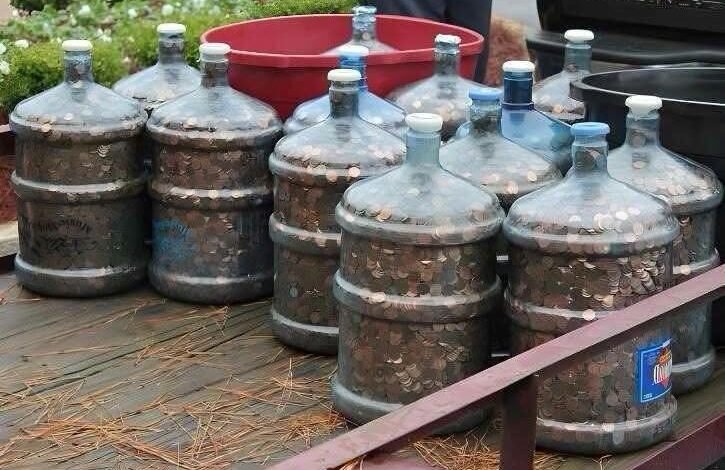
When Otha walked through the doors of his local bank, he wasn’t carrying treasure in the way most people imagine.
He wasn’t holding a briefcase filled with cash or presenting a winning lottery ticket.
Instead, he arrived with fifteen large five-gallon water jugs, each packed to the brim with pennies collected over decades.
The containers were so heavy that employees had to bring out carts just to move them across the floor. Customers paused to watch. Tellers exchanged curious glances. Even the branch manager stepped away from the office, intrigued by the extraordinary sight unfolding in the lobby.
Yet no one hurried him.
There was no impatience.
No suggestion that he should have used a coin-counting machine years earlier.
Instead, the staff recognized that they were witnessing something far more meaningful than a routine bank transaction.
Together, they began counting.
Jar after jar.
Coin after coin.
Each penny passed through the machine with the same metallic click, slowly revealing the remarkable total hidden inside years of quiet dedication.
When the counting finally ended, the amount surprised everyone.
More than $5,000 in pennies.
The number itself was impressive.
But standing there beside those empty containers, Otha understood something the figures alone could never explain.
The pennies had already fulfilled their greatest purpose long before they reached the bank.
For him, each coin represented a moment.
Not a financial investment.
A personal one.
Years earlier, Otha had adopted a simple habit.
Whenever he found a penny lying on the ground, he picked it up.
Before placing it into one of his jars, he paused for a brief moment of gratitude.
Sometimes he reflected on the blessings already present in his life.
Sometimes he simply whispered a quiet “thank you.”
The value of the penny never mattered.
The pause did.
Over time, those tiny interruptions transformed ordinary days.
What others hurried past without noticing became opportunities to slow down, breathe, and recognize something good.
A penny in a parking lot.
Beside a sidewalk.
Near a grocery cart.
Under a restaurant table.
Each discovery became less about money than mindfulness.
Friends occasionally teased him.
“It’s only one cent.”
He would smile.
“I know.”
That was precisely the point.
If something so small could remind him to be grateful, then perhaps gratitude didn’t require extraordinary circumstances.
It only required attention.
The jars gradually filled.
Not quickly.
Not dramatically.
One coin at a time.
Days became months.
Months became years.
Years quietly accumulated into something no one—including Otha—fully appreciated until those fifteen enormous containers rolled into the bank.
Watching the final total appear on the screen, people naturally focused on the money.
Otha focused on something entirely different.
He remembered morning walks.
Conversations.
Family milestones.
Ordinary afternoons.
The pennies had become markers scattered throughout the story of his life.
Each one represented a brief decision to notice rather than rush.
To appreciate rather than overlook.
That was the true wealth he carried into the bank that day.
The dollars were simply the visible result.
His story continues to resonate because it gently challenges the way many of us measure value.
Modern life often encourages us to chase bigger achievements, faster success, and larger rewards.
We celebrate dramatic breakthroughs while overlooking the quiet habits that gradually shape who we become.
Otha’s jars suggest another possibility.
That meaningful change rarely arrives all at once.
It accumulates.
One thoughtful choice.
One grateful moment.
One small act repeated often enough to become a way of living.
The pennies themselves were almost insignificant.
Most people wouldn’t bend down to pick one up.
Some might not even notice it lying on the pavement.
Yet Otha built something remarkable from objects nearly everyone else ignored.
Not because pennies possess extraordinary purchasing power.
Because he chose to assign them extraordinary meaning.
His example reminds us that gratitude doesn’t have to wait for life’s biggest celebrations.
It can begin with ordinary mornings, familiar routines, and the smallest unexpected reminders.
Sometimes the richest life isn’t built by collecting more valuable things.
It’s built by finding greater value in the things already scattered along our path.
When the last jar was finally emptied and the final penny counted, the bank employees applauded.
Not because a man had deposited more than five thousand dollars.
But because they had quietly witnessed the result of decades spent practicing gratitude one tiny coin at a time.
The money would eventually be spent.
The jars would become empty.
But the lesson hidden inside them remains.
Real wealth isn’t always measured by what fills a bank account.
Sometimes it’s measured by how many moments we choose to notice before they disappear.
Otha’s pennies were never just loose change.
They were reminders that even the smallest things, gathered patiently and appreciated consistently, can become something far greater than anyone ever expected.:::