I must have walked past it half a dozen times before I finally stopped pretending not to notice it.
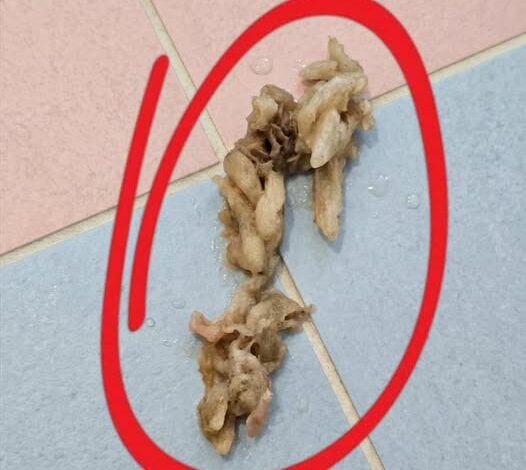
At first, it sat in the corner of the kitchen floor almost invisibly, just strange enough to tug at the edge of my attention without fully registering as a problem. But once I actually looked at it, really looked at it, I couldn’t stop staring. It was pale yellow in places, darker brown in others, with an uneven shape that seemed disturbingly organic. The surface looked damp and soft, almost swollen, and parts of it appeared to be splitting open in thin fibrous strands that made my stomach tighten immediately.
The longer I looked, the worse it became.
My brain started cycling through possibilities faster than logic could keep up. Mold? Fungus? Some kind of cocoon? A dead insect colony? Every explanation seemed slightly more disgusting than the last. There was something deeply unsettling about the way it sat there silently in the corner, as though it had appeared overnight without permission.
I crouched several feet away from it, trying to inspect it without getting too close.
That only made things worse.
The darker patches across its surface looked almost rotten, and the texture had the exact kind of ambiguous wetness that immediately triggers panic in the human brain. It looked fragile but threatening at the same time — the sort of thing that might burst, squirm, or release something awful the second it was disturbed.
I remember thinking absurdly specific thoughts in rapid succession.
Should I call maintenance?
What if it’s toxic?
Could bugs hatch from it?
How long has that been there?
How did I not notice it sooner?
The ridiculousness of the situation didn’t make the fear feel any less real. In fact, that’s often how these moments work. The imagination rushes forward aggressively when certainty disappears. A strange object becomes a threat simply because the brain hates unexplained things, especially inside spaces that are supposed to feel safe and familiar.
And kitchens are deeply personal spaces. Discovering something alien-looking on your own floor creates a uniquely unsettling feeling, like your environment has quietly betrayed you overnight.
I considered leaving it alone entirely.
But somehow that felt worse.
Ignoring it meant accepting its presence. Every future trip into the kitchen would involve glancing nervously toward the corner, wondering whether it had moved, spread, or transformed further. My imagination had already done enough damage by that point. The thing had become psychologically larger than it actually was.
So eventually I grabbed a thick wad of tissue paper from the counter and approached it like someone defusing a bomb.
I genuinely held my breath.
That’s the embarrassing part.
A fully grown adult creeping toward what might very well have been harmless debris, armed only with paper towels and irrational dread.
I extended one cautious finger wrapped beneath layers of tissue and hesitated just above it. Up close, it looked even stranger. The outer surface had become slightly translucent in places, and the torn interior fibers resembled something biological enough to make me recoil instinctively one last time.
Then, before I could overthink it further, I pressed down.
And immediately everything changed.
It didn’t twitch.
Didn’t resist.
Didn’t burst open with insects or spores or anything remotely dramatic.
It simply collapsed beneath my finger with embarrassing softness.
Harmless.
Mushy.
Almost familiar.
The texture triggered recognition before conscious thought fully caught up. Suddenly my fear dissolved all at once, replaced by the kind of stunned realization that makes you laugh at yourself in private afterward.
Because the object was not mysterious at all.
It was banana.
Just a small forgotten piece of banana.
Probably dropped days earlier without me noticing.
In the warmth and humidity of the kitchen, time had transformed it into something grotesque enough for my imagination to build an entire horror story around it. The dark patches came from oxidation. The fibrous strands were exactly what bananas naturally contain. The strange dampness was simply decay accelerated by heat and moisture.
That tiny moment of contact shattered every terrifying possibility instantly.
And standing there in my kitchen, staring at the flattened remains of what had become an absurd psychological monster in my head, I felt equal parts relieved and ridiculous.
But also strangely fascinated.
Because the experience revealed something oddly human about fear itself.
Our minds are remarkably efficient at converting uncertainty into danger. The less we understand something immediately, the more imaginative the brain becomes in filling those gaps. Evolution probably shaped that instinct for survival long ago. Assuming the worst about an unfamiliar shape in the dark kept people alive.
The problem is that instinct still activates today even when the “threat” turns out to be overripe fruit.
And once imagination gains momentum, logic struggles to catch it.
The banana became unsettling not because of what it was, but because of what I projected onto it before understanding it. My fear had transformed ordinary decay into something sinister. Every visual detail became evidence supporting a frightening explanation while obvious possibilities disappeared completely from my thinking.
That tendency extends far beyond kitchen floors.
People do it constantly.
A vague symptom becomes catastrophic illness after enough internet searching.
A strange noise at night becomes an intruder.
A blurry image online becomes proof of monsters, conspiracies, or danger.
The brain often prefers dramatic certainty over ordinary explanation because uncertainty itself feels uncomfortable.
By the time I finally cleaned the banana off the floor, I found myself laughing quietly at how elaborate my fear had become in such a short amount of time. Just minutes earlier I had genuinely considered whether I needed professional help dealing with it. Now it sat crumpled harmlessly inside a paper towel, exposed for exactly what it had always been.
A forgotten snack.
Nothing more.
And yet the experience lingered with me afterward because it felt strangely symbolic of how easily perception can drift away from reality when fear takes the lead.
Sometimes the terrifying thing in the corner is not dangerous at all.
Sometimes it’s just ordinary life, altered slightly by time, neglect, and imagination until we no longer recognize it clearly.
And sometimes all it takes to break the illusion is the courage to finally touch it.