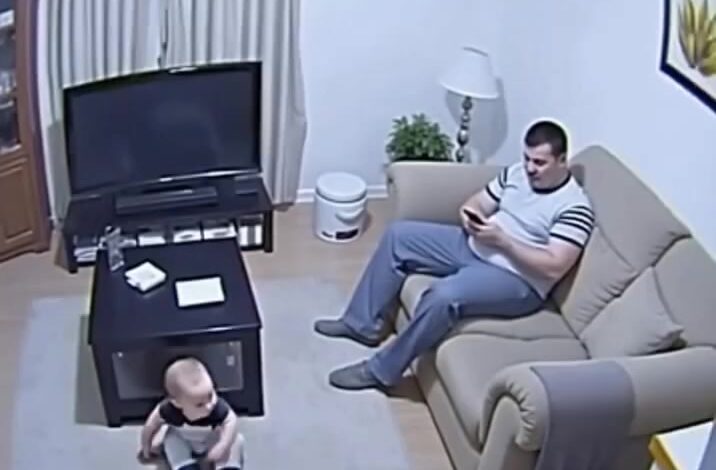
In the days after I watched the footage, I stopped trusting silence.
Not his silence.
Mine.
Because once you see something clearly—truly clearly—you realize how many smaller moments your mind quietly edited before you were emotionally ready to face them.
The camera had captured only a few seconds.
Nothing explosive.
Nothing dramatic enough to become a headline.
But trauma does not always announce itself through bruises or screams.
Sometimes it lives in flinches.
In the way a child’s shoulders rise instinctively when certain footsteps enter the room.
In the sudden stillness that replaces laughter.
In the careful emotional calculations children make long before they understand why they’re making them.
I replayed the footage over and over again late at night after our daughter fell asleep.
Every time, I hoped I had misunderstood it.
I wanted different context.
Different meaning.
Different truth.
Because the man in that video was not a stranger.
He was my husband.
The person I built a life beside.
The person who held my hand during labor.
The person who once sat on the kitchen floor assembling dollhouses and tea sets for our daughter on Christmas Eve.
That history complicated everything.
People imagine recognition arriving cleanly in situations like this.
Good person.
Bad person.
Clear line.
Easy answer.
Real life rarely works that way.
Love muddies instinct.
Familiarity softens alarm.
Memory argues against evidence.
And yet, no matter how many times I replayed the footage, I could not unsee one specific detail:
our daughter’s body changed the moment he entered the room.
That was the part I couldn’t explain away.
Children tell the truth physically long before they can articulate it emotionally.
Her shoulders tightened.
Her voice softened.
Her eyes shifted downward automatically.
Not terror exactly.
But caution.
And once a mother notices caution living inside her child’s body at home, something fundamental changes.
I started watching more carefully after that.
Not obsessively.
Honestly.
The little things gathered quickly once denial loosened its grip.
How she checked his mood before speaking sometimes.
How quickly she apologized over harmless mistakes.
How she relaxed visibly when he left for work.
How certain jokes made her go quiet instead of laugh.
None of it looked catastrophic in isolation.
That’s what frightened me most.
The harm had settled into ordinary life slowly enough that all of us almost adapted around it without naming it.
Including me.
That realization filled me with guilt sharper than anger ever could.
Because motherhood comes with an unbearable private fear:
that you might miss the thing you were supposed to protect your child from.
For several nights, I barely slept.
I lay awake replaying memories, conversations, arguments, trying to determine whether I was overreacting or finally reacting correctly after ignoring too much for too long.
He noticed the distance eventually.
“You’ve been weird lately,” he said one evening while standing in the kitchen doorway.
Weird.
Such a small word for the collapse happening quietly inside me.
I looked at him differently now.
Not with hatred.
With scrutiny.
And underneath that scrutiny sat grief.
Because recognizing harmful behavior in someone you love creates a specific kind of heartbreak people rarely discuss honestly enough.
You mourn while they are still standing in front of you.
The confrontation happened three days later.
Rain hammered softly against the windows while our daughter slept upstairs beneath the glow of her nightlight. I remember gripping a mug of untouched tea so tightly my fingers hurt because I needed something physical to anchor myself against the shaking inside my chest.
He sat across from me at the dining table, distracted at first, scrolling through emails on his phone.
Then he looked up.
“What’s going on?”
My voice nearly failed immediately.
Fear does that sometimes—not because you doubt yourself, but because speaking truth aloud threatens to permanently change the shape of your life.
Still, I forced the words out.
“I saw the footage from the living room camera.”
Everything in his face changed instantly.
Confusion first.
Then defensiveness.
Then something harder to identify.
“What footage?”
I described exactly what I saw.
The interaction.
The tone.
The way our daughter physically reacted.
At first he denied meaning entirely.
“You’re making this bigger than it is.”
That sentence nearly broke me.
Because minimizing harm often becomes the final shelter people run toward when accountability begins approaching.
But I stayed firm.
Not loud.
Not hysterical.
Steady.
And that steadiness mattered more than anger would have.
“I’m not accusing you of being a monster,” I told him carefully. “I’m telling you something in this house no longer feels emotionally safe for her.”
He opened his mouth to interrupt.
I continued anyway.
“I love you. But I will not love you more than I protect her.”
Silence filled the room after that.
Heavy.
Unavoidable.
For the first time, he truly listened.
Not because I finally found perfect words.
Because boundaries change conversations differently than emotion does.
I explained everything:
the tension in her body,
the over-apologizing,
the fear beneath ordinary interactions.
And finally I said the sentence I had been carrying silently for days:
“She should not have to emotionally manage adults to feel safe at home.”
That landed.
I could see it.
Not dramatic guilt.
Not instant transformation.
Recognition.
Painful recognition.
He lowered his eyes toward the table and whispered quietly:
“I didn’t realize she felt that way.”
I believed him.
And somehow, that made everything more frightening instead of less.
Because harm does not always require cruelty.
Sometimes it grows through unchecked frustration, emotional volatility, intimidation, sharpness, control, or unresolved anger that adults normalize because “nothing terrible happened.”
But children experience emotional environments physically.
Tone matters.
Tension matters.
Unpredictability matters.
I knew one conversation alone would never solve this.
Love without accountability changes nothing.
So the next step had to be bigger than promises.
I contacted a family counselor the following morning.
Neutral space.
Professional guidance.
Someone trained to identify patterns neither of us could safely navigate alone anymore.
My husband resisted at first.
Not aggressively.
Embarrassed.
People often hear “therapy” as accusation instead of opportunity.
But I stayed firm there too.
“This isn’t optional.”
The counselor’s office became the first place where excuses stopped hiding successfully behind routine or intention.
Inside those sessions, things finally received names.
Emotional intimidation.
Reactive communication.
Stress displacement.
Hypervigilance in children.
Clinical words.
Painful truths.
Sometimes my husband cried afterward in the car.
Sometimes he grew defensive.
Sometimes he sat silent for entire evenings processing things he clearly never allowed himself to examine honestly before.
And our daughter?
She slowly began speaking too.
Not all at once.
Children heal in fragments.
One session she admitted she always tried to “stay extra good” when Dad seemed stressed because she worried he would become angry.
Another time she whispered:
“I can tell what mood he’s in from the way he closes doors.”
That sentence hollowed me out completely.
Because no child should become emotionally fluent in tension before adolescence.
Still, naming the patterns changed something important.
Secrets lose power when spoken clearly in rooms built to hold truth safely.
Healing did not arrive dramatically after that.
No sudden breakthrough.
No perfect transformation.
Just work.
Painfully consistent work.
Apologies followed by changed behavior instead of excuses.
Long conversations.
Parenting classes.
Boundaries enforced repeatedly.
And slowly, the atmosphere inside our home shifted.
Our daughter stopped watching his moods constantly.
She laughed louder again.
She interrupted conversations freely without bracing afterward.
Tiny things.
Huge things.
One evening months later, I realized she no longer froze when hearing his footsteps in the hallway.
I nearly cried from relief alone.
Not because everything was magically fixed.
Because safety had started returning to her body.
That distinction matters.
Children don’t heal through speeches.
They heal through repeated experiences of consistency, gentleness, predictability, and respect.
One night, after our daughter fell asleep, my husband sat beside me quietly on the couch and admitted something I still think about often.
“I thought being a good father meant providing,” he said softly. “I never realized how much emotional safety matters too.”
Neither of us spoke for a while after that.
Because some truths arrive late but still in time.
Looking back now, I understand the camera footage differently.
It wasn’t proof of one terrible moment.
It was a doorway.
A chance to notice what had been quietly growing beneath ordinary life before it hardened into something far worse.
Facing it early didn’t erase the hurt.
It didn’t magically undo the fear our daughter carried inside herself.
But it gave us one honest chance.
One chance to interrupt the pattern.
One chance to protect her before survival became her personality.
One chance to decide what kind of family we were willing to become moving forward.
And in the end, that decision mattered more than protecting comfort, appearances, or pride ever could.
Because loving a child sometimes means being brave enough to confront the quiet harm before it becomes impossible to deny.
Even when the person you must confront is someone you once trusted completely.