I didn’t sleep after we found the bear.
Not really.
I lay awake listening to the old house settle around me — pipes clicking softly behind the walls, floorboards shifting under cooling night air, branches scraping the gutters outside my bedroom window. Every ordinary sound seemed sharpened somehow, charged with possibility.
The bear sat alone on the kitchen table beneath the dim overhead light.
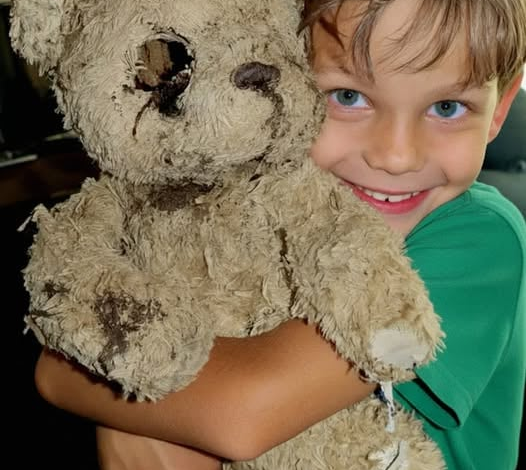
One button eye remained intact.
The other hung loose by a thread.
Mud still clung to its fur despite my attempts to rinse it clean in the sink. Age had stiffened the fabric strangely, and the stitched smile across its face looked less comforting now than exhausted.
But it wasn’t the bear itself keeping me awake.
It was the voice.
Earlier that evening, while trying to dry the toy beside the radiator, I had accidentally pressed against its stomach. Something crackled deep inside the stuffing before a tiny hidden recorder sputtered weakly to life.
Static.
Silence.
Then a child’s voice, warped and broken with age:
“Don’t leave me, Mason…”
The message ended abruptly in static again.
I must have replayed it twenty times.
Each time my stomach tightened harder.
Because there was something unbearable about the way the child spoke — not playful, not performing for a toy microphone, but frightened. The kind of fear children try to swallow because they still believe adults are supposed to fix things once they finally hear the truth.
I kept expecting another explanation to appear naturally.
A prank.
A coincidence.
An old recording from some forgotten family game.
But deep down, another instinct had already taken hold.
Someone buried this bear deliberately.
That realization changed everything.
My son Eli found it earlier that afternoon along the edge of the woods bordering our walking trail. We had almost passed it entirely. Only one muddy ear remained visible beneath leaves and packed dirt where recent rain had eroded part of the ground away.
“Look, Mom,” Eli had called excitedly. “Someone lost their teddy bear.”
At first, I nearly told him to leave it there.
But grief changes how parents respond to abandoned things.
Especially grieving parents.
Three years earlier, my husband died suddenly from a heart attack at forty-one. Since then, Eli and I developed rituals simply to survive the emptiness afterward:
Saturday pancakes,
evening walks,
small routines designed to keep silence from swallowing the house completely.
Those walks through the woods became our safest place somehow.
No condolences.
No paperwork.
No careful conversations about “moving forward.”
Just trees, dirt paths, and movement.
So when Eli uncovered the bear smiling crookedly through mud, I carried it home mostly because throwing away something once loved felt crueler than cleaning it.
Now it sat downstairs beneath kitchen light while every creak inside the house made me wonder whether I’d just carried something terrible through my front door.
At 3:17 a.m., I finally gave up trying to sleep.
I walked downstairs barefoot and stood staring at the bear across the dark kitchen.
The hallway light caught its remaining eye strangely.
Watching.
Waiting.
I hated myself a little for feeling afraid of a stuffed animal. Yet fear had already transformed into something heavier by then:
responsibility.
Because once you suspect something matters, ignoring it becomes its own kind of choice.
Someone buried this toy like a gravestone.
Leaving it hidden suddenly felt worse than uncovering whatever truth came attached to it.
By morning, exhaustion hardened into resolve.
Eli ate cereal sleepily while I wrapped the bear carefully inside a grocery bag.
“Where are you taking him?” he asked.
“The police station,” I answered gently.
He frowned.
“Did somebody do something bad?”
Children ask impossible questions with terrifying directness.
I knelt beside him slowly.
“I don’t know yet,” I admitted. “But I think somebody might still be very sad.”
The police station smelled faintly of burnt coffee and old paper. A young desk officer looked politely confused when I explained why I’d come in carrying a muddy teddy bear.
At first, I could see him preparing for routine dismissal.
Probably another anxious woman.
Probably nothing.
Then I pressed against the bear’s stomach.
The recorder crackled.
Static hissed softly through the room before the tiny broken voice emerged again:
“Don’t leave me, Mason…”
Everything changed instantly.
The officer’s expression sharpened so fast it frightened me.
He stood fully upright now.
“Can you do that again?”
I nodded silently.
This time, he called someone else over before replaying it.
Within minutes, the atmosphere around us shifted completely. Another officer appeared carrying gloves. Someone asked where exactly we found the bear. Another officer began writing rapidly while studying the toy with growing seriousness.
No one treated it like a curiosity anymore.
They handled it gently now.
Like evidence.
Like memory.
Almost like remains.
One older detective crouched beside Eli carefully.
“You found this in the woods?”
Eli nodded.
“Was it buried?”
“Kind of,” Eli said softly. “Like somebody wanted nobody to see it.”
The detective looked at me then with an expression I would later recognize as cautious recognition — the look people get when separate pieces of an old unresolved thing begin aligning unexpectedly.
Before we left, they asked us not to discuss the bear publicly.
“There may be an active connection to a cold case,” the detective explained carefully.
Cold case.
The phrase lodged somewhere painful inside my chest.
For weeks afterward, I heard almost nothing.
Life resumed outwardly:
school drop-offs,
laundry,
grocery runs,
our evening walks through the same woods now carrying entirely different emotional weight.
But internally, everything felt altered.
I kept thinking about the child’s voice trapped inside that toy for years underground.
How long had it waited there?
How many people walked past without noticing?
How close had rain and erosion come to uncovering it naturally anyway?
Some nights I imagined the bear buried beneath seasons of snow and roots while families moved on overhead unaware.
Waiting patiently for someone to listen.
Then the detective called.
A boy named Mason Reed disappeared nearly eleven years earlier.
Eight years old.
Last seen not far from the wooded trail Eli and I walked regularly.
Case unresolved.
The bear belonged to him.
I sat completely still while the detective explained details carefully withheld from media all those years. The recorder inside the bear had been one of Mason’s favorite toys, a gift from his mother shortly before he vanished.
Investigators now believed the burial site connected directly to evidence overlooked during the original search.
“We may not have found this without your son,” the detective admitted quietly.
After hanging up, I cried harder than I expected.
Not from fear.
From proximity.
Because grief recognizes grief instantly.
Months later, Mason’s mother asked to meet us.
I almost said no.
Partly because I worried about reopening her pain.
Partly because I feared witnessing what eleven years of uncertainty does to a person.
But when she arrived at the café carrying a faded photograph in trembling hands, every hesitation disappeared.
The photo showed a smiling little boy holding the same bear before time and dirt transformed it into something haunting.
One bright button eye.
Crooked stitched smile.
Perfectly recognizable.
“He took it everywhere,” she whispered.
Then she looked toward Eli.
“You brought him back to me.”
Not literally.
Not completely.
But enough.
Enough to replace endless wondering with truth.
Enough to let mourning finally settle where uncertainty once lived.
As she cried quietly across the table, I realized something strange and devastating at once:
all those evening walks after my husband’s death were never really about exercise or distraction.
They were survival.
A grieving mother trying desperately to keep herself and her son moving through unbearable absence one ordinary day at a time.
I thought the woods only witnessed our sorrow.
I never imagined they were carrying someone else’s too.
Now, whenever Eli and I walk those same trails, the silence feels different.
He still races ahead kicking leaves while I follow more slowly beneath shifting branches and filtered sunlight. But every abandoned object catches my attention now:
a lost glove,
a broken toy,
something half-buried after rain.
Because the world hides stories constantly.
Some tragic.
Some unfinished.
Some waiting years for someone willing to stop long enough to notice.
And somewhere deep in those woods, beneath roots and seasons and forgotten time, a mother’s grief waited patiently beside a child’s buried teddy bear until another grieving family unknowingly helped carry it back into the light.