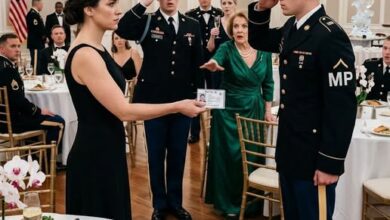
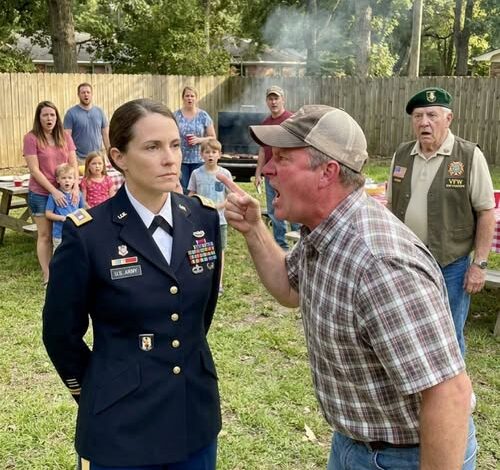
My father told me to take off my Army uniform in front of twenty relatives because he thought I was pretending to be important. Then the Green Beret uncle he worshiped looked at my sleeve, went white, and whispered the classified name my family was never supposed to hear.

The alarm did not sound like panic at first.
Just a sharp electronic pulse echoing through concrete corridors.
But every person inside that operations building reacted instantly.
Doors sealed automatically somewhere down the hall. Red emergency lights washed across the walls. Officers reached for sidearms before conscious thought fully caught up. General Morrison grabbed my arm hard enough to bruise.
“Move.”
Not run.
Not panic.
Move.
That controlled tone frightened me more than shouting would have.
We exited through a side corridor while armed MPs flooded toward the west wing. Boots hammered against polished floors. Radios crackled with overlapping commands:
“Possible breach near archive access—”
“Lockdown protocol active—”
“Second team moving lower stairwell—”
My pulse stayed strangely calm.
Training does that sometimes. Terror arrives later, after the body finishes surviving.
“What exactly was accessed?” I asked while Morrison guided me down the stairwell.
“We don’t know yet.”
“That is not a real answer.”
“It’s the only one I have.”
The emergency lights painted his face dark red for half a second before fading again. For the first time since I’d known him, General Morrison looked genuinely unsettled.
That terrified me.
Outside, dawn had barely begun softening the horizon over Hunter Army Airfield. Humidity clung heavily to the morning air while helicopters sat motionless in the distance like sleeping predators.
Two armed agents waited beside a black SUV.
Morrison turned toward them immediately.
“No electronic contact unless routed through secure channels. No stops. No deviations.”
One agent nodded.
“Destination confirmed?”
Morrison looked at me first.
Something passed briefly through his expression then.
Not pity.
Not fear exactly.
Regret.
“Safehouse Echo-Seven,” he answered.
The younger agent swore quietly under his breath.
I noticed.
“Why would we need Echo-Seven?”
Neither man answered immediately.
That silence told me enough.
Echo-Seven was not used for ordinary protective relocation. It existed for situations where identities, operational continuity, or national security overlap became catastrophic.
I climbed into the SUV slowly.
And for the first time in years, I felt something dangerously close to uncertainty.
The drive lasted almost two hours.
No phones.
No radio chatter beyond encrypted bursts.
No explanations.
I watched Georgia blur past the windows while pieces of my life rearranged themselves violently inside my head.
My father.
Not a mechanic.
Not just a bitter man obsessed with control and hierarchy.
Intelligence support unit.
Compromise investigation.
Two dead agents.
I replayed every childhood memory through that new lens:
his obsession with military structure,
the impossible certainty in his opinions,
the way he watched doors automatically in restaurants,
how he always noticed exits without appearing to.
Things I interpreted as personality suddenly looked like training residue.
And underneath all of it sat a heavier realization:
my father had spent decades mocking the very kind of work he once failed at himself.
That kind of bitterness does not come from nowhere.
Around mile seventy-three, the older agent finally spoke.
“You need context.”
“Yes,” I answered flatly. “I do.”
He kept his eyes on the road.
“In 1989, your father worked auxiliary support on an operation tied to Syrian asset extraction routes.”
My stomach tightened immediately.
Syrian.
The same region connected to Operation Viper.
“He was not field personnel,” the agent continued carefully. “Mostly logistics, signal coordination, transportation support. But there was a leak.”
“A deliberate leak?”
“We don’t know.”
I looked toward him sharply.
“You don’t bury investigations for thirty years over uncertainty.”
No answer.
That answer mattered too.
The younger agent finally spoke from the passenger seat.
“The operation collapsed. Two assets were executed before extraction.”
“And my father?”
“Officially cleared.”
Officially.
Another dangerous word.
I leaned back against the seat slowly.
“When did you realize Viper connected to the same network?”
“Three years ago,” the older agent admitted.
“Why wasn’t I told?”
“Because compartmentalization kept you safer.”
Safer.
Interesting how often institutions use that word while withholding the truth from people expected to risk their lives professionally.
By late morning we reached the safehouse.
Echo-Seven looked nothing like I expected.
Not underground bunkers.
Not concrete walls lined with monitors.
Just a quiet property hidden deep outside Augusta:
white farmhouse,
long gravel road,
thick pine forest surrounding everything.
Invisible by design.
A woman in civilian clothes opened the door before we even reached the porch.
Mid-fifties.
Sharp posture.
Marine haircut gone silver.
She studied me carefully.
“So this is Viper.”
I hated that name outside operational settings.
“I go by Rebecca.”
She nodded once.
“Not today.”
Inside, the house felt sterile despite appearing ordinary. Reinforced windows disguised beneath curtains. Comms equipment hidden inside bookshelves. Weapons lockers concealed behind pantry doors.
A home built entirely around surviving the possibility of violence.
The woman introduced herself as Director Evelyn Shaw.
CIA.
Wonderful.
That explained the tension immediately.
Military intelligence and CIA collaboration always becomes complicated once old failures resurface.
She led me toward the kitchen.
“Coffee?”
“Yes.”
“You’ll need stronger eventually.”
That did not comfort me.
Shaw slid a thick file folder across the table after pouring two cups.
No classification stripe this time.
Personal.
My name sat typed neatly across the front.
“You’ve been under passive monitoring since Operation Viper,” she said.
I stared at her.
“What?”
“Standard procedure after high-impact operations.”
“No,” I answered quietly. “Monitoring a decorated officer for eight years is not standard procedure.”
Shaw met my gaze evenly.
“Not unless someone believed there was unresolved exposure connected to you.”
The room seemed suddenly smaller.
“You thought I was compromised?”
“We thought someone connected to the original network might eventually identify you.”
“And yesterday they did.”
Shaw nodded once.
I opened the folder slowly.
Most pages contained operational summaries I already knew:
Syria,
hostage extraction,
civilian recovery timelines,
classified asset movement.
Then I reached the final section.
Photographs.
Surveillance images.
My house near Fort Liberty.
My gym parking lot.
A grocery store.
An airport terminal.
Dates spanning years.
Someone had been watching me long before yesterday.
“Who took these?”
“We don’t know.”
Anger rose sharp and immediate beneath my ribs.
“You monitored me for nearly a decade while never warning me?”
Shaw’s expression hardened slightly.
“We monitored potential external surveillance around you.”
“Semantics.”
“No,” she replied calmly. “Tradecraft.”
I almost laughed bitterly.
Every intelligence institution eventually starts sounding emotionally interchangeable:
necessary secrecy,
strategic omissions,
protective deception.
Meanwhile real people lose the ability to tell where observation ends and identity begins.
Shaw leaned forward slightly.
“Colonel Hayes, I need you to understand the scale of this carefully.”
I stayed silent.
“The men connected to the failed operation in 1989 disappeared financially after the collapse. Different names. Different countries. But over the last decade, fragments resurfaced around black-market extraction networks.”
My stomach tightened.
Human trafficking routes.
Diplomat smuggling.
Weapons transfers.
I knew the pattern already.
Shaw continued:
“Operation Viper dismantled part of that infrastructure during the Syrian extraction.”
“And now someone realizes who led it.”
“Yes.”
I looked toward the window where sunlight filtered through pine branches outside.
“So what exactly am I now?”
Shaw answered immediately.
“A target.”
The word settled heavily into the room.
Not dramatic.
Not cinematic.
Just factual.
A knock interrupted us.
One of the agents entered carrying a tablet.
“Ma’am.”
Shaw read whatever appeared on the screen, and for the first time since meeting her, her composure slipped visibly.
“What?” I asked sharply.
She looked up slowly.
“Your father is gone.”
Every nerve inside me tightened instantly.
“What do you mean gone?”
“He left the house approximately forty minutes after your extraction.”
“With who?”
“We don’t know.”
“No,” I snapped. “Track his phone.”
“We tried.”
That frightened me immediately.
“Dead signal?”
The agent nodded.
Not destroyed.
Not inactive.
Dead.
Professionally dead.
Someone who knew how to disappear electronically.
I stood abruptly.
“My father was never just support staff.”
“No,” Shaw agreed quietly.
The realization unfolded completely then.
My father’s bitterness.
His obsession with authority.
His hatred whenever he looked at me in uniform.
It was never only misogyny.
Part of him recognized exactly what I became.
And part of him knew he failed where I succeeded.
That kind of shame mutates over decades.
“Do you think he leaked my identity?” I asked finally.
Neither Shaw nor the agents answered quickly enough.
That silence hurt more than confirmation would have.
I looked down at the old photograph Morrison showed me earlier.
My father beside Uncle Grant and two dead men.
All young.
All smiling.
All unaware of the wreckage waiting years ahead.
Then another realization struck me suddenly.
“Grant.”
Shaw looked up.
“What about him?”
“He recognized the callsign immediately.”
“Yes.”
“He also knew enough to panic afterward.”
Understanding sharpened across Shaw’s face instantly.
“He knows more than he admitted.”
Exactly.
And if my father disappeared right after exposure protocols triggered, then Uncle Grant’s timing at the cookout stopped looking accidental.
The room felt colder suddenly.
Not because enemies were coming.
Because betrayal was moving closer to home.
Shaw stood immediately.
“We need Grant brought in.”
The younger agent was already reaching for his radio.
Then every light inside the farmhouse went dark.
Silence swallowed the building instantly.
No hum from appliances.
No air conditioning.
No electronics.
Just stillness.
Professional stillness.
Every agent reached for weapons at once.
Backup generators should have activated automatically.
They hadn’t.
Which meant someone disabled them manually.
Somewhere outside, gravel crunched softly beneath slow approaching tires.
Shaw drew her pistol.
And from the darkness beyond the kitchen windows, headlights appeared one by one between the pine trees.
Not police.
Not military.
Black SUVs moving silently through morning fog toward the safehouse like predators finally arriving at a place they were never supposed to find.
Shaw looked at me once.
No rank now.
No protocol.
Only urgency.
“They’re here.”
And suddenly every lesson my father ever taught me about survival — every suspicious glance, every warning about weakness, every brutal demand to stay alert — rearranged itself inside my mind into one horrifying possibility:
he may not have been preparing me to survive him.
He may have been preparing me for them.