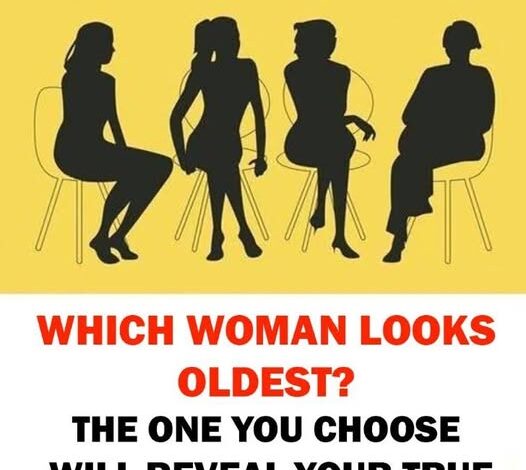
Personality tests based on first impressions continue spreading across the internet for one simple reason: they create the unsettling feeling that a stranger somehow understood something personal about you within seconds. A single image flashes across a screen, you make one instinctive choice almost automatically, and suddenly a paragraph appears describing traits, fears, emotional habits, or relationship patterns that feel oddly accurate. Whether people are choosing animals, faces, symbols, colors, or — in this case — deciding which woman appears oldest, these visual tests fascinate millions because they expose how quickly the human brain forms emotional judgments before logic fully catches up. :contentReference[oaicite:0]{index=0}
The truth is that the human mind rarely experiences the world objectively.
Long before conscious reasoning begins, the brain is already sorting information through invisible shortcuts built from memory, experience, emotion, cultural conditioning, attraction, insecurity, and countless subconscious associations collected over an entire lifetime. In everyday situations, these rapid judgments help people move efficiently through overwhelming amounts of social information. We instinctively react to body language, facial tension, posture, confidence, energy, clothing, eye contact, movement, and emotional atmosphere within fractions of a second.
Most of the time, we do not even notice ourselves doing it. :contentReference[oaicite:1]{index=1}
That hidden process is what makes tests like this feel strangely intimate.
Two people can stare at the exact same image and walk away focusing on completely different details. One person notices confidence immediately. Another notices exhaustion. One sees elegance while another sees sadness. The image itself never changes — only the emotional lens through which it is interpreted.
And according to the personality framework attached to this particular challenge, the woman who appears oldest to you first may reflect the qualities your brain instinctively prioritizes when evaluating people emotionally.
The important part is speed.
These tests rely heavily on first instinct because immediate reactions supposedly bypass overthinking and expose more automatic emotional patterns. Once people begin analyzing too carefully, logic interferes with the raw subconscious associations the test is attempting to capture.
So the question becomes deceptively simple:
Which woman looked oldest to you first? :contentReference[oaicite:2]{index=2}
At first glance, that sounds purely visual.
But the interpretation behind the exercise claims the answer may reveal deeper aspects of personality — including how someone interprets strength, emotional energy, maturity, relationships, vulnerability, and social behavior.
WOMAN #1 — THE CALM OBSERVER
If Woman #1 appeared oldest to you immediately, the interpretation suggests you are likely someone deeply drawn toward emotional steadiness, quiet confidence, and internal balance. Your mind tends to associate maturity less with outward appearance and more with emotional composure. Rather than being impressed by loud personalities or dramatic behavior, you instinctively notice calmness, grounded energy, and people who remain emotionally controlled during stressful situations. :contentReference[oaicite:3]{index=3}
Others probably experience you as dependable, thoughtful, and emotionally safe. Friends may come to you during difficult moments because your reactions feel measured instead of chaotic. You often listen more carefully than people realize, quietly studying emotional dynamics while louder personalities dominate attention.
This personality type tends to be highly observant.
You notice subtle shifts in tone.
Tension hidden beneath forced smiles.
The exhaustion someone tries unsuccessfully to conceal.
The awkward silence between two people pretending nothing is wrong.
You absorb details emotionally even when you say very little aloud.
However, this strength carries hidden pressure too. People who become emotional anchors for others often struggle privately because everyone assumes they are handling life better than they actually are. You may carry stress silently while presenting stability outwardly simply because vulnerability does not feel entirely safe. :contentReference[oaicite:4]{index=4}
WOMAN #2 — THE FEARLESS FIGHTER
If Woman #2 appeared oldest to you first, the interpretation leans toward ambition, resilience, and intense independence. Your attention naturally gravitates toward confidence, strong presence, and decisive energy before softer emotional cues register fully. You notice power quickly.
People with this personality type are often deeply goal-oriented. Even after setbacks, disappointment, heartbreak, or failure, something inside them continues pushing forward almost automatically. Others may describe you as bold, outspoken, intimidating, or fiercely determined because you rarely hide opinions simply to avoid conflict. :contentReference[oaicite:5]{index=5}
You tend to evaluate people rapidly based on confidence and authenticity. Dishonesty, insecurity disguised as arrogance, or emotional manipulation often repel you instinctively because you value directness and self-awareness strongly.
At the same time, strength like this can become emotionally isolating.
The world often assumes resilient people require less care, less reassurance, less emotional support. As a result, many highly independent personalities quietly carry enormous pressure alone because they no longer trust others to recognize when they are struggling internally.
Your resilience protects you.
But it may also exhaust you.
WOMAN #3 — THE EMOTIONAL INTUITIVE
If your eyes landed on Woman #3 first, the interpretation suggests you are highly intuitive, emotionally perceptive, and deeply connected to atmosphere and feeling. You likely process emotional energy almost as strongly as spoken language itself. Logic matters to you, but emotional truth matters just as much — sometimes more. :contentReference[oaicite:6]{index=6}
You probably sense tension before anyone says a word.
You notice discomfort in facial expressions.
Sadness hidden inside humor.
The emotional weight carried beneath casual conversation.
A room’s emotional atmosphere affects you deeply, whether positively or negatively. Because of this sensitivity, people often feel emotionally understood around you very quickly. You naturally create environments where vulnerability feels safer than performance.
Surface-level relationships rarely satisfy you emotionally.
You crave sincerity.
Depth.
Meaningful conversation.
Emotional honesty.
Connections that feel psychologically real rather than socially convenient.
However, emotional sensitivity also creates challenges. You may replay conversations repeatedly afterward, overanalyze subtle interactions, or absorb emotional stress that does not actually belong to you. Your imagination can magnify uncertainty internally, making emotional wounds linger longer than they might for more detached personalities. :contentReference[oaicite:7]{index=7}
Still, your empathy remains one of your greatest strengths because people feel genuinely seen around you.
WOMAN #4 — THE GUARDED REALIST
If Woman #4 seemed oldest to you first, the interpretation points toward practicality, emotional caution, and disciplined realism. You tend to trust actions more than words and often approach life carefully rather than impulsively.
Unlike highly reactive personalities, you usually analyze situations internally before committing emotionally. You value honesty, reliability, and consistency more than charm or emotional intensity. At first, some people may experience you as distant or reserved. But that emotional distance often exists because trust feels deeply serious to you, not because you lack warmth. :contentReference[oaicite:8]{index=8}
Once someone genuinely earns your trust, however, your loyalty becomes extremely strong. You protect the people you love fiercely and often prefer solving problems independently rather than burdening others emotionally.
This personality type frequently develops after disappointment, betrayal, or emotional instability earlier in life. Caution becomes a form of self-protection. Vulnerability feels meaningful enough that you reveal it selectively rather than casually.
Others may misread your restraint as emotional coldness.
In reality, you simply guard emotional access carefully because trust matters enormously to you.
SO WHAT DOES ANY OF THIS ACTUALLY MEAN?
Psychologists would quickly point out that tests like these are not scientifically rigorous personality diagnostics. Human personality is vastly more complicated than a single visual reaction. Countless variables influence perception — culture, trauma, stress levels, personal memories, relationship history, emotional state, insecurities, social conditioning, even the specific mood someone happens to be in while viewing the image. :contentReference[oaicite:9]{index=9}
Yet dismissing these tests entirely misses why people remain so fascinated by them.
Their value does not necessarily come from scientific precision.
It comes from reflection.
They create moments where people pause long enough to examine how they instinctively interpret the world around them. Why did one face feel “older” emotionally? Why did confidence stand out more than calmness? Why did sadness register faster than strength?
Those reactions reveal patterns worth thinking about even if the test itself is ultimately more psychological entertainment than measurable science.
And perhaps the most revealing part has very little to do with the image itself.
The women in the picture remain unchanged no matter who looks at them.
What changes completely is the viewer.
One person sees exhaustion.
Another sees wisdom.
One sees confidence.
Another sees loneliness.
The image becomes almost like a mirror reflecting the emotional habits, fears, experiences, and priorities already existing inside the observer. :contentReference[oaicite:10]{index=10}
Which means these personality tests may not truly expose hidden truths about strangers at all.
They may simply reveal the emotional lens through which you currently experience the world — and the kinds of qualities your mind instinctively notices first when looking at other people.
And sometimes, that realization can be more revealing than the test itself.