A Boy Asked Me to Dance at Prom Because Everyone Avoided Me for My Scars — The Next Morning, His Parents and Police Showed Up at My Door

I used to believe the fire had already stolen everything worth stealing from me.
Not just my father.
Not just the house.
Not even the skin the flames permanently changed that night.
The fire took certainty first. Then safety. Then the version of myself I might have become if I had never heard walls cracking apart under heat while smoke swallowed the hallway around me. By the time I turned seventeen, I had spent more years surviving the aftermath than actually remembering life before it. People think scars only alter appearance, but that isn’t true. Scars change the atmosphere around you. They shift conversations before words are spoken. They teach strangers how to stare politely while still staring. They make children curious and adults uncomfortable. Over time, you learn how to shrink yourself automatically before anyone else has the chance to make you feel exposed.
School became an exhausting exercise in pretending not to notice things.
The whispers.
The glances.
The sudden silences when I entered rooms.
Some classmates were openly cruel because cruelty is easy when someone already looks wounded. Others acted painfully sympathetic, which somehow hurt worse. They tilted their heads while talking to me. Softened their voices too much. Treated me like a fragile reminder that terrible things happen randomly to innocent people.
I hated both reactions equally.
Because neither one saw me clearly.
They saw the fire first.
Always the fire.
Never just me.
That is why I never planned on attending prom.
The idea sounded unbearable from the beginning. Standing beneath bright lights while classmates secretly analyzed the scars climbing my neck and shoulder felt less like celebration and more like public humiliation disguised as tradition. I already knew the names people used when they thought I couldn’t hear them.
Burnt girl.
Monster.
Zombie skin.
Tragedy case.
Teenagers can weaponize almost anything, especially fear.
Then there was Ezra.
Even now, remembering him still feels complicated.
Not because I stopped loving him completely.
Because part of me probably never will.
Ezra entered my life so quietly at first that I barely noticed the shift happening. He started sitting beside me in chemistry after another student switched seats suddenly one morning pretending not to smell smoke residue whenever I walked by. Ezra never acknowledged moments like that directly. He simply sat down beside me as though choosing my company required no courage at all.
And somehow, that normality terrified me more than cruelty ever had.
Because kindness creates risk.
Cruel people are easy to protect yourself from emotionally. You expect pain from them. But genuine kindness cracks defensive walls open slowly until hope starts slipping through before you can stop it.
Ezra laughed at my sarcasm instead of shrinking away from it. He argued with me about books. Sent me terrible songs at two in the morning insisting they would “change my life.” He asked about my future instead of my past. And most importantly, he never once asked about the fire itself.
That mattered more than he probably realized.
Most people treated the fire like the center of my identity, either avoiding the topic awkwardly or circling it constantly through careful, pitying curiosity. Ezra behaved as though my scars were simply one detail among thousands making up who I was. Around him, I occasionally forgot to feel damaged.
That feeling became addictive.
At first, I distrusted him because nobody stays kind without wanting something eventually. Life had taught me that lesson too many times already. People enjoy feeling heroic around wounded individuals until the emotional weight becomes inconvenient. Then they disappear.
But Ezra kept showing up anyway.
Every day.
Steady.
Patient.
Like he genuinely liked the difficult, angry, guarded version of me I worked so hard to hide from everyone else.
When he asked me to prom, my immediate instinct was panic.
Not because I didn’t want to go.
Because I wanted to go too much.
Hope becomes dangerous after trauma.
Once life teaches you how quickly beautiful things can disappear, wanting something deeply starts feeling reckless. I remember staring at Ezra while he waited nervously for an answer, noticing how his hands shook slightly despite his calm voice. Everyone at school admired him effortlessly. Teachers trusted him. Students gravitated toward him naturally. Yet standing there asking me to prom, he looked strangely fragile.
Like my answer actually mattered.
So I said yes before fear could stop me.
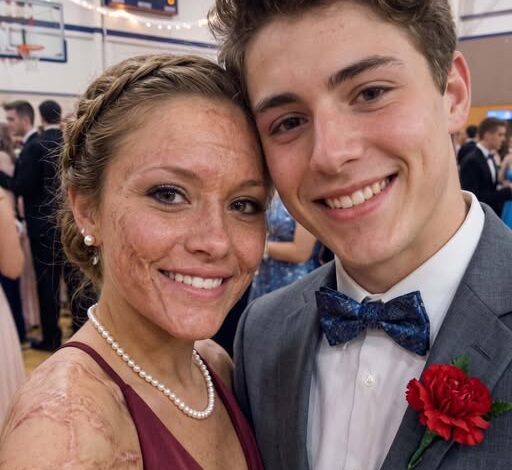
The night of prom, I stood in front of the bathroom mirror for almost an hour trying to decide whether bravery and humiliation sometimes looked identical from the outside. My dress concealed most of the scars crossing my shoulder and chest, but never all of them. Nothing ever covered all of them. Makeup hid only so much. Mirrors remained exhausting no matter how much therapy or time passed afterward.
Part of me considered pretending to be sick.
Another part remembered Ezra’s face when I said yes.
Then he arrived at my front door wearing a crooked tie and holding flowers he admitted his younger sister picked out because “his taste in romance apparently sucked.”
And when he looked at me, something inside me cracked open quietly.
Because he smiled exactly the way boys in movies smile at girls they genuinely find beautiful.
Not inspirational.
Not brave.
Not tragic.
Beautiful.
That single expression undid years of carefully constructed emotional armor in seconds.
At prom, the stares still existed initially. I felt them following me through the gymnasium decorated with glittering streamers and cheap fairy lights struggling to imitate elegance. Conversations paused subtly when I passed nearby. Some people looked away too quickly. Others stared too long.
But Ezra never let go of my hand.
Whenever anxiety threatened pulling me under, his thumb brushed softly against my palm like a reminder that I was still here, still safe, still visible in a way that no longer felt unbearable.
For a few fragile hours, I forgot to hate being seen.
We danced terribly.
Laughed constantly.
Took blurry photographs.
Shared melted chocolate-covered strawberries near the punch table while making fun of the decorations.
And somewhere between songs, I caught myself imagining impossible things again.
A future.
Love.
Normal happiness.
The terrifying possibility that my life might become larger than the fire after all.
Then Ezra disappeared.
At first, nobody worried much. Teenagers wandered in and out of prom constantly. Some went outside for air. Others drove around town briefly before returning. But as the night stretched longer, concern slowly replaced annoyance. His friends stopped laughing about it. Calls went unanswered. Teachers began searching parking lots.
By morning, police officers stood inside our kitchen asking questions while my mother gripped the counter hard enough her knuckles turned white.
“Are you sure Ezra never mentioned anything unusual lately?” one officer asked carefully.
The question felt strange immediately.
Then they told me what happened.
A burned-out storage building on the edge of town.
Evidence Ezra had been there recently.
Witnesses claiming they saw him arguing violently with someone before prom.
Suddenly the boy who made me feel safe was being discussed like a potential criminal.
And somewhere deep beneath the confusion, terror settled into place because instinctively I already understood one horrifying truth:
this connected back to my fire somehow.
Trauma recognizes itself.
The deeper the investigation went, the stranger everything became. Ezra’s parents looked devastated every time they saw me, carrying the kind of guilt too large to hide successfully. Detectives reopened questions surrounding the fire that killed my father ten years earlier — a fire officially ruled accidental after minimal investigation.
Except now someone believed the original conclusion had been wrong.
Revisiting those memories felt like being dragged backward through broken glass emotionally. I spent years trying desperately not to remember details from that night. Smoke crawling beneath doors. Heat tearing through the hallway. My father screaming my name somewhere beyond the flames while the ceiling groaned overhead.
I survived by learning how not to remember fully.
Now strangers forced me to relive every second.
Eventually, clues led me to a cabin several towns away belonging to Ezra’s uncle. When I finally found him sitting alone inside, exhaustion hollowed him out so completely he barely looked recognizable anymore.
I expected rage.
Screaming.
Hatred.
Instead, I saw someone drowning beneath guilt too heavy to survive under much longer.
He looked at me like he had rehearsed losing me repeatedly in his mind already.
Then he told me the truth.
Years earlier, before either of us truly understood consequences, Ezra had been there the night of the fire. Not alone — with older boys he desperately wanted acceptance from. What started as vandalism spiraled out of control faster than anyone expected. Flames spread violently. Panic replaced bravado instantly. Everyone ran.
Except the fire kept growing.
And my father never made it out.
Ezra spent the next decade carrying that guilt silently. When he recognized my name years later at school, it shattered whatever fragile emotional survival he built for himself. At first, he only wanted to know whether I survived.
Then he got to know me.
And everything became worse.
Because he fell in love with the girl whose life he believed he helped destroy.
The confession hollowed me out completely.
Part of me wanted to scream until every wall around us shattered.
Part of me wanted to hit him.
Another part remembered every moment he treated me gently when nobody else knew how.
The terrible truth was this:
the boy sitting in front of me was not evil.
He was a child who made one catastrophic decision trying desperately to belong somewhere. A reckless mistake became irreversible tragedy before anyone understood what was happening.
That reality did not erase my scars.
Did not bring back my father.
Did not erase years spent hiding from mirrors, strangers, photographs, and myself.
But revenge suddenly felt strangely empty too.
Because Ezra already punished himself every single day for ten years.
And standing there watching him break apart emotionally, I realized something even harder:
the fire already stole enough from both of us.
I was exhausted from letting it define every future version of me.
For years, I believed survival meant carrying pain forever as proof that what happened mattered. But maybe survival actually meant something more frightening:
learning how to live beyond the worst thing that ever happened to you.
Not forgetting it.
Not excusing it.
But refusing to let tragedy become the only story your life is ever allowed to tell.