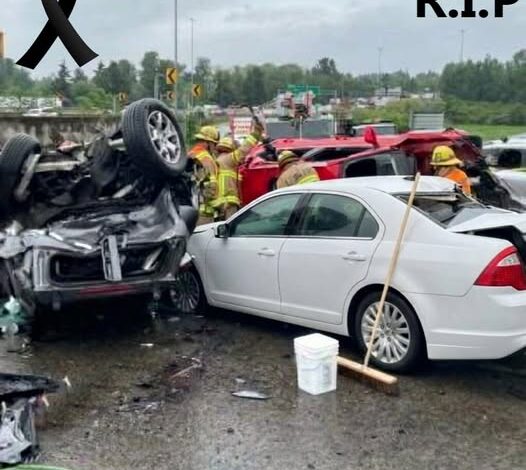
They say tragedy never announces itself properly.
No thunder.
No ominous feeling in the air.
No final moment where the world pauses long enough for people to understand that life, exactly as they know it, is about to split permanently into before and after.
For the people who loved Josaia Raisuqe, that truth became unbearable on an ordinary morning that began like countless others before it. Training sessions. Laughter between teammates. Cleats against pavement. Plans for upcoming matches. Messages unanswered because there would always be time later.
Until suddenly there wasn’t.
At approximately 8:15 a.m., somewhere between routine and catastrophe, everything changed.
One moment, Raisuqe was leaving training as he had done hundreds of times before — a powerful Fijian winger still carrying years of rugby ahead of him, still moving through the world with the physical confidence elite athletes seem to possess so naturally. The next moment, a fatal collision shattered that future completely.
The news spread the way devastating news always spreads at first:
uncertainly.
One phone call.
Then another.
Someone hearing something from a teammate.
A message forwarded too quickly.
Rumors moving faster than facts while people desperately searched for reassurance that the story had somehow been exaggerated.
But then came official confirmation.
And with it, the sickening realization that hope had already run out.
Teammates who had laughed with him hours earlier suddenly found themselves staring at phones in disbelief. Coaches repeated the information aloud as though saying it enough times might eventually make it feel real. Friends sat frozen in kitchens, locker rooms, parking lots, and living rooms unable to reconcile the image in their minds — the strong, explosive athlete sprinting down fields under stadium lights — with the brutal simplicity of the words “he died this morning.”
Death feels especially cruel when attached to athletes.
Perhaps because elite sports condition people to associate physical strength with invincibility. Watching someone move with power, endurance, and fearless energy week after week creates the illusion that their bodies somehow exist outside ordinary fragility. Fans see collisions survived. Injuries overcome. Impossible recoveries. The athlete becomes symbolic of resilience itself.
Then reality intervenes in the most unforgiving way possible.
And suddenly everyone remembers that even extraordinary bodies remain human underneath.
In Castres, grief settled over the rugby community almost immediately.
Not performative grief.
Not the polished public mourning organizations often release through carefully written statements.
Real grief.
The kind that leaves locker rooms too quiet.
The kind that transforms ordinary routines into emotional landmines because every hallway, training ground, and stadium seat still carries traces of someone who should have walked through them again.
Teammates reportedly struggled to speak about him without breaking down completely. Some remembered his laugh first — loud, infectious, impossible to ignore once it filled a room. Others talked about his work ethic, how relentlessly he trained even after exhausting sessions when most players had already mentally checked out for the day.
But the stories that lingered longest were often the smallest ones.
The rides home he gave younger players.
The quiet encouragement after bad games.
The habit of checking on people privately when he sensed something was wrong.
That is what death reveals so painfully:
the little acts of kindness nobody realizes are becoming permanent memories while they happen.
For many Fijian athletes playing abroad, rugby represents more than profession alone.
It carries family expectation.
National pride.
Sacrifice.
Responsibility.
Players often leave entire worlds behind chasing careers capable of supporting relatives thousands of miles away. They endure loneliness, cultural distance, physical punishment, and enormous pressure while trying to succeed professionally in countries far from home.
Raisuqe understood that reality intimately.
Which is why his death echoes beyond one club or one city.
Back in Fiji, the news landed like a shockwave through communities where young athletes grow up seeing players like him as proof that impossible dreams can become real. Suddenly parents, cousins, childhood friends, and former coaches found themselves grieving not only the man himself but the future they imagined still unfolding around him.
Thirty years old.
In ordinary life, thirty feels young.
In professional rugby, it often marks the beginning of a player’s deepest understanding of the game. Experience sharpens instinct. Confidence settles fully into the body. Careers evolve from raw athleticism into leadership. Many believed Raisuqe still had some of his strongest years ahead of him.
That possibility vanished in seconds.
Now investigators examine skid marks, timelines, road conditions, impact angles, witness statements, and vehicle data searching for explanations capable of organizing chaos into something measurable. Authorities will eventually produce reports. Technical conclusions. Official findings explaining speed, collision mechanics, visibility, timing.
But no report will answer the question grief always asks first:
How can someone be alive one ordinary moment…
and unreachable forever the next?
That is the part human beings never truly adjust to.
The speed.
How quickly entire futures collapse.
One minute a person exists naturally inside conversations, plans, schedules, routines.
Then suddenly everyone speaks about them exclusively in past tense.
Friends replay final conversations obsessively afterward. Teammates wonder whether they should have said something more before leaving training. Family members reread old messages searching for comfort hidden inside ordinary words they once skimmed quickly.
This is what sudden death does.
It transforms normal moments into sacred artifacts people cling to afterward because nothing else remains tangible enough to hold.
Meanwhile, the world continues moving with unbearable indifference.
Traffic still fills roads.
Games will still be played.
Training sessions will resume eventually.
Stadium lights will switch on again.
And that continuation often feels offensive at first to grieving people.
How can life continue so normally after someone disappears from it completely?
But eventually grief teaches another painful truth:
the world keeps moving even when hearts temporarily cannot.
For athletes especially, absence becomes strangely visible afterward. Fans notice empty spaces instinctively. A missing locker. A jersey no longer worn. A familiar sprint down the wing that never happens again. Certain moments inside matches suddenly trigger memory automatically because the body expects someone to still be there.
And when they are not, grief returns fresh all over again.
Tributes now flood social media from across the rugby world.
Former teammates.
Coaches.
Fans.
Opponents.
Friends.
Photographs under stadium lights.
Videos of impossible runs.
Stories filled with phrases like “always smiling” and “one of the good ones.”
People searching desperately for language large enough to contain sudden loss.
But perhaps the saddest part of mourning public figures is realizing how many people loved them in entirely different ways simultaneously.
To some, Raisuqe was a teammate.
To others, a son.
A brother.
A friend.
A role model.
A rival.
A source of pride.
A father figure to younger players.
A reminder of home for fellow Fijians abroad.
Death does not remove one person from the world.
It fractures dozens of emotional worlds connected to them at once.
And somewhere now, people who loved him are waking up into mornings they still cannot fully believe are real.
Mornings where instinct still reaches toward sending him messages.
Mornings where someone almost says his name aloud before remembering.
Mornings where grief arrives fresh again because memory briefly forgets what reality already knows.
The stadiums will fill again eventually.
Crowds will cheer again.
Matches will continue.
Young wingers will sprint across the same grass beneath the same floodlights.
But for many people, something permanent has shifted now.
Because every kickoff will carry a shadow of remembrance.
Every sideline laughter will echo slightly differently.
Every ordinary morning will feel a little more fragile than it once did.
And somewhere inside that silence left behind, the memory of Josaia Raisuqe will continue running long after the final whistle.