Tourist allegedly abused for throwing rocks at beloved seal receives vile surprise in the mail

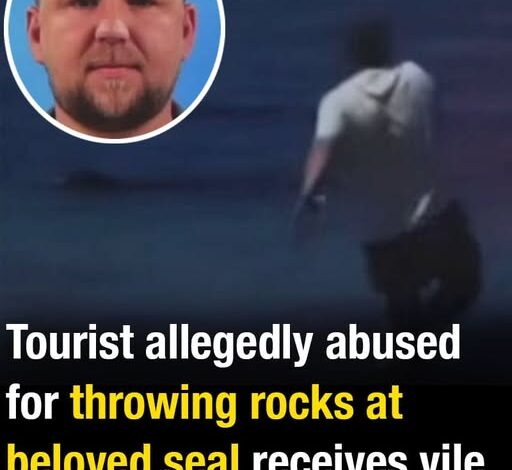
By his own account, Igor Lytvynchuk never believed he was becoming the central figure in a national controversy.
He wasn’t trying to make a statement.
He wasn’t seeking attention.
He wasn’t attempting to provoke outrage.
At least, that is the version of events he and his attorney continue to present.
According to their explanation, what happened on that Hawaiian shoreline began not with cruelty, but with misunderstanding.
A misunderstanding rooted in experience.
A misunderstanding shaped by assumptions.
And a misunderstanding that would ultimately alter the course of his life.
The incident itself unfolded in only a matter of moments.
Yet those moments would become frozen in photographs, videos, news reports, social media posts, and public debate.
Viewed millions of times.
Analyzed from every angle.
Discussed by strangers who would never meet him.
Judged by people who had already reached conclusions.
And transformed into a symbol far larger than the event itself.
In Lytvynchuk’s telling, he believed he was responding to what he perceived as a threat.
Years spent fishing in Washington State had exposed him to sea lions, animals that can be aggressive, territorial, and intimidating when encountered up close.
Those experiences shaped his understanding of marine wildlife.
When he later encountered a Hawaiian monk seal, he allegedly interpreted the situation through that existing framework.
To him, the animal appeared dangerous.
Hostile.
Potentially harmful.
Something that required intervention rather than protection.
His attorney argues that this assumption was not born from malice.
It was born from ignorance.
Specifically, ignorance about Hawaii’s unique ecosystem and one of its most beloved native species.
Hawaiian monk seals are not merely another marine animal.
They occupy a special place in the islands’ ecological and cultural identity.
One of the most endangered marine mammals in the world, they are fiercely protected under federal law. Conservation groups, wildlife officials, and local communities have spent decades working to preserve a species that once stood on the brink of disappearing entirely.
To many Hawaiians, monk seals are more than protected wildlife.
They are symbols of the islands themselves.
Living reminders of an ecosystem found nowhere else on Earth.
Creatures whose survival carries significance far beyond biology.
That context matters.
And according to his defense team, it was context Lytvynchuk simply did not possess.
His lawyer has repeatedly stated that he misunderstood what he was seeing.
That he failed to recognize the seal’s protected status.
That he failed to appreciate the cultural importance attached to it.
And that he now deeply regrets the consequences of those actions.
In interviews and legal filings, the defense portrays him as devastated.
Not merely by the legal jeopardy he faces.
But by the perception that he intentionally abused an animal.
Because once a narrative forms in the public imagination, altering it becomes extraordinarily difficult.
Especially in the age of social media.
The internet rarely operates according to the standards of a courtroom.
Evidence matters.
But emotion often matters more.
Intentions become secondary to outcomes.
Nuance struggles to survive.
And once a villain is identified, public opinion can move with astonishing speed.
That process unfolded almost immediately after the incident became public.
Images spread rapidly.
Videos circulated.
Comment sections exploded.
Anger intensified.
For many observers, the facts seemed straightforward.
An endangered animal had been harmed.
The act appeared deliberate.
The outrage felt justified.
The emotional response was understandable.
People care deeply about vulnerable animals.
Particularly endangered species.
Particularly species already fighting for survival.
And particularly in a place where conservation efforts have become such an important part of local identity.
Yet public anger did not remain confined to criticism.
It expanded.
Escalated.
Mutated.
What began as outrage increasingly blurred into something else.
Punishment.
Then public humiliation.
Then something even more troubling.
According to reports, Lytvynchuk became the target of extensive online harassment.
Personal information was allegedly shared.
Addresses circulated.
Contact information spread across various platforms.
The practice commonly known as doxxing transformed a public controversy into a personal one.
Suddenly, strangers possessed access to aspects of his private life.
And some chose to use it.
Hate mail followed.
Messages filled with threats.
Insults.
Accusations.
Expressions of rage from people who knew him only through headlines.
Then came reports of even more direct retaliation.
An alleged physical assault.
Further harassment.
And one particularly bizarre incident involving a bag of feces reportedly mailed to his residence.
At that point, the situation had clearly moved beyond debate about wildlife protection.
It had become a public spectacle.
A collective act of condemnation.
A demonstration of how quickly internet outrage can spill into real-world consequences.
This raises uncomfortable questions.
Not about whether actions should have consequences.
Most people agree they should.
Not about whether endangered species deserve protection.
They do.
Not about whether violations of wildlife laws should be taken seriously.
They absolutely should.
The more difficult question concerns where accountability ends and public vengeance begins.
Because those are not always the same thing.
The legal system exists, at least in theory, to answer questions of responsibility through evidence, procedure, and proportional consequences.
Public outrage operates differently.
It has no formal limits.
No consistent standards.
No clearly defined endpoint.
Once activated, it can continue indefinitely.
Months.
Years.
Sometimes longer.
The individual at the center of the controversy becomes frozen inside a single moment.
A single mistake.
A single action.
A single headline.
Regardless of everything that came before or everything that follows.
That phenomenon is not unique to this case.
It has become increasingly common in the digital era.
One viral event.
One controversial video.
One public misstep.
And an entire human life becomes compressed into a simplified narrative.
Hero.
Villain.
Victim.
Monster.
The categories arrive quickly.
Reality rarely fits inside them.
Lytvynchuk now finds himself living inside that reality.
While federal authorities pursue charges under the Endangered Species Act, another process unfolds simultaneously.
A parallel trial.
One conducted not in courtrooms but online.
There, rules of evidence matter less than public perception.
Intentions matter less than emotional reactions.
And forgiveness often proves difficult to find.
Every new development reignites discussion.
Every article generates new waves of commentary.
Every update attracts renewed attention.
The legal proceedings may eventually reach a conclusion.
Judges will rule.
Evidence will be evaluated.
Penalties, if warranted, will be imposed.
The judicial process possesses a finish line.
Public judgment often does not.
That is what makes the situation so complicated.
Many people feel genuine anger toward what happened.
Many believe accountability is necessary.
Many see the case as an important reminder that endangered species deserve protection and respect.
Those concerns are legitimate.
At the same time, others look at the escalating personal attacks and wonder whether society is increasingly comfortable replacing justice with humiliation.
Whether outrage has become an end in itself.
Whether the internet’s appetite for punishment occasionally exceeds its appetite for understanding.
These questions do not excuse harmful actions.
Nor do they erase consequences.
They simply acknowledge a difficult reality.
Human beings are often more complicated than the worst thing they have ever done.
Intentions matter.
Context matters.
Knowledge matters.
Growth matters.
Regret matters.
And yet public discourse frequently struggles to hold all those truths simultaneously.
It prefers clarity.
Certainty.
Simple stories.
Simple villains.
Simple conclusions.
The real world rarely provides them.
As the case continues, two narratives compete for attention.
One focuses on the seal.
The protected animal.
The endangered species.
The importance of conservation.
The need for accountability.
The consequences of ignorance.
The other focuses on the man.
His explanation.
His mistakes.
His alleged misunderstanding.
And the extraordinary backlash that followed.
Both stories are real.
Both stories exist.
And both reveal something about the modern world.
One highlights humanity’s responsibility toward vulnerable species.
The other highlights humanity’s increasingly complicated relationship with punishment.
Perhaps history will ultimately remember the legal outcome.
Perhaps it will remember the broader conservation message.
Or perhaps it will remember something else entirely.
The speed with which one moment can redefine an entire life.
Because regardless of how the courts rule, one reality already seems clear.
For Igor Lytvynchuk, what happened on that shoreline will not remain an isolated incident.
It has become a permanent chapter.
A defining chapter.
The kind that follows a person long after headlines fade.
The kind that reshapes how strangers see them.
The kind that forces a single moment to compete against everything else they have ever been.
Whether that is justice, consequence, tragedy, or some uneasy combination of all three remains a question people will continue debating long after the final verdict is delivered.
But for now, two trials continue simultaneously.
One inside a courtroom.
And one inside the court of public opinion.
Only one of them has rules.
And only one of them is guaranteed to end.