I Married a Blind Man So He’d Never See My Scars – On Our Wedding Night, He Said, ‘You Need to Know the Truth I’ve Been Hiding for 20 Years’

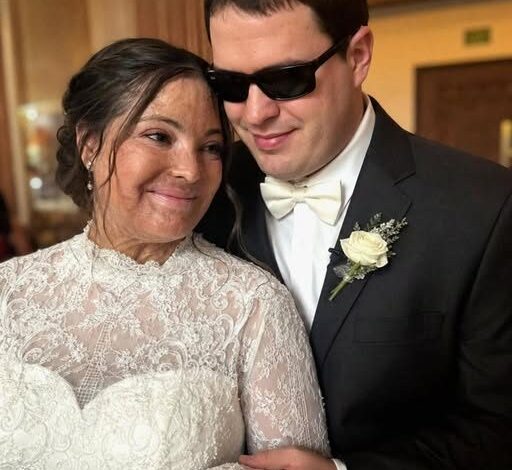
Some truths arrive too late to leave anyone unchanged.
Not because they erase love completely.
Because they force love to stand beside something unbearable and somehow survive the comparison.
That was the feeling Merritt carried on the morning of her wedding — though at the time, she could not yet name it. Standing inside the small church dressing room while sunlight slipped softly through stained glass windows, she felt suspended between terror and hope so fragile it almost hurt to hold. Her sister, Lorie, stood behind her fastening the endless row of pearl buttons running down the back of the gown, hands trembling slightly as though she were trying not to cry before the ceremony even began.
Then Merritt looked into the mirror.
And for a moment neither of them spoke.
Lorie’s eyes filled first.
“You look beautiful, Merry,” she whispered softly.
Beautiful.
The word still felt foreign after all those years.
At thirteen, after the explosion, people stopped using words like beautiful around Merritt entirely. Doctors called her fortunate. Nurses called her resilient. Neighbors called her lucky to survive. Nobody realized how cruel that word could become over time.
Lucky meant skin grafts.
Lucky meant surgeries.
Lucky meant strangers staring openly in grocery stores before quickly pretending not to.
Lucky meant becoming the girl everyone pitied before they ever learned her name.
The explosion destroyed more than flesh.
It took ease from her.
Confidence.
The simple ability to walk into a room without immediately calculating who was trying not to look too closely at the scars climbing her neck and shoulder.
And after their parents died, Lorie became everything all at once — older sister, guardian, protector, emotional shelter against a world that often treated Merritt less like a teenage girl and more like a tragedy people politely observed from a distance.
Lorie sat beside hospital beds when Merritt refused mirrors entirely.
Held her after school dances she never attended because she could not survive the thought of boys staring.
Spent years teaching her how to exist inside a body society insisted on reducing to damage first and humanity second.
So when Lorie cried in that church dressing room, Merritt understood immediately what those tears truly meant.
Not sadness.
Relief.
Because once upon a time, neither of them genuinely believed this day would ever happen.
Marriage belonged to other women.
Women untouched by fire.
Women who moved through life without flinching under strangers’ curiosity.
Women who never learned how quickly people confuse scars with brokenness.
Yet somehow, despite everything, Merritt was about to marry a man who made her feel seen in ways she no longer believed possible.
His name was Callahan.
And she met him in the basement of that same church nearly two years earlier.
At first, it was his patience she noticed before anything else.
A little boy sat struggling through piano scales at the old upright piano while Callahan tapped gentle rhythms beside him, smiling with impossible calm every time the child groaned dramatically in frustration.
“Again,” Callahan encouraged softly. “The song isn’t going anywhere.”
The little boy collapsed theatrically across the keys.
Callahan laughed.
“Trust me, buddy,” he joked. “Mozart survived longer than your attention span.”
Merritt smiled before she even fully looked at him.
Then she noticed the white cane leaning against the piano bench.
The dark glasses.
The golden retriever curled loyally at his feet.
Blind.
But strangely, that fact barely registered compared to something else entirely:
the way he listened when people spoke.
Most people saw Merritt’s scars first.
Their eyes flickered instinctively toward damaged skin before conversations even began. Some tried hiding the reaction politely. Others failed completely. But almost everyone looked first and listened second.
Callahan reversed that naturally.
When she spoke, he focused entirely on her words.
Her pauses.
Her nervous jokes.
Her silences.
It terrified her slightly how quickly that kind of attention dismantled walls she spent years constructing carefully.
Weeks later, he asked her to coffee.
She almost refused.
By then Merritt had already convinced herself romance belonged permanently outside her reach. She told herself she had accepted that reality gracefully, though secretly she still mourned it quietly sometimes while lying awake alone at night.
But something about Callahan felt emotionally safe in ways difficult to explain.
So she said yes.
Their first date nearly broke her heart before it even properly began.
Nervously staring down at untouched coffee, Merritt blurted out the fear she carried into every interaction with men eventually.
“I should probably warn you,” she said carefully, “that I don’t look like most women.”
Callahan smiled instantly.
“Good,” he answered lightly. “I’ve never been interested in ordinary things.”
The laugh escaped her before she could stop it.
Then unexpectedly, tears nearly followed.
Because people underestimate how devastating kindness becomes once someone survives years believing themselves fundamentally unlovable.
Callahan never treated her delicately afterward.
Never pitied her.
Never acted as though loving her required bravery or sacrifice.
Instead, he made her feel desired without apology attached to it.
And slowly, terrifyingly, Merritt fell in love.
By the time she walked down the church aisle beside Lorie, her hands shook hard enough that her bouquet trembled visibly. But then she saw Callahan waiting near the altar with Buddy, his golden retriever, proudly wearing a ridiculous bow tie one of his students insisted the dog needed for the wedding.
Children from Callahan’s piano class attempted to perform the processional music.
It was objectively awful.
Wrong notes.
Uneven timing.
Chaotic sincerity.
Merritt adored every second of it.
And for once in her life, nobody stared at her scars.
Not really.
She was not “the burned woman” that day.
She was simply the bride.
That realization alone felt miraculous enough to bring tears dangerously close all afternoon.
The reception remained small and beautifully imperfect — grocery store cake, folding chairs, paper cups, children sliding beneath tables while adults laughed too loudly over cheap champagne.
Ordinary happiness.
The kind Merritt once believed belonged permanently to other people.
Then night came.
Lorie drove them to Callahan’s apartment afterward while Buddy snored softly in the backseat after an exhausting day of attention and dropped appetizers. Before leaving, Lorie hugged Merritt tightly and whispered into her hair:
“You deserve happiness.”
Those words stayed with her as the apartment door closed and silence finally settled around her and Callahan alone for the first time as husband and wife.
The quiet felt enormous suddenly.
Not because she feared intimacy exactly.
Because she feared being fully known.
Some hidden part of Merritt had always wondered whether Callahan’s blindness made loving her easier somehow. She hated admitting the thought even privately, but it existed nonetheless — the suspicion that perhaps she only felt safe because he could not truly see the scars the way sighted men inevitably would.
Standing there beside him in dim apartment light, she realized how deeply her emotional safety depended on never feeling completely visible.
Then Callahan reached toward her slowly.
“Merritt,” he whispered softly, “can I touch your face?”
She nodded.
His fingertips traced the scar tissue gently, reverently almost, as though memorizing something precious instead of damaged.
Every instinct inside her wanted to recoil automatically.
Years of shame train bodies to flinch long after danger disappears.
But Callahan touched her with such tenderness that she forced herself to remain still.
“You’re beautiful,” he whispered.
And something inside Merritt finally shattered open.
She buried her face against his shoulder and cried harder than she had in years because for the first time in her life, someone loved her without conditions hidden beneath kindness.
Not despite the scars.
Not overlooking them.
Simply loving her completely.
Then everything changed.
Callahan suddenly went quiet.
Very quiet.
“There’s something I need to tell you,” he said finally. “Something that may change everything.”
Merritt laughed nervously through tears.
“What?” she joked weakly. “You can secretly see?”
But he did not laugh.
Instead, he removed his glasses slowly.
For one terrifying moment, she truly believed he was about to reveal some elaborate deception — that his blindness itself had somehow been false all along.
But then she saw his eyes.
Unfocused.
Looking slightly beyond her into emptiness.
No deception there.
Then he asked the question that froze her blood instantly.
“Merritt,” he whispered, “do you remember the kitchen explosion?”
The room stopped breathing.
She had never told him details about the explosion.
Only that she suffered injuries as a child.
Nothing more.
Ice spread through her chest slowly.
“How do you know about that?” she whispered.
Then Callahan told her the truth.
Twenty years earlier, he had been sixteen years old.
He and several neighborhood boys had been behind the building fooling around recklessly with siphoned gasoline, showing off in the careless way teenage boys often do when consequences still feel imaginary and distant. One mistake caused a leak. Then came a spark.
Then the explosion.
Then fire.
Then Merritt’s entire life changed forever.
The boys ran.
Every one of them.
Days later, Callahan saw a newspaper story about a badly burned thirteen-year-old girl named Merritt.
And he carried that guilt for decades.
Months after the explosion, a separate car accident killed his parents, his brother, and eventually his eyesight too.
Two ruined lives twisted together long before either of them understood it.
Merritt sat frozen listening to her wedding night unravel around her.
“Why didn’t you tell me?” she whispered finally.
Callahan’s voice cracked.
“Because I loved you,” he admitted quietly. “And because I was terrified.”
He confessed that once he realized who she was, he tried convincing himself to leave her alone entirely.
But he couldn’t.
“You deserved the truth,” he whispered. “But I was afraid if I told you too soon, I’d lose you before you ever knew how much I loved you.”
“You took away my choice.”
“I know.”
No excuses.
No manipulation.
Just guilt laid bare completely.
And somehow that honesty hurt worse.
Merritt left the apartment shortly afterward still wearing her wedding dress beneath a borrowed coat, wandering cold streets unable to process whether her marriage had begun or ended in the same night.
Eventually she reached her childhood neighborhood and called Lorie.
Her sister arrived within minutes.
And when Merritt finished telling her everything, Lorie simply held her while she cried beneath streetlights.
“Part of me hates him,” Merritt admitted.
“But another part?” Lorie asked gently.
Merritt closed her eyes.
“Another part still loves him.”
That was the unbearable truth.
Love had survived the confession somehow.
Broken perhaps.
Shaken certainly.
But alive.
By morning, exhaustion burned enough anger away for clarity to finally settle.
Running from pain already stole too much of Merritt’s life.
She refused letting fear make this decision too.
So she went back.
Buddy heard her first, barking wildly before she even reached the apartment door. Callahan appeared almost instantly.
“Merritt?”
“How did you know it was me?” she asked softly.
A sad smile crossed his face.
“Buddy told me first,” he answered. “My heart told me second.”
Then he nearly tripped over the rug trying to reach her.
Instinctively, she caught him before he fell.
His hand closed around hers carefully.
“You’re still the most beautiful woman I’ve ever known,” he whispered.
Then Merritt smelled smoke.
“Callahan,” she said slowly, “what’s burning?”
Behind him, an omelet blackened catastrophically in a frying pan.
For one stunned second, silence hung between them.
Then Merritt started laughing helplessly through tears.
Buddy barked excitedly.
Callahan laughed too.
And standing there inside that smoky kitchen between betrayal and forgiveness, Merritt realized something life-changing:
healing was never going to erase what happened.
The explosion remained real.
The guilt remained real.
The scars remained real.
But maybe love did not require pretending pain never existed.
Maybe it simply required believing people could become more than the worst thing they once did.
Merritt walked to the stove, removed the ruined pan carefully, and shook her head with exhausted affection.
“The kitchen,” she informed him softly, “officially belongs to me now.”
Buddy wagged his tail approvingly.
And for the first time since she was thirteen years old, Merritt no longer felt ashamed when someone touched her scars.
Because the man who knew the darkest truth connected to them still held her like she was something precious anyway.