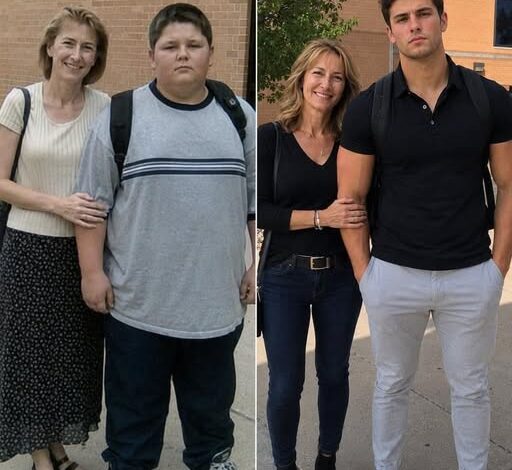
The Reunion Was Never About Them
When Evan told me he planned to attend the reunion without an invitation, I thought I understood exactly what was happening.
I thought he was doing what so many people do when old wounds refuse to fade.
I thought he was chasing answers.
Chasing validation.
Chasing the approval that had been withheld from him when he needed it most.
I thought he was returning to the place where his confidence had been dismantled piece by piece, hoping to finally rebuild it in front of the people who helped tear it down.
I was wrong.
Completely wrong.
What I didn’t understand then was that Evan had already found what most people spend their entire lives searching for.
Closure.
Not the dramatic kind we see in movies.
Not the kind that arrives through revenge, confrontation, or public humiliation.
The quieter kind.
The harder kind.
The kind that happens so gradually you don’t even notice it until one day you realize the pain no longer controls your decisions.
The truth was, the reunion had never really been about them.
It was about him.
And by the time he walked through those ballroom doors, he had already won a battle none of them even knew existed.
The Boy Nobody Saw
Growing up, Evan was the kind of kid people overlooked without realizing they were doing it.
He wasn’t loud.
He wasn’t athletic.
He wasn’t the center of attention.
He wasn’t the student teachers pointed to as an example.
He wasn’t the one classmates rushed to sit beside at lunch.
He existed in the spaces between other people’s stories.
Present, but rarely noticed.
Included, but never fully accepted.
There is a particular loneliness that comes from being invisible.
Not hated.
Not bullied in the obvious ways.
Simply unseen.
People often assume that cruelty is the worst thing a child can experience.
Sometimes it isn’t.
Sometimes the deepest wound comes from feeling forgettable.
From sitting in classrooms where your hand stays raised until someone else gets called on.
From watching friendships form around you without ever fully opening to include you.
From hearing your peers talk about parties, plans, and memories that somehow happened without you.
Again.
And again.
And again.
Evan knew that feeling well.
Every school has social hierarchies.
Some are obvious.
Others are invisible.
But children understand them instinctively.
They know who matters.
Who belongs.
Who gets invited.
And who doesn’t.
By high school, Evan had become an expert at pretending none of it bothered him.
He laughed when people forgot his name.
Shrugged when classmates excluded him.
Smiled when teachers overlooked him.
He became skilled at disguising disappointment.
What nobody realized was how much energy that performance required.
Because beneath every smile lived a question he rarely spoke aloud.
What’s wrong with me?
It’s one of the most dangerous questions a person can ask.
Especially when they’re young.
Because children almost always blame themselves for the way they’re treated.
They assume exclusion means deficiency.
They assume rejection means failure.
They assume invisibility means they somehow deserve it.
For years, Evan carried that question.
And for years, it shaped the way he saw himself.
The Teacher Who Changed Everything
Transformation rarely arrives the way people expect.
Most of us imagine life-changing moments as dramatic events.
Major speeches.
Extraordinary opportunities.
Perfect timing.
Reality is usually much quieter.
For Evan, change began with a teacher named Mrs. Carter.
She taught English.
Nothing about her appearance suggested she would alter the trajectory of someone’s life.
She wasn’t famous.
She wasn’t wealthy.
She wasn’t powerful.
She was simply the first adult who truly saw him.
Not the student sitting quietly in the back row.
Not the awkward teenager struggling to fit in.
The person.
The distinction mattered.
Because when someone spends years feeling invisible, recognition becomes revolutionary.
Mrs. Carter noticed things others missed.
She noticed the essays Evan stayed late perfecting.
She noticed the books he carried.
She noticed the questions he asked.
She noticed the intelligence hidden beneath his insecurity.
Most importantly, she noticed his potential before he did.
Teachers often underestimate the power they possess.
A single encouraging comment.
A single expression of belief.
A single moment of genuine attention.
Sometimes that’s enough to change a life.
Mrs. Carter never performed grand acts of mentorship.
She simply refused to let Evan disappear.
And in doing so, she gave him something nobody else had.
Evidence.
Evidence that maybe he wasn’t the problem.
Evidence that maybe his value didn’t depend on popularity.
Evidence that maybe the story he believed about himself wasn’t true.
The Long Road Forward
Transformation is rarely immediate.
The movies lie about that.
People don’t wake up confident after one inspiring conversation.
They don’t overcome years of insecurity overnight.
Growth happens slowly.
Painfully.
Often invisibly.
Evan’s journey followed that pattern.
College helped.
Work helped.
Distance helped.
But none of those things provided instant healing.
Old wounds travel well.
They cross state lines.
Follow careers.
Appear unexpectedly during relationships.
Insecurity doesn’t vanish simply because circumstances improve.
It has to be challenged.
Repeatedly.
Over time.
For years, Evan continued carrying pieces of the boy he used to be.
The doubt.
The fear.
The need for approval.
The desire to finally prove himself.
But something gradually shifted.
Success arrived.
Not explosive success.
Meaningful success.
The kind built through persistence rather than luck.
He built a career.
Developed friendships.
Created a life.
More importantly, he developed a sense of self independent from other people’s opinions.
And that changed everything.
Because once you stop measuring your worth through external validation, the entire world looks different.
The people who ignored you lose power.
The people who rejected you lose significance.
The people who underestimated you stop occupying space inside your mind.
That process took years.
Long before the reunion invitation—or lack of one—ever entered the picture.
The Invitation That Never Came
When news of the reunion started circulating, Evan wasn’t surprised he wasn’t invited.
In a strange way, it felt perfectly consistent with the past.
The same people who overlooked him in high school simply continued doing what they had always done.
The irony was almost funny.
Almost.
Friends encouraged him to ignore it.
Family members told him it wasn’t worth thinking about.
Most people assumed the situation would reopen old wounds.
And perhaps years earlier, it would have.
Instead, something unexpected happened.
Evan decided to go anyway.
Not out of anger.
Not out of resentment.
Not even out of curiosity.
He simply wanted to attend.
That decision confused everyone.
Including me.
When he told me, I assumed he was seeking closure.
Seeking validation.
Seeking acknowledgment.
I imagined him standing in front of old classmates hoping they finally recognized what they had missed.
Looking back, I was still seeing him through the lens of the past.
I didn’t realize he had already moved beyond it.
Walking Into the Room
The ballroom buzzed with nostalgia.
Old classmates laughed over forgotten memories.
Photographs flashed across screens.
People compared careers, marriages, children, and life updates.
The usual reunion rituals unfolded exactly as expected.
Then Evan arrived.
Not dramatically.
Not with an entourage.
Not with a desire to impress anyone.
He simply walked through the doors.
And something remarkable happened.
Nothing.
The world didn’t stop.
Music didn’t pause.
People didn’t suddenly recognize some hidden greatness.
For a few moments, nobody paid much attention at all.
And that was the point.
Years earlier, that reality would have crushed him.
Now it barely registered.
Because he wasn’t there for them.
He wasn’t there to reclaim status.
He wasn’t there to settle scores.
He wasn’t there to prove anything.
The boy who once begged silently for recognition no longer existed.
In his place stood a man who understood something far more important.
You don’t need permission to belong.
You don’t need approval to matter.
And you certainly don’t need an invitation to occupy your own life.
The Speech Nobody Expected
When Evan eventually took the microphone, the room assumed they knew what was coming.
People expected a success story.
A triumphant reveal.
A subtle revenge narrative wrapped in motivational language.
They were mistaken.
His speech wasn’t about achievement.
It wasn’t about proving anyone wrong.
It wasn’t about the people sitting in the audience.
It was about Mrs. Carter.
The teacher who had changed everything.
The teacher who had passed away years earlier.
The teacher who never got to see the full impact of her influence.
As Evan spoke, the room grew quiet.
Not because he was attacking anyone.
Because he wasn’t.
Not because he was demanding recognition.
Because he wasn’t.
He was honoring someone.
Remembering someone.
Thanking someone.
The focus remained exactly where he wanted it.
On the woman who taught him that being overlooked didn’t mean being worthless.
On the woman who helped him believe in himself before he knew how.
On the woman whose faith became the foundation for everything that followed.
Then he announced the scholarship.
A fund created in Mrs. Carter’s name.
Dedicated to students who felt invisible.
Students struggling with self-worth.
Students who needed someone to see them.
The room erupted into applause.
But the applause wasn’t the important part.
Neither was the shock.
Neither was the sudden respect.
Those moments made good stories.
The real story had happened years earlier.
The Transformation Nobody Saw
People love visible transformations.
Weight loss.
Career success.
Financial achievement.
Awards.
Recognition.
The world celebrates outcomes.
What it often misses are the quieter transformations underneath.
Evan’s real victory wasn’t standing at that podium.
It wasn’t the scholarship.
It wasn’t the applause.
It wasn’t watching former classmates suddenly view him differently.
His victory happened years before.
In private.
Without witnesses.
Without recognition.
Without celebration.
It happened the moment he stopped asking himself the question that had haunted him since childhood.
What’s wrong with me?
That question had defined entire chapters of his life.
It shaped his relationships.
His confidence.
His understanding of himself.
Then one day, gradually and imperfectly, he stopped asking it.
Not because life became easier.
Because he realized the question was flawed.
There had never been anything wrong with him.
The problem was never his worth.
The problem was the story he inherited from people too limited to recognize it.
Once he understood that, everything changed.
Not overnight.
But permanently.
Leaving the Ballroom
Later that evening, after the speeches ended and the conversations resumed, Evan slipped quietly toward the exit.
The applause faded behind him.
The ballroom lights dimmed in the distance.
The event continued.
But his reason for being there had already been fulfilled.
Not because others finally saw him.
Because he finally saw himself.
As he stepped outside, years of memory seemed to collapse into a single realization.
The reunion hadn’t provided closure.
Closure had brought him to the reunion.
There is a profound difference.
One depends on others.
The other depends on you.
For most of his life, Evan believed belonging was something granted by other people.
A privilege determined by popularity, acceptance, and inclusion.
That night proved otherwise.
Belonging isn’t something others give you.
It’s something you claim.
And once you do, nobody can take it away.
Not classmates.
Not critics.
Not rejection.
Not time.
The boy who once stood alone in crowded hallways had spent years becoming someone stronger than he ever imagined.
Not because the world changed.
Because he did.
And that transformation—quiet, invisible, and hard-earned—was worth more than every invitation he never received.
Because in the end, the greatest victory wasn’t being welcomed into the room.
It was realizing he never needed permission to enter in the first place.