My Sister Thought Her In-Laws’ Tradition Was Harmless Until a Summer Barbecue Brought New Perspective

Three years after losing her husband, Sarah had become an expert at surviving.
Not living.
Not healing.
Just surviving.
Every morning began with the same exhausting calculation: how much money remained, which bill could wait, how many hours she could function on too little sleep, and whether she could keep her seven-year-old son from noticing how close everything felt to falling apart.
The grief never left.
It simply changed shape.
Some days it arrived as a sharp memory of her husband’s laugh. Other days it settled over her like a weight she carried from room to room. His death in a hit-and-run accident had shattered their future in a single night, leaving Sarah alone with a mountain of responsibilities and a child who still asked questions she could barely answer herself.
There were hospital bills.
Rent payments.
Childcare costs.
Unexpected expenses that seemed to appear whenever she finally caught her breath.
And through it all, there was Leo.
Sweet, thoughtful Leo.
The little boy who had lost his father far too young.
Sarah worked overnight shifts at a hospital to keep them afloat. By the time she returned home each morning, she felt drained beyond words. Her body ached. Her mind felt foggy. Yet every day she forced herself forward because there was no alternative.
Leo needed stability.
He needed a parent who could keep going.
Even when she wasn’t sure how.
So when Clara, her late husband’s sister, made an offer that seemed almost too generous to refuse, Sarah felt something she hadn’t felt in years.
Relief.
Clara owned a rural property in Ohio with a small cottage tucked behind the main house. She offered it rent-free. No monthly payments. No lease. No deadlines.
Just family helping family.
“You and Leo shouldn’t be struggling like this,” Clara told her. “Come here. Let us help.”
The offer felt like a miracle.
A quiet place.
Open land.
No rent.
And someone willing to watch Leo while Sarah worked nights.
For the first time since her husband’s death, Sarah allowed herself to believe life might become easier.
Within weeks, they moved.
At first, everything seemed perfect.
The cottage sat among rolling fields and trees. The air felt cleaner. The nights felt quieter. Leo had room to run and explore. Clara appeared caring and attentive, often spending time with him while Sarah slept during the day or worked through the night.
From the outside, it looked like exactly what they needed.
A family rebuilding itself.
A fresh start.
A second chance.
But slowly, almost invisibly, things began to change.
Sarah noticed it first in Leo’s silence.
Before the move, he had been talkative despite his grief. He loved sharing stories, asking questions, and filling quiet moments with endless observations about the world.
Now he spoke less.
Much less.
Conversations became shorter.
His smiles became rarer.
He spent more time alone.
Whenever Sarah asked about it, Clara always had an answer ready.
“He’s still adjusting.”
“He’s shy.”
“He’s processing everything.”
“He misses his father.”
The explanations sounded reasonable.
And Sarah desperately wanted them to be true.
After all, grief affects children differently. Moving to a new place can be difficult. Trauma doesn’t follow a predictable schedule.
Still, a small voice inside her continued whispering that something wasn’t right.
She ignored it.
Not because she didn’t care.
Because she was exhausted.
And because trusting Clara felt easier than confronting a fear she couldn’t explain.
Months passed.
Then came Memorial Day weekend.
Sarah’s brother Mark arrived for a family barbecue.
It was his first visit to the property since Sarah and Leo had moved.
The afternoon seemed ordinary enough.
Neighbors gathered.
Children played games across the yard.
Laughter drifted through the warm air.
Music played softly near the grill.
The smell of burgers and charcoal mixed with freshly cut grass.
Everything looked normal.
Until Mark noticed Leo.
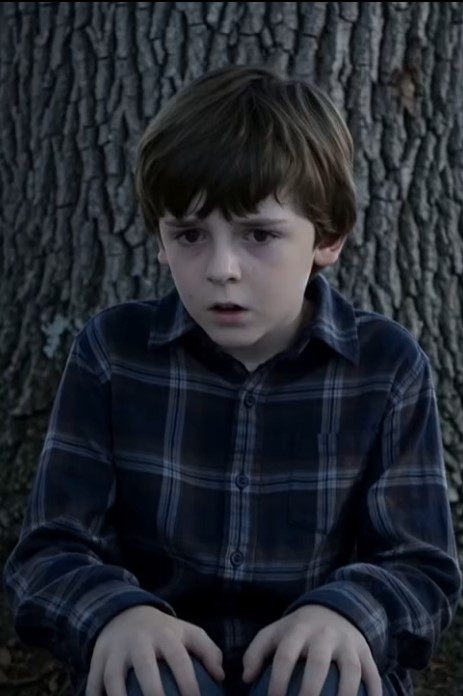
The boy sat alone beneath a tree.
Not playing.
Not talking.
Just sitting quietly while the other children ran through the yard.
At first, Mark thought nothing of it.
Then he noticed the clothes.
The temperature had climbed well into the summer heat.
Adults wore shorts.
Kids wore T-shirts.
Everyone looked warm.
Except Leo.
Leo sat in thick jeans and a heavy flannel shirt buttoned all the way to his neck.
Mark frowned.
The outfit looked completely out of place.
More importantly, Leo looked uncomfortable.
Sweat darkened his hairline.
His face appeared flushed.
Yet he never removed the shirt.
Never rolled up the sleeves.
Never loosened a button.
Concerned, Mark walked over.
“Hey buddy,” he said gently. “You okay over here?”
Before Leo could answer, Clara appeared.
Almost instantly.
As if she had been watching.
“Oh, he’s fine,” she said quickly. “Sensitive skin. We always keep him covered.”
The explanation came too fast.
Too polished.
Too practiced.
Leo lowered his eyes.
His fingers tightened around his sleeves.
Something about the interaction made Mark uneasy.
Very uneasy.
As the afternoon continued, he watched more closely.
And what he saw bothered him.
Leo never joined the other children.
Whenever someone approached him, he seemed tense.
Whenever Mark tried speaking with him, Clara somehow appeared nearby.
Watching.
Listening.
Redirecting.
Sarah remained busy hosting guests, completely unaware of the growing knot of concern forming in her brother’s chest.
Then everything changed.
It happened fast.
One moment Leo was walking toward a cooler for water.
The next, he staggered.
His steps became uneven.
His face turned pale beneath the flush of heat.
And then he collapsed.
The sound of his body hitting the patio silenced the entire gathering.
Conversations stopped.
Music faded into the background.
Someone screamed.
Sarah dropped everything and ran.
Mark reached Leo first.
Years of emergency response training immediately took over.
The boy was dangerously overheated.
His skin burned with heat.
His breathing was shallow.
Without hesitation, Mark began trying to cool him down.
He loosened the heavy flannel shirt.
Then pulled it open.
And suddenly the entire world seemed to stop.
Bruises.
Marks.
Discoloration.
Visible beneath the fabric.
Some old.
Some newer.
All impossible to ignore.
The silence that followed felt heavier than panic.
Sarah stared.
Unable to process what she was seeing.
The explanation about sensitive skin vanished instantly.
Nothing about this made sense anymore.
Nothing.
The gathering transformed from a family barbecue into an emergency.
Someone called 911.
Paramedics arrived within minutes.
Leo was treated for severe heat exhaustion and rushed to the hospital.
Sarah climbed into the ambulance beside him, shaking uncontrollably.
Her son lay on the stretcher.
The same child she thought she had protected.
The same child she trusted others to care for.
And suddenly she realized she knew far less than she believed.
At the hospital, doctors worked quickly.
Leo stabilized physically.
But medical examinations raised even more alarming questions.
The injuries did not appear consistent with a single accident.
They suggested a pattern.
A history.
Something ongoing.
Child protection authorities became involved immediately.
Investigators began examining conditions at the property.
What they discovered painted a disturbing picture.
Evidence suggested extensive monitoring and control within the household environment. Authorities reportedly identified surveillance equipment connected to areas used by Leo and uncovered signs of isolation that raised serious concerns.
The more investigators looked, the more questions emerged.
Clara and her husband Richard denied wrongdoing.
They challenged accusations.
They insisted there were explanations.
But the investigation continued.
And then digital evidence was recovered.
According to authorities, the material contradicted earlier accounts and provided a far clearer understanding of what had been happening behind closed doors.
The case expanded rapidly.
Protective measures were put in place.
Access restrictions followed.
Attempts to overturn those protections were unsuccessful.
Meanwhile, Sarah lived at the hospital.
She rarely left Leo’s side.
Guilt consumed her.
Every memory felt different now.
Every explanation she had accepted replayed in her mind.
Every moment she ignored her instincts haunted her.
But Leo never blamed her.
In fact, as the days passed and the hospital became a place of safety rather than fear, something remarkable began to happen.
He started talking again.
Slowly.
Carefully.
A little more each day.
His smile returned in brief flashes.
His shoulders relaxed.
For the first time in months, he no longer wore heavy clothing.
No longer watched doors nervously.
No longer seemed trapped inside himself.
Healing would take time.
A lot of time.
There would be counseling.
Medical care.
Long conversations.
Hard questions.
And emotional wounds that could not be repaired overnight.
But for the first time in a very long time, healing was actually possible.
Mark remained close.
Determined to protect his nephew.
Sarah never left his side.
Determined never to miss another warning sign.
Together, they began planning a future far away from the property where everything had unraveled.
Looking back, Sarah often thought about how desperately she had wanted the cottage to be a rescue.
A safe haven.
A fresh beginning.
She had accepted the offer because she was exhausted, grieving, and searching for stability.
Instead, she had unknowingly walked into something far darker.
Yet in the end, the truth emerged.
Not because secrets revealed themselves willingly.
But because one observant person paid attention.
Because concern overcame politeness.
Because someone trusted their instincts.
And because a little boy finally received the protection he deserved.
What began as a promise of safety became a painful lesson in trust.
But it also became something else.
A turning point.
The moment fear stopped hiding in shadows.
The moment silence broke.
And the moment a family stopped surviving long enough to finally begin healing.