For nearly ten minutes, I stood frozen on the beach, convinced I had stumbled onto something no one should ever find.
At first glance, it looked horrifying.
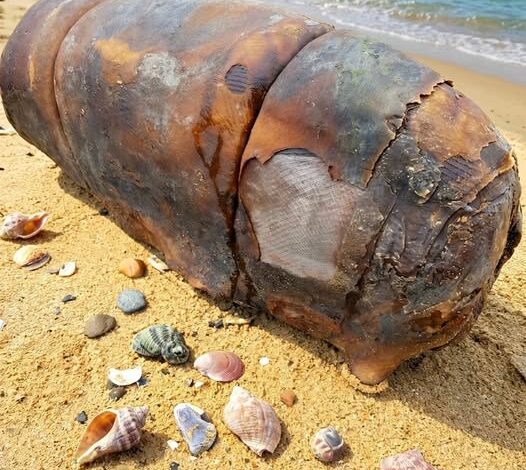
Partially buried in the sand, stretched along the tide line, was a long, twisted object that seemed disturbingly organic. The surface was dark and weathered, split open in places where layers of strange material protruded like exposed tissue.
My stomach tightened immediately.
Every crime documentary I had ever watched suddenly came rushing back.
A body.
Human remains.
Some terrible thing the ocean had dragged ashore during the night.
The closer I moved, the worse it looked.
The object was thick in some places and frayed in others. Torn strands spilled from openings in the outer layer, creating an unsettling resemblance to muscle fibers. Sections of the surface appeared leathery and scarred, as though they had been damaged by years of exposure.
I stopped several feet away.
My heart was pounding.
Part of me wanted to turn around and leave.
Another part couldn’t stop staring.
The beach itself seemed unusually quiet.
Waves rolled in and retreated with a soft hiss.
Seagulls circled overhead.
The wind pushed sand across the shoreline.
Yet all my attention remained fixed on that thing lying half-exposed near the water.
Fear has a remarkable ability to fill in missing details.
The less information we have, the more dramatic our conclusions become.
Standing there, I wasn’t looking at an object anymore.
I was looking at possibilities.
And every possibility seemed worse than the last.
Eventually curiosity overcame panic.
I took a few cautious steps closer.
Then a few more.
What I discovered completely changed the story.
It wasn’t a body.
It wasn’t an animal.
It wasn’t anything alive at all.
It was a cable.
An old, discarded cable.
Most likely industrial or submarine in origin, abandoned years earlier and left to the mercy of the sea.
The realization arrived slowly.
At first I couldn’t quite believe it.
Even up close, the object retained an eerie resemblance to something biological. The outer casing had been scorched by sunlight, battered by storms, and worn down by countless cycles of waves and sand.
Nature had spent years reshaping it.
The result was unsettling.
The protective shell had cracked and peeled away, exposing woven inner layers designed to protect the cable’s core. Those layers twisted together in patterns that looked astonishingly similar to tendons, muscle tissue, and skin.
What I had mistaken for flesh was insulation.
What I thought were exposed organs were fibers.
What seemed like evidence of something terrible was actually evidence of time.
The ocean had transformed an ordinary piece of infrastructure into something almost unrecognizable.
Standing there, I found myself laughing nervously.
Not because it was funny.
Because of how thoroughly my imagination had deceived me.
For several minutes I had been absolutely convinced I was looking at something horrifying.
My brain had assembled an entire narrative from a few visual clues.
Fear had done the rest.
It’s a strange feature of human nature.
When confronted with uncertainty, we rarely leap toward the most ordinary explanation.
We race toward the most dramatic one.
Especially when something looks unfamiliar.
Especially when it triggers ancient instincts designed to keep us safe.
The mind would rather prepare for danger that isn’t there than ignore danger that is.
In many situations, that instinct serves us well.
On that beach, however, it turned a discarded cable into a crime scene.
As I continued examining the object, another realization settled in.
The cable itself told a story.
Not the story I initially imagined.
A different one.
At some point in the past, it had been important.
Perhaps it carried electricity.
Perhaps it transmitted communications.
Maybe it connected distant systems beneath the sea.
Someone had manufactured it.
Installed it.
Relied on it.
Then eventually abandoned it.
Now it rested on a shoreline, stripped of purpose and slowly dismantled by nature.
The ocean had become its final storage place.
And that fact felt surprisingly unsettling.
We tend to think of discarded objects as gone.
Out of sight.
Out of mind.
Thrown away.
Forgotten.
But the ocean remembers.
Everything eventually ends up somewhere.
Plastic bottles.
Fishing gear.
Lost containers.
Industrial debris.
Cables.
The sea collects them all.
Years later, it occasionally returns one to shore like an artifact from a civilization trying desperately to forget its own footprint.
That old cable had become something more than debris.
It had become a warning.
A reminder.
Evidence of how much humanity leaves behind.
Evidence that nature doesn’t erase our waste—it merely transforms it.
Standing there, I realized that what disturbed me most wasn’t the object’s appearance.
It was what it represented.
For a few moments, I had believed I was looking at death.
Instead, I was looking at neglect.
A different kind of problem.
One that stretches far beyond a single beach.
Eventually I left the cable where it lay and continued walking along the shoreline.
The waves still rolled in.
The gulls still circled overhead.
The beach looked exactly the same as before.
Yet my perspective had changed.
I found myself scanning the sand differently.
Looking more carefully.
Wondering about every unusual shape the tide had delivered overnight.
Because the shoreline is full of stories.
Some are natural.
Some are human.
Some are centuries old.
Others arrived only hours earlier.
And not all of them are immediately what they appear to be.
Next time I walk along a beach, I’ll still search for shells.
I’ll still admire driftwood sculpted by the sea.
I’ll still stop to watch waves break against the shore.
But I’ll also be wondering about the things hidden among them.
The objects transformed by time, weather, and water into something almost unrecognizable.
The things we threw away years ago and assumed were gone forever.
And perhaps most of all, I’ll be wondering what other “bodies” the tide is quietly waiting to reveal—not victims of violence, but forgotten pieces of our own world returning to remind us they were never truly gone.