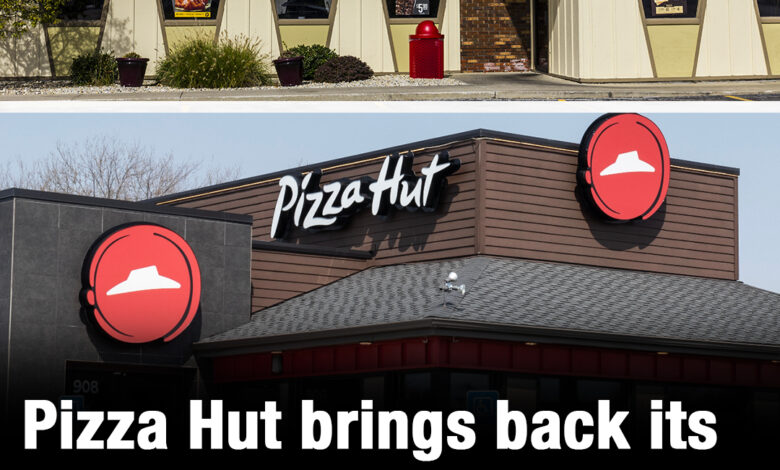
The first time people walk through the doors, many of them stop moving entirely.
Not because the restaurant is extravagant or futuristic, but because it feels impossible. The glowing red roof outside. The warm stained-glass lamps hanging above heavy wooden booths. The faint sound of arcade machines humming in the corner. The smell of pizza, melted cheese, and old carpet somehow mixing into something deeply familiar. For a split second, customers don’t feel like they’ve entered a restaurant at all.
They feel like they’ve stepped backward through time.
In an era dominated by sleek minimalism, self-checkout kiosks, sterile gray interiors, and restaurants designed more for delivery apps than actual human presence, one man has become unexpectedly famous for rebuilding something corporate America abandoned years ago: the old Pizza Hut experience.
Not ironically.
Not as parody.
But lovingly, obsessively, almost archaeologically.
Tim Sparks understands something many massive restaurant chains forgot a long time ago: people were never just buying pizza.
They were buying a feeling.
And that feeling disappeared quietly over the years.
The old Pizza Hut restaurants were once unmistakable. You could spot the steep red roofs from blocks away while riding in the backseat of your parents’ car. Friday nights meant waiting for a table while arcade sounds echoed nearby and families crowded into booths under dim amber lighting. Birthday parties unfolded beside glowing machines. Teenagers flirted over pitchers of Pepsi poured into red plastic cups packed with ice. Parents lingered over salad bars while kids fought over who got the last breadstick.
Nobody rushed.
Nobody ate staring into a phone.
Going out for pizza felt like an actual event.
Somewhere along the way, that world vanished.
Corporate redesigns slowly erased the personality from chain restaurants across America. The red roofs disappeared. The booths became smaller and colder. Dining rooms shrank or vanished completely. Arcades disappeared. Warm lighting gave way to bright white LEDs and industrial gray walls. Convenience replaced atmosphere. Delivery apps replaced dining rooms. Restaurants became optimized for speed, efficiency, and turnover rather than memory.
For millions of people, they didn’t realize how much they missed those places until they started seeing them rebuilt again.
That’s where Tim Sparks entered the picture.
Rather than following modern restaurant trends, Sparks began doing the opposite: restoring old Pizza Hut locations back to their original style. Not just vaguely retro aesthetics, but painstaking recreations of the full experience people remembered from childhood.
The glowing roofs returned.
The deep red booths returned.
The Tiffany-style hanging lamps returned.
The salad bars returned.
Even the arcade cabinets came back, humming softly in corners exactly the way people remembered them decades earlier.
When photos of the restorations first spread online, many viewers thought they were fake.
Others reacted emotionally almost immediately.
Comment sections filled with people saying the images physically hurt to look at because they triggered memories they hadn’t thought about in years. Memories of parents who were now gone. Childhood birthday parties. Little League celebrations. Friday nights after school football games. Early dates. Family dinners before divorce changed everything. Moments that felt ordinary at the time but later became sacred simply because life moved on.
People started driving hours just to experience it for themselves.
Some crossed state lines.
Others brought their children specifically to show them what restaurants used to feel like before screens took over nearly every shared public space.
And when they finally walked through the doors, many found themselves unexpectedly emotional.
Because nostalgia is rarely just about objects.
It’s about recovering versions of ourselves we thought had disappeared forever.
Parents now watch their own children race toward Pac-Man machines with the same excitement they once felt decades earlier. Couples who spent years eating rushed takeout meals suddenly linger in booths talking for hours. Friends laugh over pitchers of soda while old music hums softly overhead. For a little while, phones stay face down on tables.
The restaurants slow people down.
That may be the most powerful part of all.
In modern life, almost everything feels optimized for speed. Food arrives through apps. Conversations happen through text bubbles. Entertainment streams endlessly into isolated screens. Even restaurants increasingly feel designed for movement rather than gathering — places where customers grab a bag, tap a payment screen, and leave as quickly as possible.
But these restored Pizza Hut spaces resist that rhythm entirely.
They invite people to stay.
To sit.
To talk.
To waste time together the way people once did naturally before every spare moment became monetized, scheduled, or digitized.
For Sparks, the mission has clearly become larger than restaurant design alone. In interviews and conversations with customers, he often speaks less about nostalgia itself and more about preserving experiences modern culture keeps erasing. He understands that what people miss is not simply old furniture or outdated décor. They miss environments that encouraged presence.
The architecture mattered because it shaped behavior.
Deep booths created privacy and comfort.
Warm lighting made spaces feel intimate.
Arcade corners gave children reasons to look up from boredom instead of down at screens.
Salad bars forced people to move slowly through a shared public space rather than eating alone in cars.
Even the red plastic cups trigger something emotional for customers because they belong to a period when dining out still carried ceremony, however small.
Many visitors describe strange moments of disorientation when they first sit down inside one of these restored locations. The surroundings feel so accurate that their brains momentarily expect old conversations, old smells, old family members to walk back into existence. Some laugh. Some grow quiet. Some openly cry.
Employees have reportedly witnessed older customers sitting silently in booths for long stretches before explaining that they hadn’t realized how badly they missed places like this until they returned.
Because the restaurants do not merely recreate a visual aesthetic.
They resurrect emotional geography.
A map of where people once felt safe, connected, hopeful, or young.
Of course, nostalgia alone cannot fully recreate the past. Some customers still argue online about recipes changing over time. Others insist the original pan pizza tasted different decades ago. A few want every tiny detail restored exactly as it existed in the 1980s or early 1990s.
But for most people, the deeper emotional reaction happens long before the first slice arrives at the table.
It happens the moment they walk through the door and hear arcade sounds echoing softly again.
The moment stained-glass lamps cast warm light across red booths.
The moment they realize families around them are actually talking to one another instead of staring silently at phones.
The moment the outside world briefly slows down.
That is the real product Tim Sparks is rebuilding.
Not pizza.
Not branding.
Memory itself.
And perhaps that explains why these retro restorations have resonated so powerfully in a culture increasingly exhausted by speed, isolation, and digital overload. People are hungry for places that feel human again. Places with personality. Places where imperfection, warmth, noise, and lingering are still allowed.
In a world obsessed with futuristic convenience, these restaurants feel almost radical precisely because they ask so little from technology and so much from human presence.
You sit down.
You stay awhile.
You look at the people across from you.
And for an hour or two beneath the glow of those old lamps, it becomes possible to believe the best parts of the past were never entirely lost after all.