An Elderly Veteran Was Publicly Disrespected by a Billionaire’s Security Team — Then Unexpected Help Arrived

The Nevada desert has a way of exposing people.
Under that kind of heat, with miles of empty highway stretching in every direction, there are very few distractions left between who someone pretends to be and who they actually are. Power becomes clearer there. So does cruelty. So does dignity.
That truth settled quietly over the old Route 66 rest stop the afternoon Arthur Miller’s Jeep refused to start.
Arthur had spent most of his life solving problems without asking for help. At seventy-four, his movements had slowed, but habit still guided him with the same careful discipline forged decades earlier during military service. Even the way he worked beneath the raised hood of his worn 1974 Jeep CJ-5 reflected patience shaped through years of endurance.
The Nevada heat pressed down relentlessly.
Sweat rolled across his weathered face while he checked the fuel line again, adjusted the carburetor, and listened closely for signs the engine might finally turn over. Around him, the desert stretched endlessly in waves of dust and silence. There was something almost sacred about the stillness:
the hum of distant wind,
the smell of heated asphalt,
the loneliness of open highway travel.
Inside the Jeep sat the few possessions Arthur carried most carefully.
A faded military duffel bag bearing the insignia of the 101st Airborne Division.
A pressed dress uniform.
And a neatly folded American flag.
To strangers, the bag looked old and worn.
To Arthur, it carried nearly an entire lifetime.
The Jeep itself had traveled beside him for decades after his military service ended, carrying memories across thousands of miles. But the trip he was making now mattered differently. He was traveling toward a private memorial service for his late wife—a final promise he intended to keep no matter how long the road became.
That promise sat quietly inside the Jeep beside him while he worked.
Then the sound of engines shattered the silence.
Three black luxury SUVs appeared across the highway horizon, moving fast enough to throw dust behind them in violent clouds before turning sharply into the gravel lot. Their arrival changed the atmosphere instantly. The stillness disappeared beneath the roar of expensive engines and the unmistakable choreography of people accustomed to power clearing paths ahead of them.
The lead SUV stopped only feet from Arthur’s stalled Jeep.
A security guard stepped out immediately.
Tall.
Broad-shouldered.
Rigid with authority.
His name was Vance, and from the moment he looked at Arthur’s Jeep, irritation flashed openly across his face. To him, the old vehicle was not a struggling traveler’s transportation. It was an inconvenience delaying important people.
“Move it,” he ordered sharply.
Arthur remained calm.
He explained the Jeep had stalled unexpectedly and that he was trying to repair it as quickly as possible. He even gestured toward an open section of pavement nearby, pointing out there was still enough room for the convoy to pass without obstruction.
But men who mistake intimidation for strength rarely listen once they decide someone beneath them is inconvenient.
Vance repeated the demand more aggressively.
Arthur continued trying to restart the engine, refusing to escalate the confrontation despite the hostility building around him.
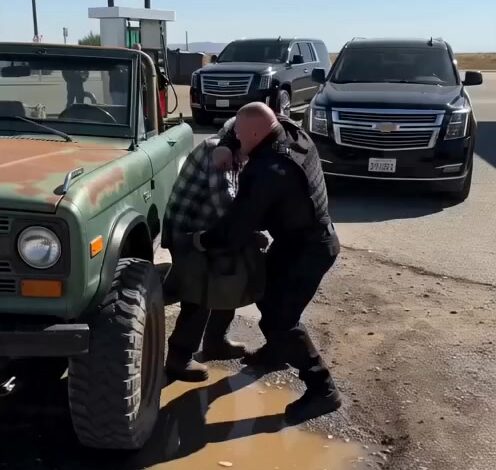
Then, without warning, Vance shoved him backward.
The impact slammed Arthur against the side of the Jeep hard enough to reignite old injuries buried deep beneath years of quiet endurance. Pain flashed across his back and shoulders instantly. For a brief second, he struggled simply to steady himself upright.
Still, he did not retaliate.
That restraint matters.
People often misunderstand military veterans, imagining strength only through aggression or dominance. But many veterans understand something civilians often do not:
real discipline means controlling force even when anger would feel justified.
Arthur breathed deeply and regained his balance.
Then the situation became far worse.
Vance leaned into the Jeep and grabbed the faded military duffel bag from the passenger seat.
Arthur’s voice changed immediately.
Not loud.
Not panicked.
But urgent.
“Don’t touch that bag,” he warned.
There are objects people carry that stop being possessions entirely. They become extensions of memory itself:
flags folded after funerals,
old uniforms,
photographs,
letters,
dog tags,
wedding rings.
The duffel bag held pieces of Arthur’s life no amount of money could replace.
Vance ignored him completely.
He walked several steps away and threw the bag violently into a muddy drainage ditch beside the rest stop. Dirty water splashed across the fabric instantly, staining the worn 101st Airborne insignia that Arthur had preserved for decades.
For a second, Arthur simply stared.
Not because he feared the guard.
Because grief and disbelief collided too quickly to process.
Then Vance stepped directly onto the bag with his boot, grinding it deeper into the mud while continuing to bark orders and insults toward the elderly veteran.
Around them, people watched.
And that silence became its own form of tragedy.
Travelers standing nearby looked away rather than intervene. Inside the diner, the manager briefly glanced toward the parking lot before closing the blinds instead of becoming involved.
Even inside the SUV convoy itself, billionaire developer Julian Cross noticed the confrontation through tinted glass—then quietly lowered the window shade and turned away.
That detail lingers emotionally because indifference often wounds as deeply as cruelty.
The security guard acted violently.
But everyone else allowed the humiliation to continue.
Arthur stood alone beside the Jeep while the desert wind carried dust across the parking lot.
Then something changed.
The heavy diner door opened slowly behind him.
At first came only sound:
boots against concrete,
chairs scraping,
the faint rustle of leather jackets.
Then figures emerged into the sunlight one after another.
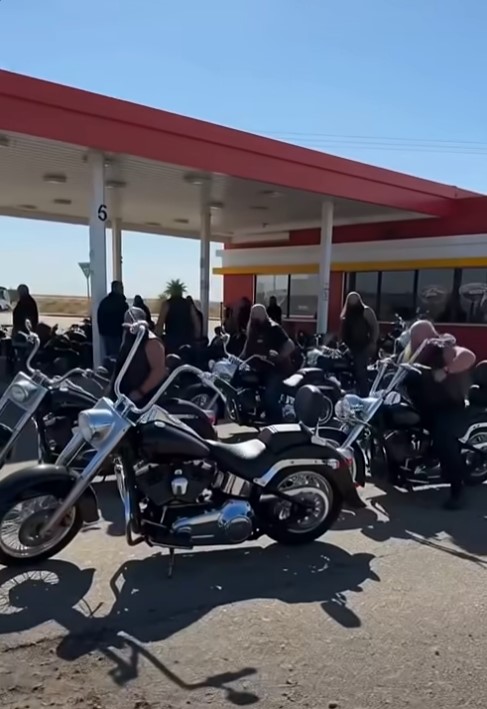
Bikers.
Dozens of them.
Not chaotic.
Not rushing.
Not shouting.
Just moving with deliberate calm toward the center of the parking lot.
At the front walked a massive man known simply as Grizz, president of the Outlaw Brotherhood motorcycle club. He said nothing initially. He only walked directly toward Vance and stopped a few feet away, eyes lowering toward the military duffel bag half-buried beneath mud and boot marks.
Then, in a calm voice carrying far more authority than shouting ever could, Grizz spoke:
“Take your foot off the bag.”
The atmosphere shifted instantly.
Not because violence erupted.
Because the balance of moral weight inside the parking lot changed all at once.
The bikers spread naturally across the area, surrounding the convoy without direct threats or aggressive movement. Yet their presence carried unmistakable meaning:
someone was finally willing to stand beside the veteran.
For the first time, the security team’s confidence visibly faltered.
Vance hesitated.
Then slowly stepped backward.
And what happened next may have mattered more than any confrontation could have.
Grizz knelt directly into the mud.
Without hesitation.
Without concern for dirt or appearance.
He lifted the soaked military bag carefully into his hands and began brushing mud from the insignia with a clean bandana as gently as if restoring something sacred.
That small act transformed the moment entirely.
Because respect is often communicated most powerfully through care.
Not speeches.
Not threats.
Not dramatic revenge.
Just one human being recognizing the meaning of another person’s sacrifice.
Arthur watched silently while the mud was cleaned from the faded insignia. His face remained steady, but emotion moved visibly beneath the surface. The bikers understood something instantly that the billionaire’s convoy never did:
the bag represented service,
memory,
loss,
and dignity earned through suffering.
Around them, the desert resumed its endless movement.
Wind across asphalt.
Dust swirling through sunlight.
The distant hum of highway traffic returning faintly beyond the rest stop.
And suddenly the confrontation no longer felt merely about a stalled Jeep.
It became something larger:
a collision between power and character.
The convoy arrived wrapped in wealth, authority, and intimidation. Yet none of it produced respect.
The bikers arrived carrying no visible status at all beyond loyalty, instinct, and recognition of human dignity.
And in the end, those qualities mattered more.
Perhaps that is why stories like this resonate so deeply.
Because many people know what it feels like to become invisible once age strips away society’s usual markers of importance. Older veterans especially often move through public spaces quietly carrying histories strangers never bother asking about.
Arthur looked like an old man with a broken Jeep.
But appearances hide entire lifetimes.
Inside that worn body existed decades of sacrifice,
discipline,
love,
and promises still being honored long after easier people might have given up.
The billionaire’s convoy saw obstruction.
The bikers saw a veteran.
That difference revealed everything.
And perhaps the most powerful part of the story is that no one defended Arthur because of his wealth, influence, or usefulness.
They defended him because respect should never depend on those things in the first place.
Especially not beneath a vast desert sky where every human being eventually becomes small compared to time,
memory,
and the simple question of whether we chose dignity or cruelty when another person needed us most.