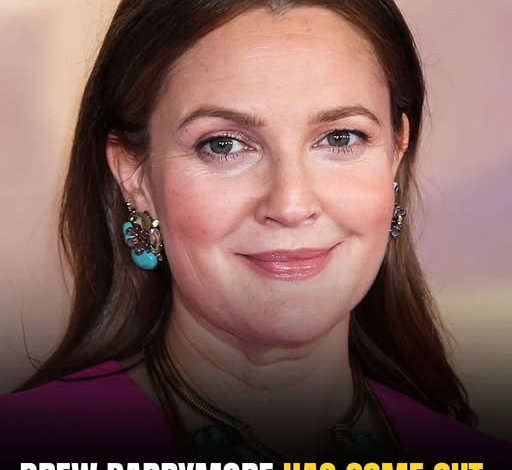
For much of her life, the world believed it knew Drew Barrymore.
It knew the child star whose face appeared on movie screens before she was old enough to understand fame. It knew the teenager whose struggles unfolded beneath relentless headlines. It knew the actress, the producer, the talk-show host, the mother, the woman who seemed to spend decades learning how to rebuild herself in public.
But the truth about a person is rarely contained in the roles others assign them.
Sometimes the most important parts of identity exist quietly for years, waiting for a moment when honesty feels safer than silence.
When Barrymore spoke openly about her bisexuality, the revelation did not feel like a dramatic reinvention. It felt like something gentler and more profound: a woman deciding she no longer needed to edit her own story.
That distinction matters.
Public conversations about sexuality are often framed as announcements, confessions, or transformations. The language implies that something has suddenly changed. Yet for many people, the reality is quite different. The truth has existed all along. What changes is the willingness to speak it aloud.
Barrymore’s comments carried that sense of ease.
There was no grand declaration.
No demand for attention.
No attempt to create controversy.
Instead, there was a simple honesty that suggested she had reached a place where authenticity mattered more than public expectations.
After a lifetime spent under observation, that kind of openness carries its own quiet courage.
Few people grow up under the microscope she experienced.
Every mistake became news.
Every relationship became public property.
Every chapter of her life was interpreted, analyzed, and discussed by strangers.
Many people in that position spend years constructing protective versions of themselves—carefully edited identities designed to survive scrutiny.
What makes Barrymore’s perspective compelling is that it seems to move in the opposite direction.
Rather than narrowing herself into something easier for others to understand, she has increasingly embraced complexity.
She speaks openly about heartbreak.
About loneliness.
About motherhood.
About aging.
About the difficult work of becoming comfortable with who you are.
Her reflections on attraction and love fit naturally within that larger journey.
When she talks about appreciating women’s beauty or acknowledges her attraction to women, there is little sense of performance. Instead, there is the calm confidence of someone describing a reality she no longer feels obligated to hide.
That authenticity resonates far beyond celebrity culture.
For many people, particularly those who grew up watching Barrymore’s career unfold, her words touch something deeply personal.
Visibility matters.
Not because every public figure must become a symbol, but because seeing someone live honestly can make honesty feel possible.
Many individuals spend years wrestling privately with questions about identity.
They wonder whether they fit neatly into expected categories.
They worry about disappointing family members, friends, or communities.
They fear being misunderstood.
Sometimes they fear understanding themselves.
In that context, hearing someone speak candidly about their own experience can be powerful.
Not because it provides answers.
But because it offers permission.
Permission to be uncertain.
Permission to be evolving.
Permission to exist without having every aspect of yourself perfectly explained.
Barrymore’s journey also highlights an important truth about self-discovery: it does not operate on a deadline.
Popular culture often treats identity as something that should be fully resolved in youth, as though adulthood arrives with complete certainty attached.
Life rarely works that way.
People continue learning about themselves at twenty, forty, sixty, and beyond.
They change.
They grow.
They uncover truths that were always present but not yet fully understood.
There is no expiration date on authenticity.
No age at which self-understanding becomes unnecessary.
Barrymore’s willingness to discuss her bisexuality reflects that reality.
It suggests that becoming yourself is not a single event.
It is an ongoing process.
A series of decisions to move closer to the truth rather than further away from it.
What makes her story particularly meaningful is that it emerges from a life already filled with transformation.
She has survived public mistakes.
Professional reinventions.
Personal heartbreaks.
Periods of chaos and periods of healing.
Through it all, she has gradually become someone who appears less interested in performing perfection and more interested in practicing honesty.
That shift may be her most significant achievement.
Not a film role.
Not a television show.
Not a business venture.
But the ability to stand comfortably within her own story.
In a culture that often rewards certainty and punishes complexity, there is something refreshing about that.
People are not always simple.
Love is not always simple.
Identity is not always simple.
The most authentic lives rarely are.
Perhaps that is why Barrymore’s words continue to resonate.
They remind us that self-acceptance is not about fitting neatly into someone else’s expectations.
It is about making peace with your own reality.
About allowing different parts of yourself to coexist without shame.
About recognizing that authenticity is not something earned after achieving perfection.
It is something practiced, imperfectly, every day.
For those who have followed her journey from child star to adult woman, the moment feels less like a revelation than a continuation.
Another chapter in a life defined by resilience, growth, and the refusal to let other people write the final version of her story.
And for those navigating similar questions in their own lives, her honesty offers something quietly valuable.
A reminder that there is no single timeline for becoming yourself.
No requirement to have everything figured out.
No need to apologize for complexity.
Only the ongoing invitation to live a little more truthfully than you did yesterday.
Sometimes that is enough.
Sometimes that is everything.