Everyone in Class Laughed at My Boyfriend Because of His Height – But at Graduation, Our Teacher Invited Us on Stage and Said Words That Left Everyone Speechless

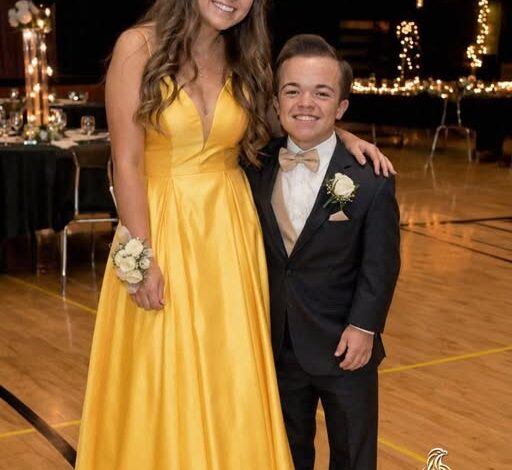
The moment the music stopped, the entire gym changed.
Not loudly at first.
The bass faded into a sharp burst of static, conversations collapsed mid-sentence, and hundreds of students turned instinctively toward the center of the dance floor where Elliot and I stood frozen beneath the white glare of the gym lights. It felt like the air itself tightened. You could hear sneakers squeaking faintly against polished wood somewhere near the bleachers, the restless rustle of people whispering too quietly to fully make out.
And right there, in the middle of it all, stood Elliot.
Still holding my hand.
Still wearing the expression of someone already bracing for humiliation before it fully arrived.
I knew that look because I had watched him carry it for years.
Elliot had become the kind of person people laughed at automatically, almost out of habit. Not because he was cruel or arrogant or strange in any dangerous way, but because he was gentle in a school that rewarded sharpness. He tutored freshmen after classes. Fixed broken laptops in the library for free. Remembered birthdays nobody else remembered. He moved through hallways quietly, never demanding attention, which somehow made certain people decide he deserved ridicule instead of respect.
And cruel people always mistake kindness for weakness.
That night was supposed to be another example.
Someone had spread rumors online all week that Elliot would be crowned “King of Charity Cases” at the dance. Fake posters circulated through group chats. A table near the punch bowl had already started snickering the moment he walked in wearing the suit his aunt helped him buy. Even before the music cut out, I could feel the trap tightening around him.
He knew it too.
But he came anyway.
That mattered more than most people realized.
Because when someone spends years being mocked publicly, showing up at all becomes its own kind of courage.
The principal stepped awkwardly toward the microphone near the stage while teachers exchanged nervous glances. For one horrible second, I thought the prank was actually going to happen in front of everyone.
Elliot’s hand loosened slightly in mine.
Like he was preparing himself to survive it quietly.
Then Mrs. Parker walked onto the stage.
Everything changed.
Mrs. Parker had taught English for almost thirty years, and students treated her with the kind of respect that couldn’t be forced. She didn’t raise her voice often, but when she spoke, rooms listened. She adjusted the microphone slowly while the gym settled into uneasy silence.
Then she said Elliot’s name.
Not mockingly.
Not as a setup.
Not as the punchline everyone expected.
As the recipient of the Heart of the School Award.
The shift in the room was immediate and almost physical.
You could actually see confusion move across faces.
Smirks faded halfway.
Whispers stopped.
A few students laughed nervously at first because they assumed it was still part of the joke.
Then Mrs. Parker kept speaking.
She talked about the freshman Elliot stayed after school helping every Tuesday and Thursday. The students he tutored for free. The girl whose grades improved enough to avoid repeating a year because Elliot spent lunches teaching her algebra. The quiet donations he made to the winter coat drive without ever putting his name on anything.
And suddenly, the room wasn’t laughing anymore.
Freshmen near the back stood first.
One after another.
Without hesitation.
One boy shouted, “He helped me pass biology!”
Then another voice:
“He stayed late every week with me!”
Another:
“He fixed my laptop before finals!”
Their voices echoed through the gym louder each time, breaking apart the silence piece by piece until applause started rising almost accidentally from different corners of the room.
Not polite applause.
Real applause.
The kind people can’t fake because emotion gets there before self-consciousness does.
I looked at Elliot beside me and realized he genuinely didn’t know what to do.
For years, he had learned how to survive humiliation.
Not admiration.
That’s a different kind of vulnerability entirely.
His face flushed red beneath the gym lights while students kept clapping louder. Some teachers were crying openly now. Even people who had mocked him earlier suddenly couldn’t seem to meet his eyes directly anymore.
Because that’s the uncomfortable thing about moments like this:
once goodness becomes visible, cruelty suddenly looks incredibly small.
Mrs. Parker handed Elliot the plaque carefully, smiling like she had been waiting a long time for the school to finally notice what she already knew about him.
When Elliot stepped toward the microphone, I expected his hands to shake.
They didn’t.
That may have been the most unforgettable part.
He wasn’t angry.
Wasn’t vindictive.
Didn’t try humiliating anyone back.
He simply stood there honestly.
And honesty can feel devastating when an entire crowd suddenly realizes how unfair they’ve been.
Elliot looked out across the gym slowly before speaking.
“Thank you,” he said quietly. “Especially to the people who were kind to me when nobody else thought it mattered.”
The room went completely still again.
No dramatic speech.
No revenge.
No desperate attempt to win approval.
Just truth.
Then he said something I still think about constantly:
“You never really know how much someone needs kindness until they stop expecting it.”
I watched faces change all across that gym.
Some students looked ashamed.
Some emotional.
Some deeply uncomfortable.
Because his words forced everyone into the same realization at once: they had spent years treating someone extraordinary like background noise simply because he never demanded attention loudly enough.
And maybe worse than cruelty itself is indifference.
That understanding hung in the air heavier than any insult ever could.
Elliot thanked the freshmen who stood up for him by name. Thanked Mrs. Parker. Thanked the janitor who let him stay late after tutoring sessions. He spoke calmly, steadily, like someone finally realizing he no longer needed permission to take up space.
Not once did he ask the crowd to like him.
That changed everything.
People are used to seeing outsiders beg for acceptance publicly.
They don’t know what to do when someone stands confidently without needing it anymore.
By the time he stepped away from the microphone, the applause sounded different than before.
Bigger.
Warmer.
Almost protective.
And suddenly the people who mocked him looked painfully obvious standing there in silence.
Because Elliot was never actually the joke.
He was the mirror.
The dance resumed eventually. Music flooded back through the speakers, conversations slowly restarted, lights softened again. But the energy inside the gym had shifted permanently.
When Elliot and I stepped back onto the dance floor, students moved aside for us naturally.
Not out of pity.
Out of respect.
And for the first time all night, Elliot smiled without hesitation.
A real smile.
Not the careful guarded one he usually wore to survive hallways and classrooms.
The kind of smile that appears when someone finally understands their worth was never dependent on the people who failed to see it.
I think everyone in that gym felt it then:
some moments don’t just embarrass people.
They expose them.
The prank was supposed to brand Elliot publicly forever.
Instead, it revealed something far more lasting about everyone watching.
Who laughed.
Who stayed silent.
Who stood up.
And long after the decorations came down and the music stopped echoing through the gym, people still remembered that night for one reason:
not because Elliot was humiliated—
but because, for the first time, the entire school was forced to see how extraordinary quiet kindness actually looks when the spotlight finally finds it.