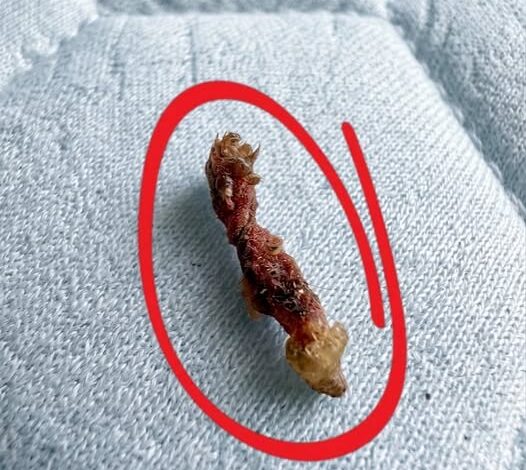
For a long moment, the room felt smaller, heavier. I hovered over that strange, shriveled thing like it might suddenly move. My family gathered around, each of us quietly measuring our distance from the bed, trading theories that only made the tension worse. Insect. Parasite. Something from the ceiling. Something from my back. The more we stared, the less it made sense, and the more my skin crawled with the idea that it had shared the bed with me all night.
Only later, after zoomed-in photos, online searching, and comparing images, did the truth sink in with almost embarrassing relief: it was just a dried piece of cooked meat, probably chicken, that had somehow ended up in the sheets. No monster, no infestation—just a forgotten scrap turned horror prop. The fear was real, the threat wasn’t. But that feeling of not knowing? That might haunt me longer than any actual bug ever could.
It started with something small enough that most people probably would have brushed it away without thinking twice.
I was changing the sheets late at night, tired and distracted, halfway through the familiar routine of straightening blankets and shaking pillows when I noticed it near the foot of the bed. At first glance, it looked organic in the worst possible way: dark, shriveled, curved slightly inward like something that had once been alive.
I froze immediately.
There are certain objects the human brain reacts to before logic has time to intervene. Strange things found in beds belong high on that list. Your imagination bypasses reason entirely and rushes straight toward contamination, infestation, danger.
I leaned closer carefully without touching it.
That somehow made it worse.
The thing had texture. Uneven ridges. Tiny pale streaks running through it. One edge looked oddly fibrous, another almost shell-like. Under the bedroom light, it cast a tiny shadow against the sheet that made it appear larger and more sinister than it probably was.
For several seconds, I simply stared.
Then my skin started crawling.
Not metaphorically either—actual prickling across my arms and neck, the kind your body produces when fear arrives before explanation. Suddenly every blanket fold felt suspicious. Every itch on my leg became evidence of invisible catastrophe.
I called for my family immediately.
That was mistake number one.
Fear spreads fast in groups because people feed each other possibilities. Alone, I might have eventually settled on something ordinary sooner. But the moment everyone crowded into the bedroom, the object transformed from weird to terrifying.
My daughter stood near the doorway refusing to come closer.
“That is absolutely a bug,” she whispered dramatically.
“It’s too big for a bug,” my husband replied, which somehow felt much worse.
Then came theories.
Parasite.
Cocoon.
Dead mouse tail.
Something fallen from the attic.
Something attached to clothing.
Something that came off me while I slept.
That last possibility nearly made me leave the room entirely.
The more we discussed it, the stranger the thing seemed to become. Fear distorts perception that way. Objects stop looking ordinary once anxiety attaches narrative to them. Suddenly the shriveled shape appeared almost intentional, like evidence of something hidden rather than random debris.
And the fact that it had been in my bed all night made everything emotionally worse.
Beds are supposed to feel safe.
Protected.
Clean.
Finding something unfamiliar there feels oddly violating because sleep already leaves people vulnerable. The mind immediately begins replaying unconscious hours:
Did it touch me?
Was there more than one?
How long had it been there?
What if I rolled onto it during the night?
I found myself inspecting my own skin reflexively despite having no symptoms whatsoever.
Fear is incredibly physical.
Soon all four of us stood around the bed like amateur investigators at a crime scene nobody wanted responsibility for solving. Nobody volunteered to touch it again. We just stared collectively while tension grew more ridiculous by the minute.
Finally, I grabbed a tissue, picked it up cautiously, and placed it onto a paper towel under brighter kitchen lighting.
That did not help.
Under the kitchen light, the object somehow became even more unsettling. It looked dry but greasy simultaneously. One side appeared porous. Another almost leathery. My son suggested maybe it had once had legs.
I nearly threw it away immediately after that comment.
Instead, I did what modern people always do when confronted with mysterious horror:
I started searching online.
Big mistake.
The internet is uniquely capable of escalating harmless uncertainty into full psychological collapse. Search results immediately flooded with nightmare fuel:
parasites,
shed insect casings,
bed bug infestations,
dried larvae,
rodent droppings,
fungal growths.
Every image looked vaguely similar if I stared long enough.
That is the dangerous thing about anxious searching: once fear takes over, the brain begins forcing connections between unrelated things desperately trying to confirm danger. Harmless similarities suddenly feel definitive.
I zoomed in on photos obsessively.
Compared textures.
Rotated the object under light.
Used my phone flashlight like a forensic investigator.
At one point, my daughter announced she would never sleep in the room again.
Reasonable honestly.
Then something shifted.
While turning the object over beneath the light, I noticed a smell.
Faint.
Savory.
Not rotten exactly.
Not biological in the horrifying sense I feared.
Familiar.
I paused completely.
Carefully, cautiously, I brought it slightly closer.
Chicken.
I stared at it in disbelief.
Not an insect.
Not a parasite.
Not evidence of hidden infestation lurking inside our mattress.
A dried piece of cooked chicken.
Probably dropped during late-night snacking, kicked beneath blankets unnoticed, then dried into something disturbingly alien-looking over time. The pale streaks were fibers. The shriveled texture came from dehydration. The weird curved shape was just cooked meat hardening overnight.
For several seconds nobody spoke.
Then the relief hit so suddenly I started laughing uncontrollably.
Not elegant laughter either.
The shaky kind that comes after adrenaline realizes it no longer has a purpose.
My husband laughed next.
Then the kids.
Within minutes the terrifying mystery object had transformed from nightmare to family joke.
“All this over chicken?” my son said between laughing.
“To be fair,” I replied, “it looked deeply cursed.”
And honestly, it really had.
That became the funniest part afterward: how convincingly fear had transformed something ordinary into something monstrous. Once we knew the truth, the object looked obviously harmless. Embarrassingly harmless. But before certainty arrived, our imaginations had constructed entire horror stories around it.
The emotional shift fascinated me almost as much as the panic itself.
Because the fear had been completely real.
My racing heart was real.
The nausea was real.
The crawling skin sensation was real.
Only the threat was imaginary.
That distinction says something important about human psychology. People often assume fear must correspond proportionally to actual danger, but uncertainty alone can generate enormous distress. The unknown frightens us because the mind rushes instinctively to fill gaps in knowledge—and it usually fills them with worst-case scenarios first.
Especially late at night.
Especially in vulnerable spaces like bedrooms.
Especially when surrounded by other anxious people adding possibilities faster than logic can eliminate them.
Afterward, we joked about it endlessly.
My daughter started referring to random leftovers as “bed parasites.” My husband dramatically inspected every crumb he found afterward like a detective. Someone suggested framing the photo we took during peak panic.
But beneath the humor lingered something strangely unsettling too.
Not about the chicken itself.
About the feeling.
That horrible suspended moment of not knowing.
Because uncertainty creates a very specific kind of fear different from ordinary danger. When danger becomes identifiable, people can respond:
remove it,
treat it,
escape it,
understand it.
But uncertainty traps the mind in endless possibility.
That may be why horror movies often hide monsters partially instead of revealing them immediately. Imagination frightens people more efficiently than certainty ever can. The brain creates personalized terror from incomplete information.
And for a few long minutes in my bedroom, that is exactly what happened.
A harmless piece of dried chicken became:
a parasite,
a bug,
a contamination,
an invasion,
a threat hidden inches away while I slept.
All because my brain desperately wanted explanation before evidence existed.
The next morning, I changed the sheets again anyway.
Thoroughly.
Not because logic demanded it.
Because emotionally, the bed still felt haunted slightly by uncertainty itself.
Even now, whenever I find something random tangled in blankets—a sock, tissue, crumbs—I experience a tiny flash of suspicion before reason catches up.
What if?
That question arrives instantly now.
And maybe that is the strangest part of the entire experience:
sometimes the most unsettling thing is not discovering something dangerous.
It is discovering how quickly your own mind can transform ordinary scraps into monsters the moment certainty disappears.