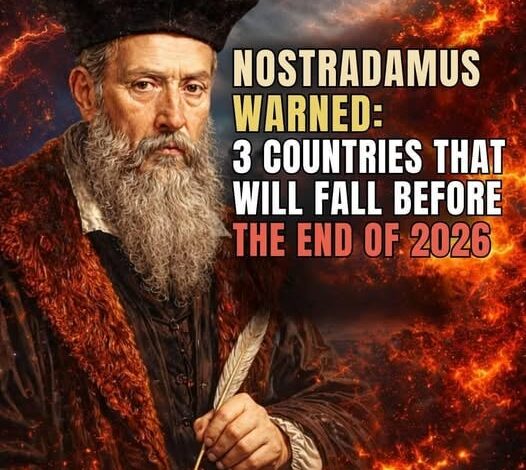
Nostradamus has endured for centuries not because his predictions are precise, but because they are elastic enough to survive every generation’s fears. His quatrains rarely point clearly to one event, one leader, or one nation. Instead, they drift through symbols, fragments, and unsettling imagery — wounded eagles, burning cities, collapsing crowns, rising floods, shadowed wars. That ambiguity is exactly what gives them power. People do not read Nostradamus to discover certainty. They read him to find echoes of the anxieties they already feel building around them.
And right now, those echoes feel unusually loud.
His references to a weakened eagle resonate in an era when many Americans openly question the stability, unity, and direction of their own country. Political division has deepened into something that often feels less like disagreement and more like mutual distrust bordering on cultural fracture. Institutions that once projected permanence now seem fragile under constant pressure from polarization, misinformation, economic unease, and exhaustion. For some readers, the image of the eagle no longer represents unquestioned dominance. It represents uncertainty about whether American power can remain coherent in a world becoming increasingly unstable and multipolar.
The symbolism surrounding the bear feels equally charged.
For decades, Russia has cultivated the image of strength, endurance, and strategic patience. Yet years of sanctions, international isolation, prolonged conflict, and economic strain have created visible cracks beneath that projection of control. To those searching Nostradamus for relevance, the image of a cornered or wounded bear appears eerily aligned with modern geopolitical tension. They see a nation under pressure, dangerous precisely because it feels trapped between preserving power and confronting decline.
Then there is the fading lion.
Many interpret that symbol through the lens of Britain — a country wrestling publicly with questions of identity, relevance, sovereignty, and economic direction in the aftermath of Brexit and years of political instability. The lion once symbolized imperial certainty, global influence, and national confidence. Today, for some observers, it instead reflects a nation searching for a stable narrative about what it wants to become in a rapidly changing world.
What makes these interpretations compelling is not that Nostradamus predicted modern events with supernatural accuracy.
It is that history repeatedly produces conditions that feel emotionally similar across generations.
Empires always fear decline.
Powerful nations always struggle with overreach, division, and uncertainty.
Periods of rapid technological and social change almost always create public anxiety about collapse, replacement, or irreversible transformation.
Nostradamus survives because he writes in archetypes rather than specifics. His verses are broad enough to absorb each era’s fears while remaining mysterious enough to feel prophetic.
That is why people continue returning to his work whenever the world feels unstable.
During wars.
During pandemics.
During financial crises.
During political upheaval.
Human beings search desperately for patterns when reality becomes frightening or difficult to predict. Prophecy offers emotional structure in moments when ordinary explanations feel inadequate. Even skeptics sometimes find themselves drawn toward vague predictions during periods of uncertainty because ambiguity itself allows people to project meaning onto events that otherwise feel chaotic.
But perhaps the most revealing aspect of Nostradamus is not what he supposedly foretold.
It is what audiences choose to see inside the prophecies.
The quatrains often function less like predictions and more like mirrors.
A person already anxious about war notices references to fire and bloodshed.
Someone fearful about political collapse sees symbols of weakened rulers and broken alliances.
People worried about economic instability focus on famine, disorder, and social unrest.
The text adapts itself psychologically to the reader’s fears.
In that sense, Nostradamus reveals far more about humanity than about the future itself.
He exposes how deeply people long for narrative during uncertainty.
How urgently societies want reassurance that events, however frightening, still follow some hidden logic or destiny.
And history shows that these emotional cycles repeat constantly.
One generation fears invasion.
Another fears technological collapse.
Another fears nuclear annihilation.
Another fears internal decay.
The details change, but the emotional architecture remains remarkably similar.
That is partly why Nostradamus still feels haunting centuries later. His writings capture emotional patterns more effectively than literal events. He understood instability, fear, ambition, violence, and the fragility of political power because those forces are permanent features of human civilization.
Empires rise believing themselves invincible.
Then they hesitate.
Overextend.
Fracture internally.
Adapt or disappear.
Alliances that once looked permanent collapse unexpectedly.
Former enemies become strategic partners.
Economic systems transform societies faster than leaders can fully control.
Ordinary people survive through improvisation while governments struggle to maintain narratives of certainty.
History rarely moves in straight lines.
It pulses through cycles of confidence and panic, expansion and retreat, crisis and reinvention.
That is why many historians and scholars caution against reading Nostradamus too literally. The danger of prophecy is not simply superstition. It is the temptation to treat decline or catastrophe as inevitable rather than contingent on human decisions.
Because nations are not trapped inside predetermined scripts.
Societies still choose how to respond to instability.
Leaders still choose between escalation and restraint.
Citizens still choose whether fear hardens into extremism or transforms into resilience.
Even during periods of enormous upheaval, history remains shaped by millions of ordinary actions rather than destiny alone.
In that sense, the deeper lesson hidden beneath all the fascination with Nostradamus may actually be the opposite of fatalism.
His verses remind people that power is temporary.
That certainty is fragile.
That civilizations can weaken if they become arrogant, divided, or incapable of adaptation.
But they also remind us that collapse is never the only possible outcome.
Human societies are remarkably resilient.
They survive wars, depressions, pandemics, revolutions, and political crises by changing, reorganizing, and rebuilding in ways no prophecy can fully anticipate.
That complexity is what prophecy often fails to capture.
Real history is messier than prediction.
It is shaped not only by rulers and conflicts, but by teachers, workers, parents, scientists, artists, voters, refugees, and millions of people making small choices inside uncertain times.
So perhaps the enduring fascination with Nostradamus says less about belief in supernatural foresight and more about the emotional state of the modern world itself.
People sense instability.
They sense transitions unfolding politically, economically, technologically, and culturally faster than many institutions can comfortably absorb.
And in moments like that, ancient prophecies begin feeling strangely alive again because they offer symbolic language for fears already present beneath the surface.
But if history teaches anything consistently, it is this:
crisis is never permanent either.
Empires change.
Societies evolve.
Periods that once felt apocalyptic eventually become chapters future generations study with distance and perspective.
The future is rarely as fixed as frightened people imagine in the middle of uncertainty.
And perhaps that is the most important thing Nostradamus unintentionally reveals after all:
not that doom is inevitable…
but that humanity has always stood anxiously between fear and reinvention, trying to decide which story it will believe about itself next.