The festival was supposed to be the highlight of Sofia Martinez’s summer.
For months, the twenty-six-year-old traveler from Mexico had dreamed about this trip.
Not because she wanted photographs in front of famous landmarks.
Not because she wanted luxury hotels or crowded tourist attractions.
Sofia traveled for a different reason.
She wanted stories.
She wanted to understand places through the people who lived there.
The traditions they preserved.
The food they shared.
The celebrations that had survived generations.
That desire for authentic experiences had eventually led her to southern Spain.
Specifically, a small historic town in Andalusia that rarely appeared in travel brochures but was beloved by locals for its centuries-old summer festival.
The moment she arrived, she knew she had made the right choice.
Whitewashed buildings glowed beneath the sun.
Narrow cobblestone streets twisted through the town like pathways through history.
Flower-filled balconies spilled color from every window.
The entire place felt alive.
Locals greeted one another by name.
Children raced through the streets laughing.
Musicians practiced melodies that echoed between stone walls.
Everything seemed touched by tradition.
Sofia loved it instantly.
She spent days exploring.
Talking with residents.
Sampling local dishes.
Photographing details most visitors overlooked.
An elderly woman watering flowers.
A baker dusting fresh pastries with sugar.
A guitarist practicing alone in a shaded courtyard.
Those were the moments she treasured most.
When festival week finally arrived, the town transformed completely.
Colorful banners stretched between buildings.
Market stalls appeared along every street.
The scent of grilled meats, roasted almonds, and fresh bread drifted through the warm air.
Performers prepared costumes while musicians tuned instruments.
Everywhere Sofia looked, there was movement.
Energy.
Excitement.
The entire town seemed to pulse with anticipation.
She woke early that morning, eager to experience everything.
Camera around her neck, comfortable shoes on her feet, she joined the growing crowds.
The atmosphere felt magical.
Children waved flags.
Neighbors gathered outside cafés.
Tourists mingled with residents.
Laughter floated through the streets like music.
For hours, Sofia wandered through the celebration, capturing photographs and absorbing every detail.
Yet despite her excitement, she remained careful.
Before arriving in Spain, she had researched local customs extensively.
She knew some traditional festivals involved bulls.
She understood that these events required caution and respect.
Several travel guides had emphasized the importance of staying within designated viewing areas and following instructions from local authorities.
Sofia took those warnings seriously.
When she heard locals discussing a section of the festival that would involve animals later in the afternoon, she decided not to remain near the main route.
Curious, yes.
Reckless, no.
She preferred observing from a safer distance.
Eventually, she found what seemed like the perfect spot.
A quieter side street bordered by an ancient stone wall.
From there, she could still hear the music and witness the celebrations without standing directly among the crowds.
It felt secure.
Protected.
Exactly where she wanted to be.
For a while, everything remained wonderful.
Drums echoed through the town.
Guitars filled the air.
Crowds cheered as performers passed.
Sofia snapped photograph after photograph, smiling as she documented the vibrant atmosphere around her.
Then something changed.
At first, it was subtle.
A vibration beneath her feet.
She paused.
The cobblestones seemed to tremble slightly.
She glanced around, assuming it was part of the festivities.
Perhaps a parade approaching.
Perhaps heavy drums.
But the vibration grew stronger.
Then came the sound.
A deep, unfamiliar rumble.
Not music.
Not celebration.
Something else.
Conversations stopped.
People turned.
The mood shifted instantly.
Fear spread through the crowd like a sudden storm.
Sofia felt her stomach tighten.
Then she saw why.
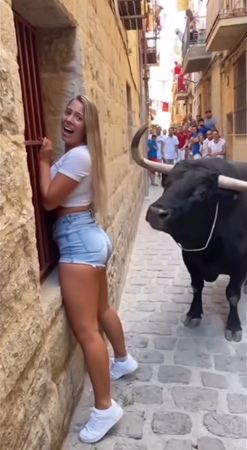
A large black bull rounded the corner.
Moving fast.
Much too fast.
For a split second, nobody moved.
Then chaos erupted.
People screamed.
Someone shouted warnings.
Crowds scattered in every direction.
The festive atmosphere disappeared instantly, replaced by panic.
Later, investigators would suggest that a small group of animals had become separated from their handlers after becoming overwhelmed by noise and confusion.
But in that moment, Sofia knew none of that.
All she knew was that an enormous bull was charging down a narrow street.
And she had nowhere to go.
Her heart slammed against her ribs.
Instinct screamed at her to run.
But the street was too crowded.
Too narrow.
Too chaotic.
People pushed past each other searching for safety.
Doorways filled.
Escape routes vanished.
Within seconds, Sofia found herself trapped against the ancient stone wall.
Her palms scraped against the rough surface as she pressed backward desperately.
The stone offered no protection.
No shelter.
Just a dead end.
The bull kept coming.
Each step seemed to shake the ground.
Its massive body looked even larger up close.
Powerful muscles moved beneath its dark coat.
Its horns curved outward like polished blades.
Every instinct inside her screamed danger.
Fear consumed her completely.
Tears filled her eyes.
Her breathing became frantic.
She searched desperately for somewhere to hide.
Anywhere.
Then she spotted a narrow recess between a doorway and an iron-barred window.
It wasn’t much.
But it was all she had.
She squeezed herself into the tiny space, flattening against the wall.
Maybe the animal wouldn’t notice her.
Maybe it would continue past.
Maybe—
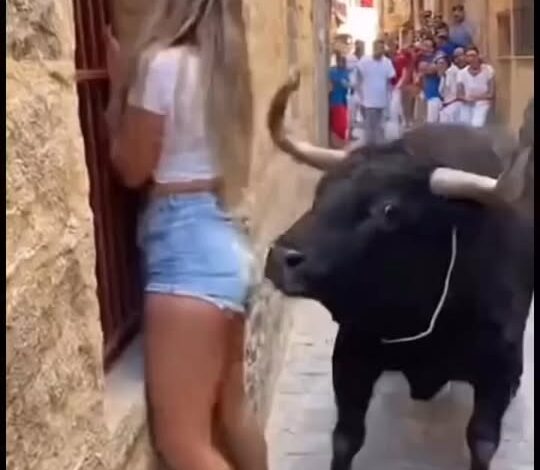
The bull stopped.
Directly behind her.
Silence swallowed the street.
The crowd froze.
Even the music seemed distant now.
Muted.
Unreal.
Sofia could hear nothing except her own heartbeat.
The animal’s breathing.
And the terrible certainty that she was out of options.
She closed her eyes.
Tears streamed down her face.
Her entire body trembled uncontrollably.
This was it.
At least, she thought it was.
The bull stood so close she could feel its breath against her back.
Warm.
Heavy.
Real.
She waited for impact.
For pain.
For something.
Anything.
But nothing happened.
Seconds passed.
Then more.
The bull remained perfectly still.
The massive animal lowered its head slightly.
Its nostrils flared.
It seemed almost curious.
Confused.
Assessing.
Witnesses later described the scene as surreal.
No one dared move.
No one dared speak.
The entire street seemed suspended in time.
Then something extraordinary happened.
The bull gently touched Sofia’s back with its nose.
Not aggressively.
Not violently.
Carefully.
Almost cautiously.
Sofia sobbed harder.
She was too frightened to understand what was happening.
Too overwhelmed to process it.
All she knew was that she was still alive.
Still standing.
Still breathing.
And somehow the animal had not attacked.
The moment stretched endlessly.
Then trained handlers finally appeared.
Moving slowly.
Patiently.
Speaking in calm voices.
They approached with deliberate caution, guiding the animal’s attention away from Sofia.
The bull lifted its head.
Paused.
Then turned.
To the astonishment of everyone watching, it allowed itself to be led away.
Just like that.
The danger was over.
The instant the animal disappeared around the corner, Sofia’s legs gave out.
She collapsed to the ground.
Months later, she would still remember the overwhelming relief that followed.
The adrenaline.
The shock.
The realization of how close she had come to tragedy.
Locals rushed to help her.
Someone brought water.
Others offered blankets and reassurance.
Medical personnel arrived quickly, confirming she had escaped without physical injury.
But emotionally, the experience would stay with her forever.
News of the incident spread rapidly.
Videos appeared online.
News outlets across multiple countries picked up the story.
Experts were asked to explain what had happened.
Animal behavior specialists later noted that bulls, like all animals, do not react identically in every situation.
Stress, confusion, noise, and unfamiliar environments can influence behavior in unpredictable ways.
Many believed the animal had entered a temporary assessment phase—pausing to interpret its surroundings rather than reacting aggressively.
They emphasized one important point repeatedly:
No one should ever expect such behavior.
Bulls remain powerful and unpredictable animals.
Safety precautions exist for a reason.
Yet despite the scientific explanations, those who witnessed the moment struggled to forget it.
For Sofia, the experience became something more than a frightening memory.
It became a lesson.
A reminder of how fragile life truly is.
How quickly ordinary moments can transform.
How important awareness and caution can be when navigating unfamiliar places.
Back home in Mexico, friends asked her about Spain constantly.
They expected stories about architecture.
Food.
Music.
Instead, she often found herself talking about that narrow street.
That impossible moment.
The warmth of the animal’s breath against her back.
The terrifying silence.
The overwhelming gratitude she felt afterward.
“It taught me humility,” she later admitted during an interview.
“Not just because I was afraid. Because I realized how little control we sometimes have over what happens next.”
Today, Sofia still loves traveling.
She still seeks cultural experiences and authentic connections.
But she carries a deeper understanding with her now.
An understanding that beauty and danger can exist side by side.
That traditions deserve respect.
That animals deserve respect.
And that life can change in a matter of seconds.
The Andalusian festival remains one of the most unforgettable experiences of her life.
Not because of the music.
Not because of the food.
Not because of the photographs she took.
But because of one suspended moment between fear and survival.
One moment when time seemed to stop.
One moment that reminded her just how precious every ordinary day truly is.
And every time she remembers that warm breath against her back, she remembers something else too:
Sometimes the most profound lessons arrive without warning—and leave you seeing the world differently forever.