At first glance, it looked horrifyingly real.
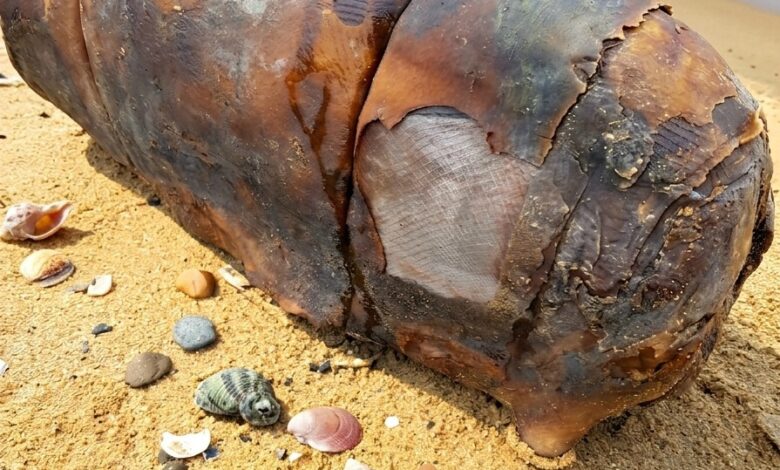
Half-buried in wet sand near the tide line, the object twisted across the beach like something that had washed ashore from a nightmare. Its surface was dark, cracked, and strangely organic-looking, with torn layers curling outward like exposed flesh. Sunlight reflected off slick patches of seawater clinging to it, making parts of the thing glisten in ways that felt deeply unnatural. For several long seconds, I genuinely thought I was staring at some kind of decomposing creature — or worse, part of one.
The beach around me had been quiet until that moment.
Just waves rolling steadily toward shore.
Wind pushing salt into the air.
Seagulls drifting overhead without urgency.
But the instant I noticed the object, the entire atmosphere changed. The ordinary sounds of the shoreline suddenly felt distant beneath the rush of adrenaline flooding my chest. I slowed instinctively, uncertain whether to move closer or back away entirely.
Something about it triggered ancient instincts immediately.
Its texture resembled torn muscle.
The frayed strands looked disturbingly like exposed tissue.
Even its shape carried an unsettling suggestion of something once alive.
I remember standing there trying to rationalize what I was seeing while my imagination sprinted far ahead of me. Every possibility my brain produced became darker than the last. Was it some unknown sea creature? Part of a whale? Industrial waste tangled with organic matter? Had something died here recently and washed apart in the surf?
Fear has a remarkable ability to fill empty spaces with stories before logic ever arrives.
And beaches, perhaps more than most places, invite that kind of imagination. The ocean constantly delivers fragments from worlds people rarely see directly. Strange fish. Broken boats. Weathered bones. Objects transformed beyond recognition by salt, pressure, and time. Standing beside the surf, it never feels impossible that something ancient or disturbing might suddenly appear from beneath the water.
So I approached cautiously.
The closer I moved, the stranger the object became. What initially looked biological started revealing hints of something artificial beneath the damage. Torn black layers peeled back to expose tightly woven fibers underneath — almost like braided tendons, except too uniform, too deliberate. Sand clung to the strands while seawater dripped slowly from deep cracks running along its surface.
Then realization arrived all at once.
It wasn’t a creature.
It was an old cable.
Most likely submarine or industrial — something once laid deliberately beneath water to carry electricity, communication signals, or data across enormous distances. Years of exposure had transformed it completely. Sunlight had scorched and hardened the outer shell. Saltwater had eaten away at protective layers. Waves had battered and twisted it against rocks until the inner structure burst outward in ragged strips.
Nature and decay had collaborated to turn discarded infrastructure into something disturbingly lifelike.
Standing there, I felt relief first.
Then embarrassment.
Then something heavier.
Because the object still looked grotesque even after I understood what it was. If anything, knowing its true identity somehow made it sadder. What had once represented human progress — connection, energy, technology — now lay rotting anonymously on a beach, mistaken for a corpse because we had abandoned it long enough for nature to begin reclaiming it.
That realization lingered with me.
The cable became harder to ignore once I stopped seeing it as a false monster and started seeing it as evidence. It was a fragment of human industry stranded at the edge of the natural world, quietly decaying in plain sight while people walked past carrying towels, drinks, and sunscreen without thinking much about where discarded infrastructure eventually ends up.
The ocean remembers everything we throw into it.
Even the things we stop thinking about.
That cable had likely once carried enormous importance. Maybe it transmitted data between coastal systems. Maybe it powered machinery far offshore. Perhaps entire conversations, transactions, signals, or communications once raced invisibly through the wires now spilling out onto the sand like exposed veins.
Now it carried only silence.
And a warning.
The beach suddenly felt different after that. Everywhere I looked, I started noticing signs of humanity tangled into the landscape in ways I normally filtered out automatically — fragments of plastic buried beneath seaweed, fishing line twisted around driftwood, faded bottle caps polished smooth by waves. The shoreline no longer looked untouched. It looked layered with forgotten remnants of systems designed far away from the people now sunbathing nearby.
What unsettled me most was realizing how quickly my mind had chosen horror over explanation.
Before logic had a chance to catch up, I wanted the object to be mysterious. Dangerous. Alive. Some primitive part of the brain seems almost drawn toward dramatic interpretations, especially in unfamiliar environments where uncertainty already exists. Fear sharpens imagination. And once imagination begins constructing stories, reality has to work much harder to interrupt them.
That instinct explains why so many ordinary things become myths online now. A blurry shape becomes a monster. A strange sound becomes evidence of conspiracy. A damaged object becomes proof of something terrifying because human beings are naturally wired to complete incomplete pictures emotionally before we complete them rationally.
The cable on the beach became a small reminder of that tendency.
Not just our habit of polluting oceans and forgetting the consequences, but our habit of projecting fear onto things we do not immediately understand.
By the time I finally walked away, the tide had started inching back toward the cable again. Waves rolled around it gently, dragging foam through its exposed fibers before retreating once more. From a distance, it looked eerie all over again — half machine, half carcass, impossible to fully separate from the unsettling story my mind had initially invented around it.
And maybe that is what stayed with me most afterward.
Not the relief of discovering it wasn’t a body.
But the realization that the world is already full of objects transformed by neglect into things strange enough to resemble nightmares.
Next time I walk along the shore, I’ll still search for shells, smooth stones, and driftwood carried in by the tide. But I know now I’ll also be looking differently at the debris scattered between them, wondering what hidden histories lie buried beneath salt and sand.
Because sometimes the most haunting things washed ashore are not creatures at all.
They are the remains of our own presence, returned to us by the sea in forms we barely recognize anymore.