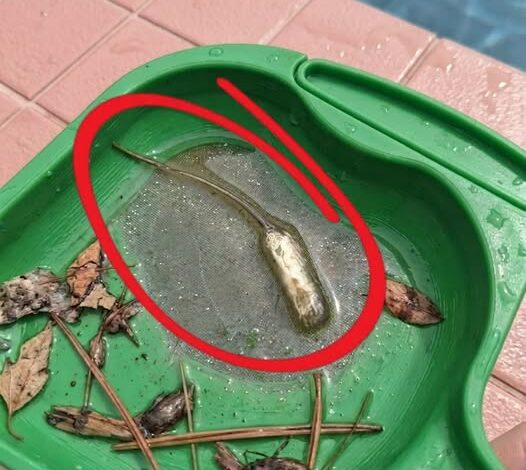
The moment I scooped it out of the pool, I knew I wasn’t looking at anything familiar.
It rested quietly in the net, pale and oddly shaped, with a long, thread-like tail trailing behind it. At first glance, it looked like something that had no business being in a backyard pool.
The longer I stared, the worse my imagination became.
I opened my phone and started searching.
Within minutes, I was scrolling through photographs of parasites, invasive species, and alarming stories posted by strangers online. Every image seemed just similar enough to make me uneasy, yet none matched perfectly. Somehow, that uncertainty made the mystery even more unsettling.
I kept glancing back at the creature in the net.
Its long “tail” seemed almost too strange to be real.
Was it dangerous?
Could it sting?
Had there been more of them in the water?
The questions multiplied much faster than the answers.
Eventually, after comparing several reliable insect identification resources, I found an exact match.
It wasn’t a parasite.
It wasn’t an invasive monster.
It was a rat-tailed maggot—the larval stage of certain hoverflies (also called drone flies).
Suddenly, everything made sense.
That remarkable “tail” wasn’t a tail at all.
It was a breathing tube, technically called a siphon, which allows the larva to live in stagnant or oxygen-poor water while reaching the surface for air. The body remains submerged, feeding on decaying organic matter, while the long tube functions like a snorkel.
It looked bizarre because it was perfectly adapted to its environment.
As strange as they appear, rat-tailed maggots are generally harmless to people. They do not bite, sting, or seek out humans. Finding one in a swimming pool usually means it wandered in from nearby standing water, clogged drains, or another damp area where hoverflies may lay eggs. Because pools are regularly filtered and treated, they are not an environment where these larvae typically thrive.
I emptied the net, checked the pool skimmer, and made sure the filtration system was running properly.
Then I laughed at myself.
Only a few minutes earlier, I’d been convinced I had discovered something straight out of a science-fiction movie.
Instead, I’d met one of nature’s more unusual insects.
The experience reminded me how powerful uncertainty can be.
When we don’t recognize something, our minds often rush toward the most dramatic explanation. In reality, many unfamiliar creatures are simply ordinary species with extraordinary adaptations that help them survive.
Sometimes the biggest difference between fear and fascination is knowing a name.
Once I understood what I was looking at, the mystery disappeared.
The “monster” became a hoverfly larva.
The frightening tail became a breathing tube.
And what had seemed deeply unsettling turned into one more reminder that nature is often stranger than fiction—but far less frightening than our imaginations first suggest.