Most parents brace themselves before entering a teenager’s bedroom. Experience teaches them to expect chaos in manageable forms: piles of laundry draped over chairs, empty snack wrappers hidden beneath the bed, mystery cups growing science experiments on desks, and enough dust to suggest nobody has opened the curtains in weeks. Usually, the mess is annoying but predictable — the ordinary evidence of adolescence unfolding behind a closed door.
But every once in a while, something hidden inside that clutter triggers a completely different reaction.
Not irritation.
Fear.
The kind that arrives instantly and irrationally before logic has time to intervene.
For one mother, what began as an ordinary afternoon cleaning session became a full-scale psychological horror scene over something buried in the shadows beside her son’s nightstand. :contentReference[oaicite:0]{index=0}
The day had started innocently enough. Armed with trash bags, disinfectant spray, microfiber cloths, and the grim determination every parent eventually develops, she decided it was finally time to tackle her son’s bedroom properly. The room itself looked exactly as expected — clothes spilling from drawers, tangled charging cables across the floor, soda cans balanced precariously on shelves, textbooks buried beneath snack wrappers, and the faint smell of stale air that only teenage bedrooms seem capable of producing. :contentReference[oaicite:1]{index=1}
Still, she worked through the clutter methodically.
One pile at a time.
One forgotten object after another.
Eventually she reached the narrow gap between the heavy wooden nightstand and the baseboard wall — one of those neglected spaces nobody cleans often enough because it requires moving furniture and confronting whatever dust-covered mysteries have accumulated there over time.
That was when she saw it.
At first, her brain refused to categorize the object at all.
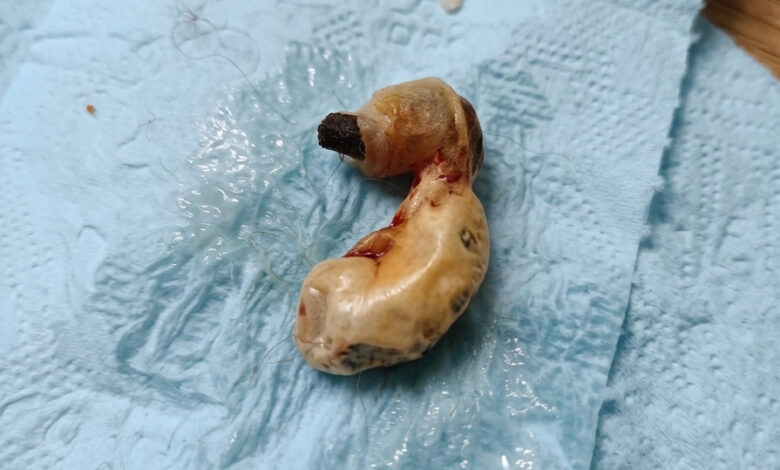
She froze immediately, crouched halfway to the floor with a cleaning cloth still hanging limply from one hand. Deep inside the dim corner sat something small, misshapen, and disturbingly organic-looking. It was partially hidden beneath layers of dust and tangled hair, making its outline impossible to identify clearly. The object looked soft and hardened at the same time, as though it had once been alive before drying into some unnatural form.
A cold wave of dread moved through her chest instantly. :contentReference[oaicite:2]{index=2}
That is the strange thing about fear: it rarely waits for evidence.
Within seconds, her imagination began constructing possibilities far more horrifying than reality. The dusty fibers clinging to the object resembled fur or mold. Its uneven texture looked biological. Something about the shape suggested decay. The longer she stared, the more sinister it appeared. Her mind desperately searched for familiar explanations but rejected each one immediately.
Spider cocoon?
Dead mouse?
Some kind of fungus?
An insect nest?
Every possibility felt disgusting.
And every second she spent staring made the thing seem more alive somehow. She later admitted that after enough anxious observation, she genuinely began convincing herself the object was subtly moving in the shadows. :contentReference[oaicite:3]{index=3}
Human perception becomes unreliable remarkably quickly once fear enters the picture.
The brain is wired to interpret uncertain shapes as potential threats because throughout human history that instinct often meant survival. It is better evolutionarily to mistake harmless debris for danger than overlook something truly dangerous. The problem is that instinct still activates today over things far less life-threatening than predators lurking in caves.
A dusty corner becomes terrifying because uncertainty allows imagination to fill empty spaces aggressively.
And once imagination takes control, ordinary objects begin mutating psychologically into monsters.
She stood there frozen long enough that her son eventually wandered into the doorway to see what had stopped the cleaning process entirely. One glance toward the corner was apparently enough to unsettle him too. He leaned cautiously against the frame, eyes narrowing while trying to identify the object from a safe distance. Even he looked half-prepared to sprint down the hallway if the thing suddenly moved. :contentReference[oaicite:4]{index=4}
For several tense moments, mother and son found themselves locked in silent confrontation with something that might very well have been nothing at all.
That shared fear somehow intensified the atmosphere further. When another person mirrors your anxiety, even silently, the threat begins feeling more legitimate. Neither of them wanted to move closer, yet neither wanted to leave the room without knowing what sat hidden beside the nightstand.
Eventually, however, the absurdity of the standoff became impossible to ignore.
The object had to be dealt with somehow.
So gathering every ounce of courage she could manufacture, the mother reached for a tissue from a nearby box, folding several layers together as a flimsy protective shield between her fingers and the unknown thing waiting in the shadows. She crouched lower, stretched her arm carefully into the dusty gap, and pinched the object between trembling fingertips. :contentReference[oaicite:5]{index=5}
She braced herself completely.
For movement.
For crunching.
For something wet or alive.
For the possibility that the object would suddenly burst apart into insects or skitter away across the floor.
Instead, the instant she touched it, reality snapped back into place.
The texture felt instantly familiar.
Rubbery.
Dry.
Completely harmless.
She pulled it slowly into the light and stared in disbelief before bursting into shaky laughter almost immediately. The horrifying mystery object was not biological at all. It was simply an ancient piece of chewing gum that had fallen beside the nightstand months earlier and remained there long enough to transform into something visually grotesque. Dust, lint, hair, and debris had coated the gum over time until its original identity became completely unrecognizable. :contentReference[oaicite:6]{index=6}
All that fear.
All those terrifying theories.
All generated by old candy.
The emotional release hit almost violently once the truth became obvious. The laughter started nervous and breathless — the body’s way of releasing tension after preparing for danger that never arrives. But within moments both mother and son were laughing genuinely at how quickly their imaginations had escalated the situation into something worthy of a horror film.
And beneath the humor sat a surprisingly profound realization.
Human beings are astonishingly easy to frighten when information is incomplete.
A vague shape in dim lighting becomes sinister.
A strange noise at night becomes an intruder.
A harmless symptom becomes catastrophic illness after enough internet searching.
An ordinary object coated in dust becomes evidence of something monstrous hiding in the corner of a bedroom.
Fear thrives inside uncertainty because the mind hates unanswered questions. It rushes instinctively toward dramatic explanations long before slower, calmer logic catches up.
That is partly why horror works so effectively psychologically. Most terrifying things remain frightening precisely because they are unclear. Shadows. Unidentified noises. Ambiguous movement. The imagination almost always invents something worse than reality itself.
In this case, reality turned out to be deeply ordinary.
Just gum.
Old, forgotten gum transformed by time, dust, and poor lighting into something terrifying enough to stop two people in their tracks.
Still laughing softly, the mother tossed the legendary “creature” into the trash bag, wiped dust from her hands, and returned to vacuuming the carpet while her son shook his head in embarrassment nearby. :contentReference[oaicite:7]{index=7}
The tension dissolved instantly once the truth arrived.
But the story survived.
Because years from now, they probably won’t remember the cleaning itself.
They’ll remember the moment they stood frozen together in a messy bedroom, genuinely convinced a wad of dusty chewing gum might be some horrifying creature lurking beside the nightstand.
And perhaps that is what makes moments like this oddly meaningful.
They remind us how fragile perception really is.
How quickly fear rewrites reality.
And how often the monsters we imagine in dark corners turn out to be nothing more than ordinary things waiting patiently for someone brave enough to finally pick them up.