Dolly Parton spent decades hiding something beneath the rhinestones.
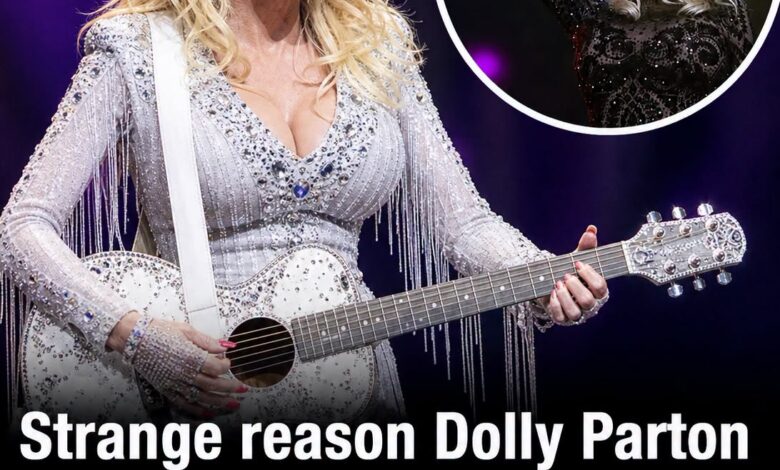
Fans noticed it in photographs, television appearances, concerts, and award shows. No matter how extravagant the outfit became, one detail remained surprisingly consistent: Dolly’s arms were usually covered.
Long sleeves.
Gloves.
Sheer fabric.
Rhinestone cuffs.
Even when a costume appeared revealing everywhere else, her arms often remained carefully concealed.
Naturally, people started wondering why.
The rumors became increasingly dramatic. Some claimed she was secretly covered from shoulder to wrist in tattoos. Others imagined elaborate sleeves hidden beneath the glamorous costumes. There were even theories that Dolly’s wholesome country image concealed a rebellious private identity she didn’t want the public to see.
The truth was both simpler and far more personal.
Dolly did have tattoos.
But they weren’t what people imagined.
They were small, delicate, colorful designs connected to something she had dealt with for years: scars.
Dolly explained that her skin had a tendency to develop keloid scarring. Unlike an ordinary scar that may gradually flatten and fade, a keloid can become raised and extend beyond the original injury. Depending on the person and their skin, those scars can remain highly visible.
For someone whose appearance had become part of an internationally recognized image, Dolly found herself looking for a way to make peace with marks she didn’t particularly enjoy seeing.
Her solution was characteristically Dolly.
If something bothered her, she would make it prettier.
Rather than treating tattoos as rebellion, she used them almost like decoration over difficult memories.
The designs she chose reflected the imagery people already associated with her.
Butterflies.
Flowers.
An angel.
Soft colors.
Pastels.
Nothing aggressive.
Nothing resembling the dramatic tattoo sleeves imagined by fans.
They were intimate little pieces of artwork designed not to shock the world but to help Dolly feel comfortable inside her own skin.
That distinction matters.
For Dolly, appearance had always involved transformation.
She famously built her public image around exaggeration. The towering blond hair, enormous eyelashes, sparkling costumes, impossibly high heels, bright lipstick, and carefully sculpted silhouette weren’t accidental.
She knew exactly what she was doing.
Dolly often joked about her appearance before anybody else could.
It was one of her greatest defenses.
Critics could call her artificial, but she had already beaten them to the punch line.
She never pretended the hair was natural.
She never pretended the glamorous image happened without effort.
She constructed “Dolly Parton” deliberately and then wore that creation with such confidence that what might have looked ridiculous on someone else became iconic on her.
The tattoos belonged to that same philosophy.
Something imperfect didn’t necessarily need to be erased.
Sometimes it could be transformed.
A scar could become a flower.
A mark could disappear beneath a butterfly.
Something associated with discomfort could become something chosen.
There is a quiet power in that.
For years, however, the secrecy surrounding Dolly’s arms created a mythology much larger than the tattoos themselves.
Every new photograph became evidence for amateur detectives.
Was there something visible beneath that sheer sleeve?
Was that a flower near her chest?
Was the makeup covering something?
Why was she wearing gloves again?
Dolly seemed amused by the fascination.
The irony was obvious.
Here was a woman who had spent her entire career wearing some of the loudest clothes imaginable, yet the public became obsessed with the tiny pieces of artwork she preferred to keep private.
Eventually, she acknowledged that she had several tattoos, while making clear that she wasn’t extensively tattooed.
They had a purpose.
They covered scars.
And she liked pretty things.
Mystery solved.
Except the story says something larger about Dolly Parton.
She understood that people don’t owe the world unrestricted access to their bodies simply because they’re famous.
Dolly could be extraordinarily open while still maintaining boundaries.
She shared stories about growing up poor in Tennessee.
She talked about marriage.
She joked about cosmetic procedures.
She discussed ambition, faith, business, heartbreak, and the enormous amount of work behind her success.
But she still decided what belonged to her.
Her body was included in that boundary.
If she wanted to cover her arms, she covered them.
If she wanted tattoos over scars, she got them.
If she wanted the tattoos to remain mostly unseen, that was her choice too.
The sleeves weren’t necessarily shame.
They could simply be privacy.
And privacy was something Dolly understood exceptionally well.
Her husband, Carl Dean, was perhaps the greatest example.
For decades, one of the world’s most famous entertainers managed to protect the privacy of the man she loved because he didn’t want celebrity.
She knew fame could become invasive.
She also knew that boundaries had to be defended intentionally.
Her tattoos existed within that same complicated relationship between public fascination and private ownership.
But focusing too heavily on what Dolly concealed risks missing what she spent her life revealing.
Because the most important marks she left weren’t underneath her sleeves.
They were everywhere else.
Long before Dolly Parton became a business empire, she was a songwriter.
That was the identity beneath everything.
She could take an emotion that felt impossible to explain and reduce it to a few lines that millions of strangers immediately understood.
Heartbreak became “I Will Always Love You.”
Jealousy became “Jolene.”
The exhausting frustrations of working women became “9 to 5.”
Poverty became stories rather than shame.
Dolly wrote about people who didn’t usually control the microphone.
Women trapped in difficult circumstances.
People working jobs that barely paid enough.
Lovers who knew they had to leave.
Families surviving without money.
Dreamers whose ambitions seemed ridiculous to everyone except themselves.
She knew those people because she had been one of them.
Dolly grew up in a large family with very little money in rural Tennessee. Poverty wasn’t an abstract subject she discovered after becoming famous.
She remembered it.
She understood what it meant for children to grow up surrounded by love but lacking material advantages.
That history eventually shaped one of the most consequential parts of her legacy.
Books.
In 1995, Dolly launched the Imagination Library, initially serving children in her home county in Tennessee.
The idea was beautifully straightforward: give young children books.
Not complicated educational policy.
Not a glamorous celebrity campaign.
Books arriving directly at home, allowing children to experience the simple excitement of receiving something addressed to them.
The program expanded dramatically.
Millions of books eventually reached children far beyond Tennessee.
For some families, those books became part of bedtime routines.
For some children, they helped build an early relationship with reading.
And for parents struggling financially, they represented something meaningful arriving without another bill attached.
That work revealed another side of Dolly’s philosophy.
She knew what it felt like to come from somewhere people underestimated.
She spent much of her adulthood making sure other people’s starting points didn’t have to determine their destinations.
Her compassion also extended beyond childhood literacy.
Over the years, Dolly became known for supporting numerous causes and responding to crises affecting communities around her.
She also expressed support for people who had often felt unwelcome in traditional country spaces.
That included LGBTQ+ fans who embraced Dolly as an icon long before every corner of mainstream entertainment treated such support as routine.
Dolly’s approach was characteristically uncomplicated.
She emphasized love.
Acceptance.
The belief that people deserved dignity even when their lives didn’t resemble her own.
She also spoke publicly against racism and supported racial equality, including expressing support for the Black Lives Matter movement.
Her willingness to say those things mattered because of where she stood culturally.
Dolly wasn’t speaking exclusively to audiences already inclined to agree with her.
Her fan base crossed generations, regions, religions, and political identities.
She had spent decades becoming someone people trusted.
And she frequently used that unusual position to encourage kindness rather than contempt.
She rarely sounded like she was delivering a lecture.
That may have made her influence stronger.
Dolly understood how to say serious things without surrendering warmth.
She could challenge an assumption and then make someone laugh.
She could defend people without turning compassion into a performance.
That ability reflected something deeper than celebrity instinct.
She knew what it meant to be underestimated.
For much of her career, people saw the enormous hair and revealing costumes and assumed the woman underneath couldn’t possibly be as intelligent as the people managing her.
They were wrong.
Dolly wrote songs.
Owned publishing rights.
Built businesses.
Developed Dollywood.
Created charitable programs.
Navigated decades of changing entertainment culture.
And maintained extraordinary control over an image that outsiders sometimes mistook for evidence that she lacked control.
The joke was often on them.
Dolly knew exactly who Dolly was.
Perhaps that is why the story of her scars and tattoos feels so appropriate.
A scar is something the body creates after being hurt.
You don’t necessarily choose its shape.
You don’t decide how visible it becomes.
You simply discover what remains after healing.
Dolly couldn’t always control that process.
But she could control what happened next.
So she added butterflies.
Flowers.
An angel.
Color over discomfort.
Beauty over something she didn’t want to stare at.
Then she covered the whole thing in rhinestones and went back to work.
There is almost a metaphor hiding there, although Dolly probably would have made a joke before allowing it to become too serious.
Her entire career was built around that kind of transformation.
Poverty became songwriting material.
Heartbreak became music.
Being underestimated became motivation.
Fame became philanthropy.
Scars became flowers.
She didn’t pretend painful things hadn’t happened.
She simply refused to let pain have the final creative decision.
That is why the mystery behind Dolly Parton’s sleeves ultimately feels so small compared with the woman wearing them.
Yes, there were scars.
Yes, there were tattoos.
Yes, there were parts of herself she preferred not to display.
But Dolly spent a lifetime showing the world something far more revealing than bare skin.
She showed what she believed.
She believed poor children deserved opportunity.
She believed women could be glamorous and formidable at the same time.
She believed people pushed to society’s margins still deserved love and respect.
She believed where you began didn’t determine where you could go.
And she believed something damaged could still become beautiful.
Her tattoos may have covered scars that only a handful of people ever saw clearly.
Her larger work did the opposite.
It made her mark impossible to hide.
It exists in songs playing decades after they were written.
In performers who learned that femininity didn’t require surrendering power.
In communities touched by her generosity.
In LGBTQ+ fans who heard acceptance from someone they admired.
In children opening books delivered through the Imagination Library.
In millions of people who saw a woman emerge from poverty, refuse to apologize for being “too much,” and build an extraordinary life anyway.
The world spent years wondering what Dolly Parton had hidden beneath her sleeves.
Perhaps the better question was what she left uncovered.
Her humor.
Her compassion.
Her ambition.
Her faith.
Her songs.
Her generosity.
Her belief that life’s scars didn’t have to remain ugly simply because they hurt when they were made.
The butterflies and flowers on her skin were private.
The mark Dolly Parton left on everyone else was anything but.