What Witnesses Noticed About Dolly Parton at One of Her Final Public Outings Before Her Passing – Details

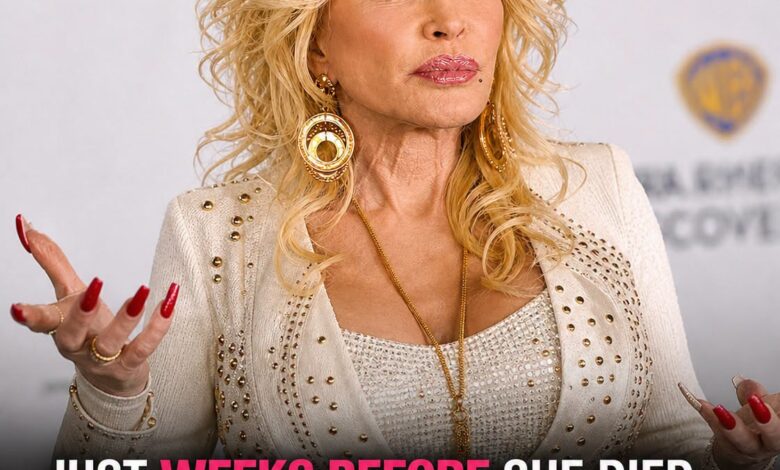
By the time Dolly Parton stepped into public view at Cornersville, the people closest to her already understood something the crowd did not.
Every step cost her.
The woman who had spent decades gliding onto stages in towering heels now moved carefully. People stayed close enough to steady her if necessary. Her pace had slowed, and beneath the immaculate makeup and familiar blonde curls was a physical fragility that could no longer be completely hidden.
But then Dolly smiled.
And for a moment, everything looked normal again.
The stilettos were still there.
The hair was still enormous.
The outfit still sparkled.
The jokes arrived exactly when they were supposed to.
Whatever was happening inside her body, Dolly Parton had made a decision before appearing in front of those people:
Illness was not going to introduce her.
She would introduce herself.
That distinction had defined much of her life.
Dolly understood image better than almost anyone in entertainment. She never pretended the famous version of herself happened accidentally. She built it deliberately, exaggerating femininity until it became almost theatrical: towering wigs, rhinestones, impossible heels, bright nails and clothes designed to make disappearing into a crowd absolutely impossible.
People sometimes mistook the spectacle for vanity.
It was closer to armor.
Behind it stood an intensely private woman who had spent decades deciding exactly how much of herself the public was allowed to have.
Fans could have the songs.
They could have the jokes.
They could have the sparkle.
They could have stories about growing up poor in the Tennessee mountains and dreaming beyond everything she could see.
But certain rooms remained closed.
Her marriage to Carl Dean was one of them.
Her deepest fears were another.
And during her final months, her health increasingly became one too.
That is what makes those last appearances so difficult to revisit.
Once you know someone was struggling, old footage changes.
A pause becomes noticeable.
A careful step suddenly matters.
A smile you once accepted without question begins to look like work.
At Cornersville, Dolly was still doing what she had done thousands of times before: giving people the version of herself they had traveled to see.
She wasn’t going to arrive looking defeated.
She wasn’t going to turn the occasion into a public bedside vigil.
She came as Dolly Parton.
Even if becoming Dolly Parton that day required help.
Even if those heels made absolutely no practical sense.
Especially then.
Because practicality had never been the point.
The stilettos were part of the language.
So were the hair, the makeup and the perfectly timed humor.
They communicated something stronger than words:
I’m still here.
People around her reportedly noticed the difference. She walked more slowly. Those assisting her appeared unusually attentive. There was an unmistakable delicacy to her movements.
Yet when it was time to perform the familiar ritual of celebrity—smile, wave, speak, joke—something inside her seemed to switch on.
That transformation wasn’t necessarily deception.
It may have been generosity.
Dolly had spent her career understanding what people came to her for.
They came for escape.
They came because her songs could turn humiliation into defiance and heartbreak into something survivable.
They came because she could discuss poverty without making poor people feel small.
They came because she could be outrageous without seeming cruel.
They came because even after achieving unimaginable wealth and fame, she somehow retained the ability to make strangers feel as though she were talking directly across a kitchen table.
Dolly made people feel better.
And as her own circumstances became harder, she appeared reluctant to stop doing that.
When questions arose about her health, she often softened them.
There were problems, certainly.
There were appointments.
There were reasons plans had to change.
But the language remained reassuring.
Nothing too frightening.
Nothing fans needed to lose sleep over.
She could joke about it.
She could keep working.
There were songs to write.
Projects to finish.
Ideas still demanding attention.
Songwriting, she suggested, remained therapeutic.
That statement carried more weight than it initially seemed to.
For Dolly, songwriting had always been more than employment.
Before the businesses, awards, theme parks and global recognition, there were words.
She had learned early that pain became more manageable once it had verses.
If something hurt, she could write around it.
If someone broke her heart, she could give the heartbreak a melody.
If poverty humiliated her, she could transform it into a story.
If the world underestimated her, she could write another song and make the world listen.
So it makes sense that she would continue writing when her own body became something she could no longer fully command.
You cannot negotiate with serious illness through sheer personality.
You cannot charm a diagnosis.
You cannot rhinestone your way out of physical decline.
But you can decide what you do with the hours that remain.
Dolly worked.
Behind the public appearances, however, life was becoming smaller.
The gates closed.
The trusted circle tightened.
Medical care replaced some of the routines that had structured her life for decades.
People who loved her saw what the public mostly didn’t: the fatigue that could not be concealed indefinitely, the physical cost of treatment, the vulnerability that existed once the lashes came off and the performance ended.
That contrast is perhaps the most haunting part.
Public Dolly remained almost indestructible.
Private Dolly was human.
And she knew it.
There is something profoundly lonely about being the person everyone expects to make things lighter.
When you have built an identity around resilience, people begin believing resilience means invulnerability.
They forget that the funny person cries.
That the strong person gets frightened.
That the caretaker sometimes needs carrying.
Dolly had spent a lifetime making difficulty look manageable.
She had turned a childhood without much money into colorful folklore.
She transformed professional rejection into ambition.
She converted heartbreak into songs millions eventually used to survive their own.
Even aging became something she joked about before anyone else could.
That was one of her great defensive gifts.
If Dolly made the joke first, nobody could use it against her.
Illness was different.
There was no clever line capable of changing what was happening.
Still, she found the lines.
“Little health issues.”
A joke.
A reassurance.
Another promise that she was working.
Another message telling fans not to worry too much.
It would be easy to interpret that as denial.
But perhaps Dolly understood perfectly well what she was doing.
Maybe she wasn’t trying to fool herself.
Maybe she was protecting everyone else.
That instinct had shaped much of her public life.
She knew how deeply people had attached themselves to the character she created.
To some, she was a singer.
To others, she was almost family.
They called her Dolly as though they actually knew her.
Children received books because of her.
Families built vacations around Dollywood.
Couples chose her songs for weddings and funerals.
People who had never met her carried her voice through the most intimate moments of their lives.
Dolly understood the emotional contract.
And she kept fulfilling her side of it.
Even when doing so became difficult.
That is why the image of her in those final months feels so powerful.
A physically fragile woman insisting on impossible shoes.
It sounds almost absurd.
Maybe that is exactly why it matters.
The shoes weren’t about comfort.
They represented continuity.
She had spent decades joking about glamour, constructing an exaggerated version of femininity that belonged entirely to her. Illness could weaken her legs, slow her walk and require another person’s arm nearby.
But it couldn’t choose her shoes.
Not yet.
There was defiance in that.
Not the loud kind.
Dolly rarely needed anger to prove strength.
Her rebellion often arrived smiling.
She had done it her entire career.
People called her dumb because of how she looked; she quietly became richer and more powerful.
They treated her as decorative; she wrote songs that became standards.
They expected the poor girl from the mountains to be grateful simply for entering the room; she eventually owned rooms of her own.
They assumed kindness meant weakness.
She repeatedly demonstrated otherwise.
So perhaps it shouldn’t surprise anyone that when her body began taking choices away, Dolly protected the ones she still possessed.
She chose what to wear.
She chose when to appear.
She chose how much to reveal.
She chose what to work on.
She chose when to joke.
She chose which fears remained behind closed doors.
There is a temptation after someone dies to reinterpret every final appearance as a goodbye.
Usually it wasn’t.
People rarely move through their last months with orchestral music playing underneath them.
They make appointments.
Answer calls.
Change plans.
Complain about small things.
Talk about next year.
Keep working.
Hope.
Dolly did too.
That makes the footage harder, not easier.
When she smiled, she may not have been secretly staging some grand farewell.
She may simply have been doing what she had always done.
Showing up.
That was her discipline.
Fame had never been merely something that happened to Dolly Parton. Maintaining it required extraordinary stamina.
Behind the seemingly effortless jokes were decades of schedules, recording sessions, business meetings, performances, rehearsals, interviews and creative decisions.
She worked relentlessly.
And when her physical strength began disappearing, the instinct to work remained.
There was always another song.
Another project.
Another idea.
Another reason tomorrow still mattered.
Perhaps that was one of the ways she faced fear.
Not by pretending death didn’t exist, but by refusing to sit quietly waiting for it.
As long as Dolly was creating something, the future still existed.
A songwriter works for someone who hasn’t heard the song yet.
An author writes for a reader who hasn’t opened the page.
A performer rehearses for an audience that hasn’t arrived.
Creation is inherently forward-looking.
And Dolly kept looking forward.
That may explain why the public reassurances mattered so much to her.
She did not want illness to become the final definition.
After decades spent creating music, businesses, charities and memories, she wasn’t going to let her medical condition swallow the entire story.
She had seen what celebrity culture does when famous people become seriously ill.
The photographs change.
The headlines change.
Suddenly, the person disappears behind medical language.
Every appearance becomes an examination.
Does she look thinner?
Is she walking differently?
Who is holding her arm?
Why was something canceled?
How serious is it?
Dolly had spent her life controlling the frame.
She wasn’t surrendering it easily.
And so she gave the world what she could.
The hair.
The heels.
The sequins.
The jokes.
The familiar voice telling everyone she was still working.
Then the cameras went away.
The gates closed.
And whatever pain existed belonged to Dolly and the people she trusted.
That boundary deserves respect.
Because beneath all the mythology, she was still a woman confronting something every human being eventually confronts:
The body does not care how famous you are.
Awards cannot negotiate with mortality.
Money can purchase extraordinary care, but not immortality.
Millions of people can love you and still be unable to follow you through the final door.
For someone whose personality seemed almost larger than mortality itself, that reality feels especially cruel.
Yet Dolly’s response was remarkably consistent with the rest of her life.
She made what choices remained.
She kept creating.
She kept laughing.
She kept protecting the people around her from more fear than she believed they needed to carry.
And whenever possible, she kept being Dolly.
That is why Cornersville lingers.
Not because she looked exactly as she always had.
She didn’t.
The fragility was there.
Once noticed, it is difficult to ignore.
But so was something else.
Will.
The body was slowing.
The woman inside it had not surrendered her identity.
There she was, surrounded by people ready to catch her if necessary, standing in shoes almost nobody in her condition would have chosen, dressed as though another stage were waiting.
Maybe that was vanity.
Maybe professionalism.
Maybe stubbornness.
Maybe humor.
Maybe all of them.
But it was unmistakably Dolly.
And perhaps that is the most fitting final image.
Not a hospital bed.
Not a diagnosis.
Not the frightening details kept behind the gates.
A woman whose body had begun betraying her but whose sense of self remained fiercely intact.
Blonde hair high.
Makeup perfect.
Sequins catching the light.
Someone close enough to steady her.
A joke ready.
A smile appearing exactly when the crowd needed it.
For decades, Dolly Parton had transformed pain into something other people could bear.
Near the end, she performed that trick one final time.
She carried the frightening part privately.
And gave everyone else the sparkle.
The tragedy is that we now understand what that sparkle may have cost her.
The beauty is that the choice remained hers.
When Dolly could no longer control what her body was doing, she could still control what she gave the world.
And what she gave, right to the end, was the version of herself she had spent a lifetime creating:
Funny.
Defiant.
Generous.
Impossibly glamorous.
Fragile, perhaps, but never reduced to fragility.
She didn’t allow illness to take the microphone.
She kept it in her own hand for as long as she could.
And when the curtain finally came down, the image left behind wasn’t simply of a woman dying.
It was Dolly Parton, still standing.
Still sparkling.
Still trying to make everyone else feel okay.