Mark let the medical report sink toward his lap.
The doctor leaned closer, placed one finger beside the marked result, and began explaining why it mattered.
I barely looked at the paper.
I watched my son.
Less than three hours earlier, Mark had walked into that office irritated and slightly embarrassed that his father had dragged him away from work because an eight-year-old said something strange about juice.
Now he was gripping the report hard enough to wrinkle it.
A few feet away, Lily sat on the examination table with her legs dangling over the edge. Her purple crayon rested beside her hand.
She watched us with the careful expression children get when they know the adults are frightened but aren’t sure whether they’ve caused it.
That nearly broke me.
The doctor kept his voice low.
He had already told Mark not to call Natalie yet. Whatever happened next, he didn’t want Lily placed in the middle of an adult confrontation.
Mark nodded.
I wasn’t sure he heard him.
All I could think about was the half-finished juice box sitting untouched in my car.
Hours earlier, it had looked completely ordinary.
So had everything else.
The day had begun with a birthday present.
It was a gray Tuesday in late October, cold enough that wet leaves clung to the sidewalks and somebody’s furnace scented the neighborhood with the first smoke of the season.
Lily was turning eight that weekend.
Her gift rode buckled into my passenger seat because I’d used too much tape and somehow still managed to wrap it badly.
I expected ten minutes at my son’s house.
Instead, Natalie opened the door before I’d finished knocking.
“Mark’s at work.”
No hello.
The kitchen smelled sharply of lemon cleaner.
The house was strangely quiet.
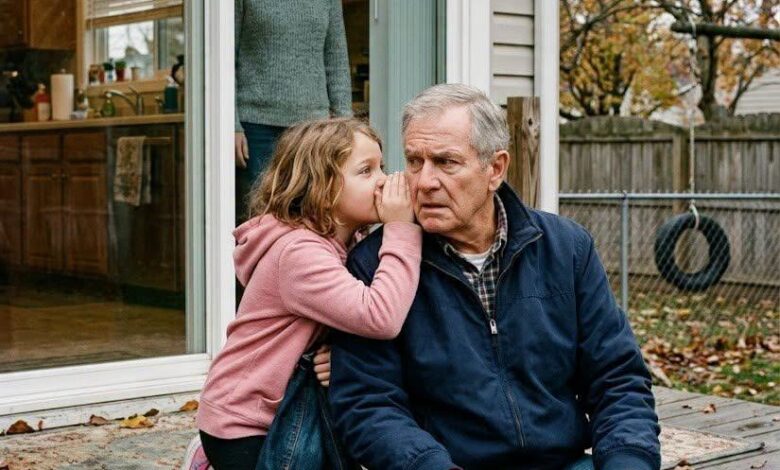
Through the sliding door, I found Lily alone on the tire swing, pink hood over her head, sneakers dragging through the mulch.
When she saw me, she smiled.
Then she checked the kitchen window.
That second glance stayed with me.
I carried her present outside.
Normally Lily attacked wrapping paper as if there were prize money for speed.
That day, she traced one finger along the tape.
“You okay, kiddo?”
“Yeah.”
Too fast.
I spent most of my career around bridges and retaining walls. Serious failures rarely began with something spectacular.
Usually, something small changed first.
A crack.
A shift.
A measurement that didn’t belong.
Lily leaned against my shoulder.
“Grandpa?”
“Yeah?”
“Can you ask Mom to stop putting things in my juice?”
Every word was simple.
Together, they weren’t.
I kept my expression neutral.
“What things?”
“I don’t know. Mom says vitamins.”
She picked at a thread on her sleeve.
“But they make my legs floaty.”
“What does that mean?”
“Like they’re there, but they don’t listen.”
She hesitated.
“Then I sleep really long.”
“How long has that happened?”
“Since summer, maybe.”
Then:
“Sometimes I don’t remember the morning.”
Movement appeared behind the glass.
Natalie was watching us from the kitchen.
Two seconds.
Then she disappeared.
I didn’t confront her.
I didn’t accuse her.
I didn’t even know what I would have accused her of.
I gave Lily her present and fastened the little bracelet around her wrist.
Then I drove to the end of the street and called her pediatrician.
They offered an urgent appointment.
At 12:17, I called Mark.
“Meet me at Lily’s pediatrician.”
“What happened?”
“Don’t call Natalie yet.”
Silence.
Twelve minutes later, Natalie texted me.
She already ate.
I read those words twice.
Then drove back.
Lily came outside carrying a half-finished juice box Natalie had given her for the car.
I placed it untouched in my cup holder.
At 1:38, Lily sat on the paper-covered examination table.
Mark arrived wearing his work badge and an irritated expression.
Then the nurse asked Lily what was wrong.
“The bedtime juice makes me floaty.”
The nurse’s pen stopped.
So did Mark.
After that, nobody treated my concern like an overreaction.
The doctor ordered appropriate blood and urine testing, including toxicology screening. He explained everything to Lily while she drew a purple house on the examination-table paper.
That picture haunted me.
A square.
A roof.
Windows.
The simplest possible drawing of the place where a child is supposed to be safe.
Mark paced.
“Could Natalie have mixed up some vitamin supplement?”
“I hope so.”
Hope was all we had.
Suspicion wasn’t evidence either.
So we waited.
At 3:52, the doctor returned with several printed pages.
He looked at the report.
Then Lily.
Then Mark.
He closed the door.
“Before anyone calls Natalie, I need you to see this.”
Now, as Mark stared at the marked result, the doctor explained that the screening suggested Lily had been exposed to a sedating medication that was not listed among anything prescribed for her.
He immediately added a caution.
A screening result wasn’t the whole story.
Confirmation could be necessary. The result alone couldn’t establish exactly when the exposure occurred, how much she had received, or who had given it to her.
But it was enough to take Lily’s description seriously.
Mark swallowed.
“What kind of medication?”
The doctor explained the category in plain language.
Mark looked at Lily.
“She doesn’t take anything like that.”
“Any prescriptions from another doctor?”
“No.”
“Recent procedure? Dental treatment?”
“No.”
“Anything over the counter you’re routinely giving her?”
“No.”
His voice cracked on the last answer.
The doctor nodded.
“Then we need to proceed carefully.”
My mind raced backward.
Vitamins.
Floaty.
I sleep really long.
Sometimes I don’t remember the morning.
The text.
She already ate.
And the juice box.
“I have the drink,” I said.
Both men looked at me.
“In my car. Natalie gave Lily a half-finished juice box when I picked her up.”
“Did Lily drink any after you took possession of it?”
“No.”
The doctor’s answer was immediate.
“Don’t open it or alter it.”
I nodded.
That juice box suddenly felt less like trash and more like something I had no business touching.
From that point, the day stopped belonging to our family alone.
The doctor explained that Lily’s statements, combined with the medical concern raised by the screening, required additional steps.
Further evaluation.
Documentation.
Appropriate child-safety procedures.
No one declared Natalie guilty.
No one pretended a laboratory screen could tell a complete story.
But nobody was sending Lily home and hoping the problem disappeared either.
Mark pulled out his phone.
Then stopped.
His thumb hovered above the screen.
“What am I supposed to tell my wife?”
“For the moment,” the doctor said, “nothing in front of Lily.”
Mark looked toward his daughter.
She had picked up the purple crayon again.
“Am I sick?” she asked.
The question silenced us.
The doctor moved closer to her.
“We found something that helps us understand why you’ve been feeling strange.”
“Is it bad?”
“It means we’re going to make sure you’re safe and feeling okay.”
Lily considered that.
Then she looked at Mark.
“Daddy?”
He crossed the room.
“Yeah, sweetheart?”
“Is Mom mad?”
Mark’s face collapsed.
“No.”
He answered too quickly.
Then corrected himself.
“I don’t know what Mom is feeling right now.”
Lily looked down.
“Am I in trouble because I told Grandpa?”
I stood before I realized I was moving.
“No.”
She looked at me.
“Listen to me, Lily. You never get in trouble for telling me something makes your body feel wrong.”
Her eyes filled.
“But Mom said vitamins are good.”
I crouched beside her.
“Some vitamins are good. Some medicines help people too. But you don’t have to know what something is to tell us you don’t like how it makes you feel.”
She nodded slowly.
The doctor arranged the next steps while Mark and I stayed with Lily.
For once, neither of us tried to solve anything ourselves.
That mattered.
Angry fathers can jump to conclusions.
So can frightened grandfathers.
Lily didn’t need us constructing a case around her.
She needed us to preserve what we actually knew.
Her words.
Her symptoms.
The medical findings.
The untouched drink.
The timeline.
Everything beyond that needed evidence.
When we finally walked out of the examination room, Lily reached for my hand.
Her new birthday bracelet slid down her wrist.
I’d driven to the house that morning thinking that bracelet was the important thing I was bringing her.
I had been wrong.
What mattered was that I’d shown up.
That I’d noticed the glance toward the kitchen window.
That I’d listened when her answer came too quickly.
That when she said something made her feel “floaty,” I hadn’t demanded that an eight-year-old explain it like a doctor.
And most importantly, I hadn’t confronted Natalie before getting Lily somewhere safe.
There would be plenty of time for questions.
For records.
For explanations.
For whatever the confirmatory testing and subsequent investigation established.
But Lily’s safety couldn’t wait for the entire mystery to be solved.
As we reached the parking lot, I could see my car.
And through the windshield, I could just make out the juice box sitting in the cup holder.
Same bright packaging.
Same little plastic straw.
Same harmless-looking thing I’d seen children carry a thousand times.
Mark stopped beside me.
“Dad.”
I turned.
His face looked twenty years older than it had that morning.
“What if the test is right?”
I understood what he was really asking.
What if my wife did this?
What if my daughter’s home isn’t what I thought it was?
What if I’ve missed it for months?
I refused to answer questions the evidence hadn’t answered yet.
“Then we’ll deal with what the truth is.”
“And if there’s another explanation?”
“Then we’ll deal with that.”
He looked toward Lily.
She was trying to balance her purple crayon across two fingers now.
“So what do we do?”
I looked at my granddaughter.
“We don’t make her carry it.”
That was the only answer I trusted.
The rest would come from doctors, records, proper testing, and people trained to determine what had happened.
But one fact no longer depended on any future result.
Lily had felt something was wrong.
She had tried to describe it with the only language she had.
And she’d trusted me enough to whisper it.
Whatever came next, I would never make her regret that.
Because sometimes a child doesn’t hand you proof.
She hands you a sentence.
And your first responsibility isn’t to solve it.
It’s to listen.