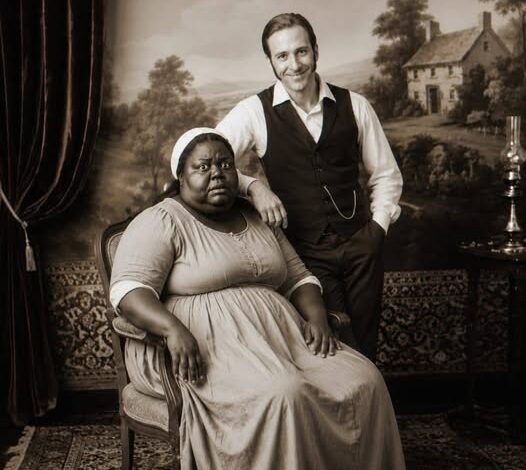
The crowd noticed Benedita the moment she entered the slave market.
In a place where hundreds of lives could be reduced to numbers, prices, and transactions, she was impossible to ignore.
The year was 1857.
The location was Vassouras, one of the most active centers of Brazil’s coffee economy and, with it, one of the many places where human beings were bought and sold as property.
Amid the noise of traders, buyers, and auctioneers, Benedita stood out immediately.
She was tall.
Remarkably tall.
Taller than many of the men surrounding her.
Years of forced labor had built strength into every part of her frame. Her shoulders were broad, her posture steady, and while others lowered their eyes under the weight of scrutiny, Benedita looked straight ahead.
There was something about her presence that resisted submission.
Even in chains.
Even there.
To most people, strength is admirable.
In the slave market, it inspired something else.
Unease.
Potential buyers circled slowly, examining those offered for sale. Conversations drifted through the crowd as casually as discussions about livestock or equipment. Men assessed age, health, endurance, obedience, and physical condition, assigning value to human lives as though character and dignity could be measured in currency.
Again and again, the same observations surfaced.
“Too tall.”
“Too strong.”
“She looks difficult.”
“Who would control her?”
One man shook his head.
Another laughed nervously.
A third described her as dangerous.
The words floated through the marketplace with shocking ease.
To the buyers, they were simple business calculations.
To Benedita, they were something else entirely.
Each comment was a reminder that she had been stripped of the most basic human freedom.
Her future did not belong to her.
Her labor did not belong to her.
Even her body was being discussed by strangers as though it were an object awaiting purchase.
What should have been seen as strength had become a liability.
What should have inspired respect inspired fear.
She had spent years carrying burdens imposed by others.
Now those same qualities were being used to determine her worth.
The bidding began.
Slowly.
Painfully.
Interested buyers stepped forward.
Then hesitated.
Offers remained low.
Faces tightened.
Questions lingered.
Nobody seemed eager to claim responsibility for the woman standing before them.
As time passed, a new humiliation emerged.
Not merely enslavement.
Rejection.
It was one thing to be treated as property.
It was another to be treated as undesirable property.
The distinction may seem small.
It wasn’t.
The hesitation of the crowd carried its own cruelty.
People lost interest.
Conversations shifted elsewhere.
Eyes wandered toward other sales.
Other lives.
Other transactions.
Benedita remained where she stood.
Waiting.
The marketplace operated according to a brutal logic.
Everything had a value.
Everyone had a price.
And when interest faded, so did perceived worth.
By that afternoon, the silence itself seemed to deliver a verdict.
Not only was she enslaved.
She was unwanted.
Even by the system that sought to own her.
History does not tell us exactly what she felt in that moment.
Historical records rarely preserve emotions.
They record names.
Dates.
Sales.
Documents.
Transactions.
The private thoughts of those forced to endure such moments often disappear forever.
But it is difficult to imagine standing there without feeling the crushing weight of it all.
The degradation.
The uncertainty.
The loneliness.
The knowledge that strangers were deciding the course of your life.
Then something changed.
A voice broke the silence.
A bid.
Not loud.
Not dramatic.
Not memorable to most people watching.
Yet for Benedita, it altered everything.
The offer came from a man named Joaquim Lacerda.
Unlike many of the others, he did not immediately dismiss her because of her size.
He did not recoil from her strength.
He did not see only risk.
For reasons history can never fully explain, he saw something different.
Perhaps he saw capability.
Perhaps resilience.
Perhaps determination.
Perhaps simply another human being standing before him.
Whatever his reasoning, his decision changed the trajectory of her story.
It is important not to soften the reality of what happened.
Slavery remained slavery.
A purchase remained a purchase.
No transaction within such a system can be separated from the violence, injustice, and dehumanization that defined it.
The chains did not become less real.
The oppression did not disappear.
The suffering already endured could not be undone.
Yet history is also shaped by individual choices.
Even within deeply unjust systems, people influence one another’s lives in ways both small and profound.
Lacerda’s decision did not dismantle slavery.
It did not restore freedom.
It did not erase what had already been taken from Benedita.
But it redirected the path ahead.
History often focuses on the largest events.
Wars.
Governments.
Revolutions.
Laws.
Movements.
Yet countless lives are changed by quieter moments.
A decision.
An encounter.
A door opening where none seemed possible.
Standing in that market, Benedita could not have known how future generations might remember her.
She could not have known which parts of her story would survive.
She could not have known that people would one day reflect on that moment nearly two centuries later.
She only knew that the silence had finally ended.
The crowd that had judged her.
Feared her.
Dismissed her.
No longer controlled the outcome.
For the first time that day, something shifted.
Not freedom.
Not justice.
But possibility.
And possibility can be powerful.
Especially for someone who has spent a lifetime being told what she cannot be.
What makes Benedita’s story endure is not the transaction itself.
It is the tension that surrounds it.
The collision between a system determined to reduce a human life to a price and a woman whose very presence resisted being reduced.
The marketplace saw an object.
The whispers described a problem.
The bidding assigned monetary value.
Yet standing beneath all of that was a person whose strength remained visible despite every attempt to diminish it.
That is what echoes across the years.
Not the sale.
Not the paperwork.
Not the amount exchanged.
But the image of a woman who stood taller than the expectations forced upon her.
A woman whose strength unsettled those who wished to control her.
A woman whose presence could not be completely erased, even by a system designed to erase individuality itself.
In the end, the significance of that day was not that someone purchased Benedita.
It was that the very qualities others feared—her strength, her resilience, her refusal to appear small—became the qualities that outlasted the marketplace, outlasted the transaction, and ultimately outlasted the people who tried to define her.
Long after the voices of the crowd faded into history, those qualities remained.
And they remain still.