It started with something so ordinary that neither of us expected the evening to become memorable.
We were at home.
The dishes had been washed.
The television murmured quietly in the background.
Outside, the day was slipping into evening, and the house had settled into that familiar rhythm of domestic comfort that comes after work is finished and there is nothing left to do except relax.
Then I saw it.
At first, it was only a shape.
A small object lying on the floor near the hallway.
Something that definitely had not been there earlier.
Something that immediately felt wrong.
I stopped walking.
“What’s that?” I asked.
My husband looked up.
For a moment neither of us moved.
The object sat perfectly still.
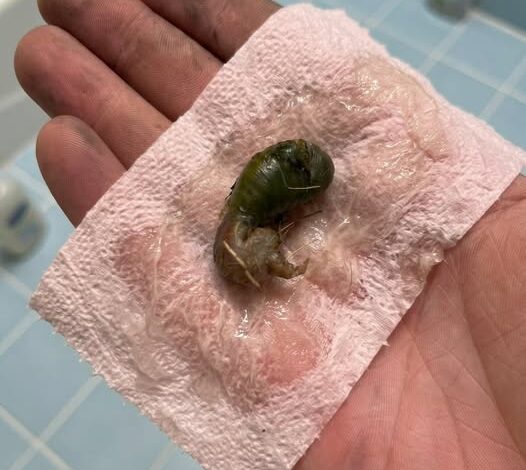
Small.
Green.
Segmented.
Unmistakably strange.
The longer we stared at it, the less either of us wanted to get closer.
It looked alive.
Or at least as though it had been alive recently.
Its body appeared divided into sections, almost like a caterpillar, yet it didn’t resemble any insect we recognized.
There was something unsettling about its shape.
Not because it was particularly large.
Because it seemed unfamiliar.
And unfamiliar things have a remarkable ability to trigger alarm.
The human brain is wired that way.
We encounter something we don’t understand, and our imagination immediately begins filling the gaps.
Rarely with comforting explanations.
I took a cautious step forward.
Then immediately stepped back.
The object looked almost artificial.
Like something that belonged in a science-fiction movie rather than on the floor of an ordinary home.
Its green surface reflected the light strangely.
The segments seemed too perfect.
Too deliberate.
Too alien.
“What do you think it is?” I asked.
My husband shrugged.
“Hopefully dead.”
That answer provided absolutely no comfort.
For several minutes, we stood there discussing possibilities.
None of them improved the situation.
Maybe it was some kind of parasite.
Maybe it had fallen from the ceiling.
Maybe it had crawled inside from the garden.
Maybe there were more.
That final possibility immediately made everything worse.
The human imagination, once activated, is rarely helpful.
The object remained motionless.
Yet somehow that made it more disturbing.
Movement would have at least provided answers.
Stillness left room for uncertainty.
And uncertainty often breeds fear.
Eventually, the debate shifted toward a practical question.
Someone had to move it.
Neither of us volunteered.
We examined it from different angles.
Attempted long-distance analysis.
Made increasingly ridiculous suggestions.
At one point, I proposed using a broom.
My husband suggested a dustpan.
Neither plan inspired confidence.
The object simply sat there, silently controlling the entire room.
Looking back, it’s almost embarrassing how much power we gave it.
But fear rarely behaves rationally.
Especially when combined with mystery.
After enough procrastination, my husband accepted the inevitable.
Someone had to investigate.
Armed with a tissue and the cautious determination of a man approaching a potentially explosive device, he slowly crouched beside it.
I remained several steps behind.
Offering moral support.
From a safe distance.
The tissue trembled slightly as he reached down.
He paused.
Took a breath.
Then carefully lifted the object.
Nothing happened.
No movement.
No sudden attack.
No horrifying surprise.
Yet somehow the close-up view created an entirely new problem.
The underside looked even stranger.
Soft.
Pale.
Almost fleshy.
The texture appeared unlike anything either of us expected.
Instead of reassuring us, the inspection only deepened the mystery.
“What is that?” I whispered.
“I have no idea,” he replied.
Neither answer helped.
The object eventually found temporary residence inside a sealed container while we considered our next move.
Neither of us felt comfortable throwing it away without understanding what it was.
At the same time, neither of us wanted it remaining inside the house indefinitely.
Thus began the investigation.
Modern mysteries rarely stay mysterious for long.
At least not when the internet exists.
Within minutes, both of us were hunched over our phones.
Searching.
Scrolling.
Comparing photographs.
Typing increasingly specific descriptions into search engines.
Green segmented insect thing.
Strange green cocoon.
Alien-looking bug shell.
Every search produced dozens of possibilities.
Some looked similar.
None looked identical.
The process became oddly obsessive.
Each image offered hope.
Then disappointment.
Wrong color.
Wrong shape.
Wrong texture.
Wrong size.
The mystery persisted.
And with every unsuccessful result, curiosity grew stronger.
What exactly had been living under our roof?
Hours seemed to pass.
Though it was probably less than one.
Eventually, buried among countless photographs of insects, larvae, cocoons, and pupae, we found it.
The match was unmistakable.
Same shape.
Same color.
Same segmented structure.
Same unusual appearance.
The answer appeared almost disappointingly simple.
A beetle pupa.
That was it.
Not a parasite.
Not a dangerous invader.
Not some bizarre creature from our worst imaginations.
Just a beetle.
Or more accurately, a beetle in the middle of becoming a beetle.
The realization arrived with immediate relief.
Followed almost instantly by fascination.
Because suddenly the object transformed.
Not physically.
Mentally.
Minutes earlier, it had been frightening.
Now it was remarkable.
Context changed everything.
The thing we had feared was actually one of nature’s most extraordinary processes.
Transformation.
A pupa represents a stage of life many people rarely witness directly.
It is neither larva nor adult.
It exists between identities.
A temporary form.
A biological waiting room.
Inside that strange green shell, profound changes occur.
Tissues reorganize.
Structures develop.
Entire body systems transform.
The creature essentially rebuilds itself.
The process is so dramatic that it almost sounds impossible.
Yet it happens constantly.
Quietly.
Unnoticed.
All around us.
Our mysterious visitor had not been hiding something dangerous.
It had been becoming something new.
And somehow that realization made the experience feel entirely different.
The fear disappeared.
In its place emerged wonder.
Because the truth was far more interesting than the theories we had invented.
For all our anxiety, the pupa had been doing absolutely nothing threatening.
It wasn’t plotting.
Invading.
Or lurking.
It was simply existing.
Waiting.
Changing.
Participating in one of nature’s oldest and most astonishing processes.
The experience became strangely philosophical.
How often do people react to unfamiliar things exactly as we reacted to that pupa?
How often does uncertainty create fear?
How often does ignorance transform ordinary realities into imagined threats?
The answer is probably more often than most of us would like to admit.
Humans have always feared what they don’t understand.
We fill gaps in knowledge with assumptions.
We invent dangers before seeking explanations.
Sometimes those fears are justified.
Many times they are not.
That small green shape on our floor became an unexpected reminder of that truth.
The object itself never changed.
Only our understanding changed.
Yet that change altered everything.
A source of anxiety became a source of curiosity.
A household mystery became a biology lesson.
A moment of discomfort became a moment of appreciation.
Even now, I can still picture it clearly.
The segmented body.
The strange texture.
The uneasy feeling it created when we first discovered it.
But what I remember most isn’t the fear.
It’s the realization afterward.
The recognition that something extraordinary had been happening right beneath our roof while we remained completely unaware.
Life transforming itself.
Quietly.
Patiently.
Without announcement.
Without permission.
Without concern for whether anyone noticed.
There is something beautiful about that.
Because transformation often looks strange before it makes sense.
Growth frequently appears unfamiliar.
Change can seem unsettling when viewed from the outside.
Yet underneath those strange appearances, something meaningful may be unfolding.
That little beetle pupa taught us far more than we expected.
Not about insects.
About perspective.
About patience.
About the danger of assuming that unfamiliar automatically means dangerous.
Most of all, it reminded us that fear often lives in the space where understanding has not yet arrived.
The moment knowledge enters, fear loses much of its power.
And what once seemed frightening can suddenly become fascinating.
What we treated as a threat was never a threat at all.
It was simply life.
Quietly becoming something new.
While we stood there, completely terrified of what we didn’t yet understand.