My father spotted me struggling down the street, my baby balanced on one hip and grocery bags hanging from my other arm.

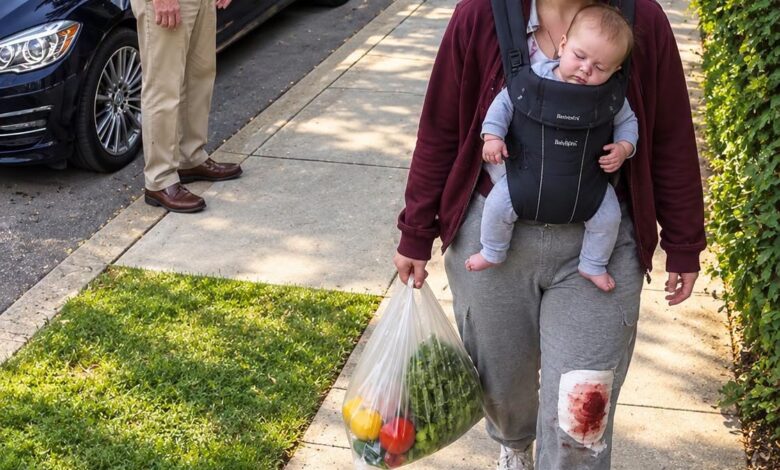
The first thing my father noticed was that I was limping.
The second was that I had my eleven-month-old son balanced on one hip, two grocery bags cutting into my fingers, and no car anywhere in sight.
He pulled over so abruptly that the tires bumped the curb.
“Camila?”
I stopped in the Monterrey heat and turned toward his car.
My ankle was swollen badly enough that my sneaker felt like a vise. Mateo was warm and heavy against me, his damp curls sticking to my cheek. A gallon of milk thudded against my knee with every step.
Dad climbed out before the engine had fully settled.
His faded CFE work shirt was darkened with sweat along the collar. He looked exactly as he always did after work—ordinary, tired, practical.
Then his eyes dropped to my ankle.
“What happened?”
“I slipped yesterday.”
“You went to a doctor?”
I shook my head.
His expression changed.
“Why not?”
I shifted Mateo higher.
“I didn’t have the car.”
Dad looked past me toward the neighborhood.
“Where is it?”
I hesitated.
That tiny pause told him more than I wanted it to.
“Camila.”
I swallowed.
“Rosa took it.”
“Luis’s mother?”
“Yes.”
“For what?”
“She said she needed it. And since we’re staying at their house, I should be grateful.”
Dad stared at me.
Not angry yet.
Just very still.
“You’re making the payments on that car.”
“Most of them.”
“And you’re walking injured with my grandson because she decided you weren’t allowed to use it?”
“It’s registered under Luis’s name.”
“That wasn’t my question.”
I looked down.
Dad took the grocery bags from my hand.
“Get in.”
“Dad, please. I don’t want a fight.”
He opened the passenger door.
“Neither do I.”
I stayed where I was.
He stepped closer and lowered his voice.
“Sweetheart, you are limping down the street carrying a baby because somebody has convinced you that asking for basic dignity makes you ungrateful.”
My eyes burned.
He gently took Mateo from me.
“Get in.”
This time, I did.
Dad did not drive straight to Rosa’s house.
He took me to urgent care first.
The doctor examined my ankle, ordered imaging, and told me I had a significant sprain.
No fracture, thankfully.
But I needed rest, support, and time off my feet.
Dad listened to every instruction.
Asked questions.
Picked up the medication.
Carried Mateo.
When we finally returned to the parking lot, I felt embarrassed by how much help I needed.
“You don’t have to do all this,” I said.
Dad stopped beside the car.
“Camila.”
I looked at him.
“You’re my daughter.”
That was all.
And somehow those three words undid months of pretending I was fine.
Six months earlier, Luis and I had still been living in our own apartment.
It was small.
The kitchen barely fit two people.
The neighbors upstairs seemed to own a bowling alley.
But it was ours.
Luis worked in sales for an automotive supplier. I handled customer accounts for a logistics company. When Mateo was born, we cut expenses, bought secondhand furniture, cooked at home, and stopped pretending vacations were something people actually took.
Then Luis lost his job.
At first, he was optimistic.
One interview became three.
Three became six.
Then weeks became months.
Our savings shrank.
That was when Rosa called.
“Come stay with us,” she said. “Family helps family.”
Her husband, Ernesto, agreed.
They had a spare bedroom.
We told ourselves it would only be temporary.
I was grateful.
And Rosa made sure I stayed grateful.
At first, the rules seemed reasonable.
No cooking after eight.
Don’t leave Mateo’s toys in the living room.
Ask before using the washing machine.
Then the rules multiplied.
His bottles took up too much refrigerator space.
Our laundry used too much electricity.
My father shouldn’t visit without warning.
I needed to buy more groceries.
I needed to clean more.
I needed to remember whose house I was living in.
“Be grateful, Camila.”
Rosa said it so often that eventually gratitude stopped sounding like appreciation and started sounding like rent.
Then she began taking the car.
The sedan had been purchased shortly before Mateo was born.
Luis had qualified for better financing, so the registration went in his name.
But most monthly payments came from my account.
I paid fuel.
Insurance.
Maintenance.
When someone backed into us at the supermarket, I paid for the repair.
It was the car I used for Mateo’s appointments and groceries.
One morning, I reached for the keys and found them gone.
Rosa was drinking coffee.
“Where’s the car?”
“I’m taking it.”
“I need to take Mateo to the clinic.”
She looked annoyed.
“It’s registered to my son.”
Luis was sitting at the table.
I looked at him.
“Luis?”
He kept staring at his phone.
“Mom needs it today.”
That should have been the moment I understood.
Instead, I told myself it was one day.
Then one day became most days.
Eventually Rosa started keeping the keys in her handbag.
And I stopped asking.
That was how things changed in that house.
Not all at once.
One surrender at a time.
The day before Dad found me, I had been carrying Mateo downstairs when my foot slipped off the final step.
My ankle twisted underneath me.
Pain shot up my leg so violently that I nearly dropped to the floor.
I held Mateo tighter and sat there breathing until the dizziness passed.
Rosa appeared in the hallway.
“What happened now?”
“I slipped.”
She looked at my ankle.
“You need to be more careful.”
“Can you drive me to a clinic?”
“I have an appointment.”
She took the car.
Luis promised to take me later.
Then he became busy filling out an online job application.
By evening, nobody mentioned the clinic again.
The next afternoon, we needed milk.
And diapers.
And food.
Rosa still had the keys.
So I walked.
That was when Dad found me.
As we left urgent care, Dad asked for Rosa’s address.
I told him.
He slowed slightly.
“What number?”
I repeated it.
He looked at me.
“Are you sure?”
“Yes.”
He pulled into a parking space.
“What?”
Dad unlocked his phone.
He opened a document folder.
Then another.
His eyebrows drew together.
“Camila.”
My stomach tightened.
“What?”
“That house belongs to me.”
I actually laughed.
Not because it was funny.
Because the sentence made no sense.
“What are you talking about?”
“The property.”
He turned the screen toward me.
The address was there.
Exact.
Street.
Number.
Everything.
“I inherited it from your grandfather.”
I stared at him.
“No. Rosa owns that house.”
“No.”
“She says she does.”
“She rents it.”
I looked at him.
Dad continued.
“The management company handles the lease. I haven’t dealt directly with the tenants in years.”
For several seconds, neither of us spoke.
Then every time Rosa had said under my roof came rushing back.
Every rule.
Every insult.
Every reminder that I should be grateful.
She had spent six months using a house she did not even own to convince me I had nowhere else to go.
Dad locked his phone.
“Now we’re going there.”
We arrived shortly after seven.
My car was in the driveway.
Rosa’s shopping bags filled the back seat.
Dad parked behind it.
He helped me out.
Then carried Mateo while I walked toward the door.
Rosa opened it before we knocked.
“Camila, where have you been?”
Then she saw Dad.
Her face hardened.
“Rafael.”
“Rosa.”
She glanced at my ankle brace.
“What happened?”
I stared at her.
“You watched me fall.”
She shrugged.
“I didn’t realize it was serious.”
Dad spoke.
“We’re here to collect Camila’s things.”
Rosa blinked.
“What?”
“She and Mateo are staying with me.”
Her whole posture changed.
“Absolutely not. Luis needs to agree.”
Dad looked almost puzzled.
“Camila is twenty-eight years old.”
“So?”
“So she doesn’t need permission to leave a house.”
Rosa crossed her arms.
“My house.”
Dad looked at her for one long second.
Then he pulled out his phone.
“Your lease is through Administradora del Norte.”
Her face flickered.
“Yes.”
“The company manages the property on my behalf.”
Silence.
Ernesto appeared behind her.
“What?”
Dad turned the screen around.
“I own this house.”
Everything stopped.
Rosa gave a short laugh.
“That’s ridiculous.”
Dad showed them the property record.
Ernesto leaned forward.
His expression changed first.
Then Rosa’s.
Color drained from her face.
For months, she had said my roof.
Now she was standing beneath somebody else’s.
But Dad did not smile.
He did not threaten her.
He did not tell them to pack.
Instead, he said something I will never forget.
“Your lease remains valid.”
Rosa stared at him.
“What?”
“You have tenant rights. I’m not removing you.”
She looked almost confused.
“Then why are you telling me this?”
“Because you’ve spent months telling my daughter she should tolerate being controlled because you were generous enough to let her stay in your home.”
He paused.
“You are a tenant here, Rosa. And even if you weren’t, shelter does not buy ownership over another adult.”
Nobody moved.
Then Luis came downstairs.
“What’s happening?”
He saw the brace.
Dad holding Mateo.
His mother’s face.
Then me.
“Camila?”
“I’m going to Dad’s.”
His eyebrows pulled together.
“Why?”
I almost couldn’t believe the question.
“I hurt my ankle yesterday.”
“I know.”
“And today I had to walk to the store carrying Mateo because your mother had the car.”
Luis looked toward Rosa.
“Mom?”
She waved one hand.
“She’s exaggerating.”
Dad’s voice sharpened.
“She has a medically documented injury.”
Luis looked back at me.
“Why didn’t you tell me it was that bad?”
I stared at him.
“I did.”
His face went still.
He remembered.
That silence was the first honest answer he had given me in months.
Dad looked at me.
“What do you want to take?”
It was such a simple question.
But nobody had asked what I wanted in a very long time.
“My clothes.”
He nodded.
“Mateo’s things.”
“Okay.”
“My documents. Laptop. Medicine.”
“Let’s get them.”
We went upstairs.
Luis followed.
I opened the closet and started packing.
“Camila.”
I kept folding.
“You don’t have to leave.”
“Yes, I do.”
“We can talk.”
“We have been talking.”
“I didn’t know it was this bad.”
That finally made me turn around.
“You knew your mother kept the car.”
He said nothing.
“You knew I was paying for it.”
Nothing.
“You knew I was injured.”
His eyes dropped.
“You just didn’t want to upset her.”
His silence said yes.
I zipped the suitcase.
“You let me carry the cost of keeping peace with your mother.”
“Camila—”
“And I’m not doing it anymore.”
Downstairs, Rosa watched Dad carry the bags.
“You’re really leaving over a car?”
“No.”
“Then what?”
I faced her.
“I’m leaving because every favor in this house became something you used to control me.”
Her jaw tightened.
“I gave you somewhere to live.”
“You offered us temporary help.”
“And you should be grateful.”
“There it is.”
She stopped.
“That word.”
I looked at her.
“I was grateful. I cooked. I cleaned. I bought food. I respected your home.”
“You—”
“But gratitude does not mean surrender.”
She looked away.
Before we left, I turned to Luis.
“The keys.”
He frowned.
“What?”
“The car keys.”
Rosa immediately reached toward her handbag.
“No. I need it tomorrow.”
I looked at my husband.
“It is registered in your name. I am making the payments. Are you going to let your mother keep controlling whether I can leave the house?”
Luis stood motionless.
Then slowly held out his hand.
“Mom.”
Rosa stared at him.
“Luis.”
“Give me the keys.”
Her face hardened.
But eventually, she pulled them from her purse and slapped them into his palm.
Luis gave them to me.
My hand closed around them.
I wasn’t going to drive with my injured ankle.
Dad arranged to collect the car later.
That did not matter.
What mattered was that the keys were mine to hold again.
That night, I slept in my old bedroom at Dad’s house.
He set up Mateo’s travel crib beside the bed.
Then brought me water.
“You can stay as long as you need.”
Immediately, the old reflex came out.
“I don’t want to be a burden.”
Dad sat down.
“Camila.”
I looked at him.
“You are not a debt.”
My throat closed.
That sentence cracked open everything I had been holding in.
I cried.
Hard.
Dad did not tell me to calm down.
He didn’t remind me other people had it worse.
He didn’t explain how much the groceries cost or how much water we were using.
He just stayed.
The next morning, I woke to coffee and Mateo babbling beside me.
Dad had already bought diapers.
Milk.
Fruit.
Baby cereal.
I stared at everything on the kitchen counter.
“You didn’t have to do this.”
Dad smiled.
“I know.”
That was when I understood the difference.
Real help does not keep receipts against your dignity.
Luis called eleven times.
Eventually, I texted him.
Mateo and I are safe. I need time to recover and think. We can discuss arrangements calmly.
He replied:
Please come home.
Home.
I stared at the word.
Then another message arrived.
Mom says your dad threatened to evict them.
I took a slow breath.
He didn’t. Their lease remains valid.
Luis did not reply.
That was another change.
For once, I refused to spend my energy correcting Rosa’s version of reality.
Dad contacted the management company and told them all future property matters would go through normal channels.
No retaliation.
No threats.
No special treatment.
I respected him more for that than if he had thrown Rosa into the street.
“I don’t want to become what she was,” he told me.
“What do you mean?”
“Someone who uses housing to control people.”
A few days later, Luis and I met at a café.
I brought the car-payment records.
He stared at the transfers.
“I didn’t realize you’d paid this much.”
“The money came from my account every month.”
“I know.”
“Then what didn’t you realize?”
He lowered his eyes.
“That I let Mom act like it belonged to her.”
We discussed the loan.
Insurance.
Registration.
Expenses.
For the first time, the conversation was about facts rather than whether his mother might get upset.
Then Luis said, “I’m sorry.”
I waited.
“I should have taken you to the clinic.”
“Yes.”
“I should have stopped Mom from keeping the keys.”
“Yes.”
“I should have listened when you told me you were unhappy.”
I felt tears rise.
“Why didn’t you?”
He rubbed both hands over his face.
“Because every time I disagreed with her, she reminded me we lived in her house.”
I stared at him.
“And you let her use that fear against me.”
“Yes.”
It hurt.
But it was honest.
Then he asked me to come back.
“No.”
His face fell.
“Camila—”
“Not to that house.”
“We can move.”
“Then get a job. Make a plan. Show me you can make decisions without waiting for your mother’s approval.”
“Are you ending our marriage?”
“I don’t know yet.”
That was the truth.
“But I know I’m not returning to what we had.”
Rosa eventually messaged me too.
A long message.
She had been misunderstood.
She only wanted to help.
Dad humiliated her.
Then came the sentence I knew would appear.
You should remember who gave you a place to stay when you had nowhere else.
This time, the words didn’t frighten me.
I replied:
I appreciated having somewhere temporary to stay. I did not agree to surrender my independence in exchange. Please contact Luis about household matters. I need space.
Then I stopped responding.
Not every argument deserves your entire evening.
My ankle healed.
I returned to work.
Dad helped with Mateo while I arranged reliable childcare.
I opened a separate savings account.
Reviewed every expense.
And started looking for an apartment.
Three months later, I found one.
One bedroom.
Small balcony.
Tiny kitchen.
Enough space for Mateo.
When I showed Dad the photos, he smiled.
“It’s good.”
“You’re okay with us leaving?”
He frowned.
“Why wouldn’t I be?”
“I just thought…”
He shook his head.
“I helped you so you could stand on your own feet, Camila. Not so you’d feel trapped owing me something.”
I laughed through tears.
Then hugged him.
Luis eventually found work.
He moved out of his parents’ house.
He started counseling.
He began contributing consistently toward Mateo.
We met regularly.
Some conversations were good.
Some were terrible.
But words no longer impressed me much.
I watched actions.
Promises had been too cheap for too long.
I did not know whether our marriage would survive.
What I did know was that I would never disappear inside it again.
Mateo’s first birthday happened a few weeks after I moved.
Dad brought cake.
My aunt brought balloons.
Luis came early and helped decorate.
Mateo smashed frosting across his face and screamed with joy while everyone laughed.
Later, Dad took a picture of me holding him.
When I looked at it, I noticed something.
I was smiling.
Really smiling.
Not the careful expression I used at Rosa’s house when I was trying to keep everybody comfortable.
I looked like myself again.
Eventually, Rosa asked to see Mateo.
I did not say no because I wanted revenge.
I gave her boundaries.
Visits arranged in advance.
No undermining me.
No using gifts, money, shelter, or transportation as leverage.
She disliked every rule.
But eventually, she agreed.
Months later, she called.
Her voice sounded smaller.
“Camila, I need to say something.”
I waited.
“I should not have taken the car.”
“No.”
She hesitated.
“I thought you and Luis needed discipline.”
I closed my eyes.
“We needed help. If you couldn’t help without controlling us, you could have said no.”
Silence.
Then:
“I’m sorry.”
I accepted the apology.
I did not confuse accepting it with erasing what happened.
Much later, Dad and I sat on his porch while Mateo played nearby.
I asked why he had never told me about the properties.
Dad shrugged.
“Your grandfather believed money should be quiet.”
“That sounds like him.”
“He said property was responsibility. People raise families in those houses. You don’t become important because your name is on the deed.”
I looked at him.
“Rosa thought the opposite.”
Dad nodded.
Then he grew quiet.
“I should have noticed you stopped visiting.”
I looked down.
“I should have told you.”
He reached over and squeezed my hand.
“We both know more now.”
Several months later, I drove past the street where Dad had found me.
The Monterrey heat shimmered against the pavement.
For a moment, I saw everything again.
The grocery bags.
Milk hitting my knee.
Mateo on my hip.
My swollen ankle.
The fear I had carried for so long that I stopped recognizing it as fear.
I pulled over.
Not because I was sad.
Because I wanted to remember where things changed.
It was not when Dad revealed he owned Rosa’s house.
Not when I got the car keys back.
Not when I moved into my apartment.
It happened earlier.
It happened when somebody saw me struggling and asked why.
And when I finally told the truth, he did not explain it away.
He believed me.
Rosa had spent months convincing me that because I lived beneath her roof, she had the right to control my life.
The irony was that the roof was never hers.
But even that was not the real lesson.
If Rosa had owned the house outright, I would still have deserved dignity.
If Dad had owned nothing but the work shirt on his back, I would still have deserved help.
If he had never found me that afternoon, I still would have had the right to leave.
I was an adult.
I was a mother.
And needing help had never made me property.
Sometimes I still think about the moment Dad opened the passenger door.
He did not ask why I had tolerated everything.
He did not tell me I should have known better.
He simply looked at his daughter limping through the heat with a baby in her arms and said:
“Get in.”
At the time, I thought he was taking me back to confront Rosa.
I understand now that he was taking me somewhere else entirely.
Toward a life where help did not require humiliation.
Where gratitude did not mean obedience.
Where home was not something another person could hold over my head.
And where I would never again have to beg anyone for permission to leave.