I Gave Food to a Hungry Veteran and His Dog – a Month Later, My Boss Dragged Me into His Office, Furious, and My Whole Life Flipped Upside Down

I was exhausted the night everything changed. Not the ordinary kind of tired that disappears after a shower and a few hours of sleep, but the deep, heavy exhaustion that settles into your bones when life has been demanding too much from you for too long. I had just finished another chaotic shift at the tiny insurance office where I worked as an administrative assistant — the kind of place where nobody notices how hard you work until something goes wrong. Phones rang nonstop, agents argued over clients behind thin office walls, and every problem somehow landed on my desk before the day was over. By the time I clocked out, all I could think about was getting home to my children.
My kids were five and seven then.
Old enough to ask difficult questions.
Young enough to still believe I could fix almost anything.
They were the center of my life and also the reason I pushed myself far beyond exhaustion most days. Since my ex-husband walked away two years earlier — right after our youngest turned three — everything had become a balancing act held together with caffeine, panic, and sheer determination. He said he “wasn’t built for family life,” like fatherhood was some temporary inconvenience he could simply resign from. After that, it was just me, my mom, and the kids trying to survive one week at a time.
My mother helped constantly despite already carrying too much herself.
She worked brutal hospital shifts and still showed up to babysit whenever she could. That afternoon, she called while I was leaving work.
“Sweetie,” she said softly, sounding completely drained, “is it okay if I let them watch cartoons for a little while? I just need to sit down for a few minutes.”
Hearing the exhaustion in her voice broke my heart a little.
“Mom, of course,” I said immediately. “You don’t even have to ask.”
She laughed quietly.
“You always say that.”
“Because it’s true.”
I stopped at the grocery store on the drive home because we had almost nothing left in the fridge. Money was tight enough that every trip involved mental math before anything went into the cart. I grabbed the usual emergency dinner supplies:
mac and cheese,
chicken tenders,
apples,
juice boxes,
cheap cereal,
whatever would stretch furthest without another trip before payday.
By the time I checked out, evening had fully settled in.
The parking lot glowed under harsh yellow lights while winter wind sliced through my coat the second the automatic doors opened. I hurried toward my car, already thinking about baths, homework, dishes, and everything else still waiting for me at home.
Then I saw him.
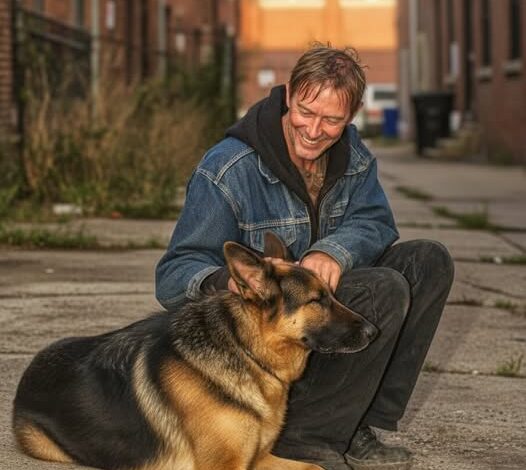
A man sat near the shopping cart return a few rows away from my car, shoulders curled inward against the cold like he was trying to physically make himself smaller. Beside him lay a German Shepherd, calm and alert, pressed tightly against his side.
The dog looked healthy.
The man did not.
His coat was thin in places where lining had worn away completely, and his hands were red from cold. When he noticed me glancing over, he hesitated before speaking.
“Ma’am…” he said quietly. “Sorry to bother you.”
I slowed instinctively.
“I’m a veteran,” he continued carefully. “We haven’t eaten since yesterday. I’m not asking for money. Just maybe some food if you have anything.”
Every warning I’d ever heard immediately started flashing through my mind.
It was dark.
I was alone.
I had children waiting for me at home.
Part of me wanted to apologize and keep walking.
But something about him stopped me.
Maybe it was the way his hand rested protectively on the dog’s back even while he was visibly freezing himself. Or maybe it was the dignity in his voice — tired but not aggressive, embarrassed but still polite.
The dog lifted its head slowly and looked at me with soft, exhausted eyes.
“Wait here,” I said finally.
I went back inside before I could overthink it.
At the deli counter, I bought a full hot meal:
roasted chicken,
mashed potatoes,
vegetables,
bread rolls.
Then I grabbed bottled water and the biggest bag of dog food I could afford without overdrafting my account.
The cashier looked down at the items, then back at me knowingly.
“Cold night for this,” she said quietly.
I nodded.
“Yeah.”
When I carried the bags back outside, the man stood immediately.
For a second, he just stared at everything in disbelief.
“Ma’am…” His voice cracked. “You don’t know what this means.”
“It’s okay,” I said softly. “Really.”
He looked down at the dog.
“You hear that, buddy? We’re eating tonight.”
The shepherd’s tail wagged slowly against the pavement.
I still remember that part most vividly for some reason.
Not the words.
Not the cold.
That tail.
Because gratitude looked so heartbreakingly simple in that moment.
The man thanked me repeatedly until he seemed unable to find more words. I told him to stay warm, got into my car, and drove home thinking it was simply one small act of kindness in a world where everyone seemed exhausted and struggling.
Then life swallowed the memory almost immediately.
Weeks passed.
Work became overwhelming again.
Bills piled up.
One child caught the flu.
My mom picked up extra shifts.
The encounter faded into the background of ordinary survival.
Until exactly one month later.
That morning at work started strangely.
People kept glancing toward my desk before quickly looking away. Around noon, my boss, Mr. Henderson, stepped out of his office and called my name sharply.
“Michelle. My office. Now.”
My stomach dropped instantly.
Mr. Henderson was the kind of manager who enjoyed making people nervous. He ran the office through intimidation disguised as professionalism, constantly reminding employees how replaceable they were.
The second I sat down, I noticed his expression looked unusually tense.
Almost angry.
He closed the office door behind me.
“Do you know why you’re here?” he asked coldly.
“No, sir.”
He slid an envelope across the desk.
“Read it.”
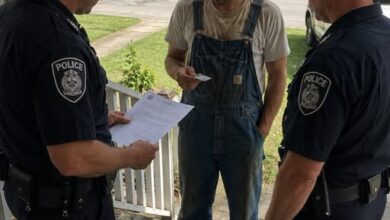
Inside was an official letter from a veterans’ outreach organization.
As I scanned the page, confusion turned into shock.
The letter described my encounter with the veteran in the grocery store parking lot. It praised the compassion shown and explained that my actions directly helped reconnect a struggling homeless veteran with emergency housing services, medical treatment, and long-term support resources.
Then came the part I truly didn’t understand:
they formally recommended I be recognized professionally for outstanding community service and leadership qualities.
I looked up completely stunned.
“I don’t understand…”
Mr. Henderson scoffed loudly.
“So now outside organizations are telling me how to run my office?”
“What? No — I didn’t ask for this.”
“But somehow they know where you work.”
“Because he must’ve told them!”
His expression hardened.
“This looks manipulative to me.”
I blinked.
“What?”
“You expect me to believe this happened naturally? Either you orchestrated this or you’re involved somehow. I don’t tolerate employees using emotional stunts to pressure management.”
I genuinely thought he was joking at first.
“Sir, I bought someone dinner.”
But he had already decided.
“I’m terminating your employment effective immediately.”
The words hit so hard I physically stopped breathing for a second.
“You’re firing me… because I helped someone?”
“I’m firing you because I don’t appreciate being publicly manipulated.”
I left his office numb.
Completely numb.
Coworkers watched silently while I packed my desk into a cardboard box trying desperately not to cry in front of everyone. Humiliation burned hotter than anger at first. I kept replaying the conversation in my head wondering how compassion somehow became grounds for termination.
That night, after my children fell asleep, I sat alone at the kitchen table rereading the letter over and over.
Eventually, I called the organization listed at the top.
A woman answered almost immediately.
When I explained who I was, her tone changed instantly.
“Oh my goodness,” she said. “We’ve actually been hoping you’d contact us.”
The next morning, I drove to their office downtown.
That’s when I learned the full story.
The veteran I helped had entered their center only days after our encounter. According to staff members, he repeatedly described that moment in the parking lot as the first time in months someone treated him like a human being instead of a problem to avoid.
He told them:
“She looked at my dog before she looked away from me.”
That sentence nearly destroyed me.
The organization immediately connected him with temporary housing, counseling, healthcare, and veteran assistance programs. Apparently, once stabilized, he insisted on finding a way to thank me properly.
That letter was his idea.
When they learned I’d been fired over it, they were horrified.
Then one of their attorneys asked:
“Would you be willing to fight this?”
I hesitated immediately.
“I can’t afford legal fees.”
The attorney smiled slightly.
“You won’t have to.”
They handled everything pro bono.
Over the next two months, my wrongful termination case exposed far more about Mr. Henderson’s behavior than anyone expected. Former employees came forward describing intimidation, retaliation, and abuse inside the office. Internal complaints resurfaced. Corporate investigators became involved.
Eventually, the company settled.
I received compensation.
My firing was overturned.
And Mr. Henderson quietly disappeared from his position soon afterward.
But strangely, by then, I no longer wanted my old job back.
Because during those weeks working with the veterans’ organization, something inside me shifted.
For years, I had counted minutes at work.
Watched clocks constantly.
Survived jobs instead of believing in them.
Then suddenly I found myself surrounded by people helping others rebuild lives after losing everything — housing, family, health, identity, hope.
And for the first time in years, work stopped feeling meaningless.
A month later, the organization offered me a full-time position helping veterans access housing programs, healthcare, food assistance, and employment support.
I accepted immediately.
Now my days look completely different.
I still answer phones.
Still organize paperwork.
Still solve endless small crises.
But now every task connects to someone trying desperately to rebuild their life instead of someone complaining about policy premiums.
Sometimes I still think about that freezing parking lot at dusk.
How close I came to walking away.
How easy it would’ve been to convince myself I was too tired, too busy, too cautious to stop.
And how one small decision changed far more than I could have imagined.
Because that night, I thought I was simply buying dinner for a hungry veteran and his dog.
I had no idea I was also walking quietly toward the life I was actually meant to live.