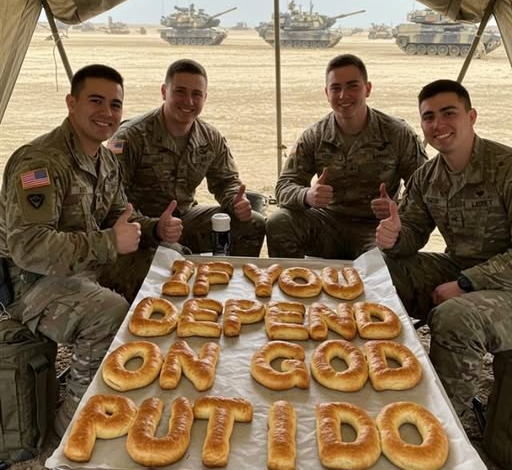
The photo spread across social media in a matter of hours. Four young soldiers sat inside a military tent somewhere in the desert, smiling beneath harsh sunlight and giving thumbs-up beside rows of bread carefully arranged into a message:
“I LOVE YOU DEPEND ON GOD PUTTIDO.”
Most people laughed at it first.
Some called it wholesome.
Some called it strange.
Others turned it into memes before scrolling on to the next thing.
But almost nobody knew the story behind the picture.
And almost nobody understood why those words mattered enough for exhausted soldiers to spend hours shaping bread by hand in the middle of a war zone.
The youngest of the four was Private Daniel Ruiz, twenty years old, born and raised in El Paso, Texas. Before deployment, he worked evenings at his uncle’s auto shop and spent weekends helping his mother take care of his little sisters while pretending adulthood didn’t scare him. Daniel had enlisted partly for money, partly for purpose, and partly because he believed military service might finally turn him into the kind of man his late father always wanted him to become.
But war didn’t make him feel strong.
It made him feel small.
The desert stripped people down emotionally. Days blurred together beneath unbearable heat and constant tension. Sleep came in fragments. Every loud noise triggered instinctive fear. Even silence became unsettling because silence usually meant waiting for something bad to happen.
And somewhere inside all that exhaustion, homesickness grew vicious.
At night, the soldiers talked quietly about ordinary things because ordinary life started feeling almost mythical after enough time overseas.
Fresh coffee from gas stations.
Rainstorms.
Football games.
Mothers yelling from kitchens.
The smell of laundry detergent.
Music playing from cars at red lights.
Tiny meaningless details became the things they missed most.
Daniel missed someone specific.
Her name was Sofia.
Before deployment, they’d been together almost three years. Not dramatic movie-love. Real love. The kind built through grocery store runs, late-night phone calls, arguments about stupid things, and conversations about a future they were both too young to fully understand.
The night before Daniel left, Sofia grabbed his hand in the airport parking lot and made him promise something.
“No matter what happens over there,” she whispered through tears, “don’t lose yourself.”
He laughed softly back then because he didn’t understand how possible that really was.
But months into deployment, he finally did.
War changes people slowly enough that they often don’t notice it happening.
At first, Daniel still called home constantly. Then less often. Then only when schedules allowed. The longer he stayed overseas, the harder normal conversations became. Sofia would ask what he did all day, and he wouldn’t know how to explain the strange emptiness between moments of fear. She’d talk about birthdays, bills, weather, television shows — life continuing normally without him — while he sat holding a phone surrounded by dust and armored vehicles feeling farther away from humanity every week.
Then came the attack.
It lasted less than four minutes.
Mortars struck near the outer perimeter just before dawn, ripping through equipment and collapsing part of the communications area. By pure luck, Daniel and the others survived physically unharmed. Another unit nearby wasn’t as fortunate.
Afterward, something inside him changed.
He stopped sleeping properly.
Stopped joking as much.
Stopped answering Sofia’s messages consistently because every conversation reminded him how impossible it felt to reconnect with the version of himself waiting back home.
One night, months later, Sofia finally sent a message that shattered him:
“I don’t care if you come back different. I just need you to come back alive.”
Daniel sat staring at those words for nearly an hour.
Then Sergeant Marcus Hale walked into the tent and noticed immediately something was wrong.
Marcus was the oldest among them — thirty-two, already on his third deployment, carrying the calm exhaustion of someone who had seen enough suffering to stop pretending war looked heroic up close. He sat beside Daniel silently for a while before finally asking:
“Girl back home?”
Daniel nodded.
Marcus smirked slightly.
“Those are always the hardest battles.”
The others laughed quietly from nearby cots.
Ethan Brooks, the loudest one in the group, tossed a piece of bread at Daniel.
“You know what your problem is?” Ethan said. “You’re trying to sound tough in your messages.”
“What’s wrong with that?”
Marcus answered before Ethan could.
“Because people back home don’t need a soldier pretending he’s invincible. They need the real person.”
Daniel looked down at Sofia’s message again.
“I don’t even know who that is anymore.”
Nobody answered immediately.
Because every man inside that tent understood exactly what he meant.
A few days later, supply trucks delivered fresh food and bread — a rare luxury after weeks of packaged rations. The soldiers joked around while unloading supplies, briefly acting like normal young men instead of exhausted people carrying rifles through endless desert heat.
That’s when Ethan came up with the idea.
“Let’s send your girl something she’ll never forget.”
Daniel rolled his eyes.
“With what? Sand?”
“Bread,” Ethan answered immediately.
Everyone laughed.
But Marcus nodded thoughtfully.
“Actually… that’s not terrible.”
So late that night, while generators hummed outside and tanks sat motionless beneath moonlight, the four soldiers gathered around a folding table shaping bread into giant uneven letters by hand.
None of them were bakers.
The letters looked ridiculous.
Crooked.
Misshapen.
Some barely readable.
But they kept working anyway, laughing harder than they had in months.
“I LOVE YOU.”
“DEPEND ON GOD.”
“PUTTIDO.”
The last word was an inside joke between Daniel and Sofia — a stupid nickname created years earlier after a typo in one of her texts. Nobody else understood it except them.
And that was the point.
For one hour inside that tent, the war disappeared.
They weren’t soldiers then.
They were just young men trying desperately to hold onto pieces of themselves before deployment erased them completely.
Another soldier snapped the photo casually before dawn.
Nobody expected anyone else to see it.
But weeks later, after Daniel finally sent the image home through unstable Wi-Fi connections, Sofia posted it online with one caption:
“They’re still trying to stay human over there.”
The internet exploded afterward.
Millions shared the photo.
Some mocked the strange wording.
Others joked about the bread letters.
Many called it fake because parts of the image looked oddly perfect beneath the desert lighting.
What most people never realized was that the photo captured something painfully real hidden beneath its awkwardness.
Not military propaganda.
Not politics.
Not nationalism.
Loneliness.
Four exhausted soldiers sitting beside handmade bread because emotional survival sometimes depends on tiny reminders that love still exists somewhere beyond the war.
Then tragedy struck again.
Two months after the photo went viral, Sergeant Marcus Hale was killed during a roadside explosion outside the base perimeter.
The news shattered the group.
Marcus had become the emotional center holding them together quietly through deployment. He was the one who reminded younger soldiers to call home. The one who noticed panic attacks before others did. The one who spoke gently after nightmares instead of pretending fear made someone weak.
After his death, Daniel couldn’t look at the photo for weeks.
Because suddenly the image stopped feeling funny.
It became evidence.
Proof that Marcus existed.
Proof he laughed.
Proof he sat alive beneath that tent shaping ridiculous bread letters while teasing younger soldiers about love.
At Marcus’s memorial service overseas, the surviving soldiers placed fresh bread beside his helmet and rifle.
No speeches.
No cameras.
Just silence.
And grief too heavy for words.
Daniel finally returned home seven months later.
At the airport, Sofia ran toward him crying before he even fully reached the terminal exit. He held her so tightly people around them quietly looked away to give them privacy.
But the strangest part came later.
After the hugs.
After the reunions.
After the relief.
Daniel struggled constantly to explain why that old bread photo still mattered so much to him.
To everyone else, it was just an odd viral image from the internet.
To him, it represented something sacred:
the moment four soldiers remembered they were still human.
Not weapons.
Not uniforms.
Not headlines.
Human beings terrified of being forgotten by the people they loved.
Years later, the photo still circulates online occasionally.
People still laugh at the strange message.
Still turn it into memes.
Still argue about whether it was AI-generated or staged.
But somewhere in Texas, framed carefully inside Daniel and Sofia’s home, hangs the original printed image.
Not because it looks impressive.
Because it reminds them both of something easy to lose in violent times:
even surrounded by tanks, fear, exhaustion, and war, the human heart still searches desperately for love, faith, and home.
And sometimes, against all odds, even broken bread arranged on a folding table becomes proof that hope survived another night.