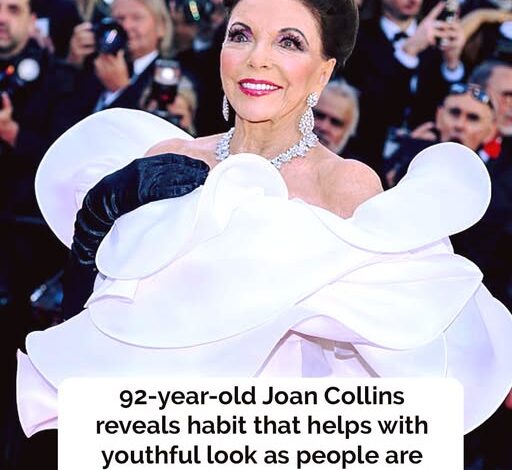
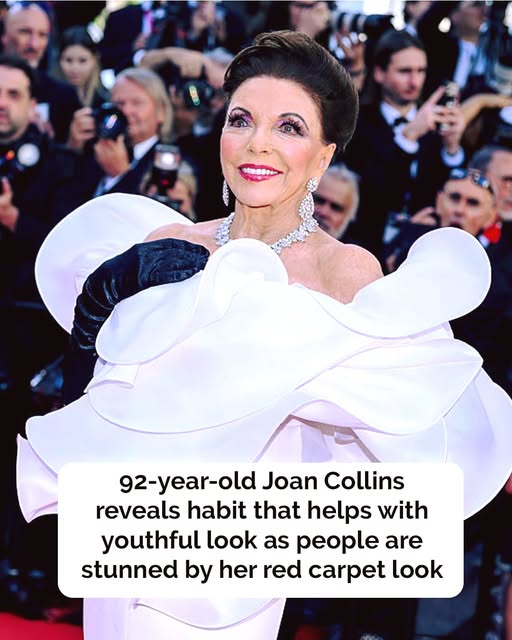
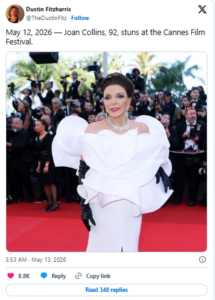
Joan Collins stepped onto the Cannes red carpet with the kind of presence that instantly silences a crowd without demanding attention. Cameras flashed relentlessly as she emerged beneath the lights of the opening ceremony for the 79th Cannes Film Festival on May 12, dressed in a dramatic white Stéphane Rolland haute couture gown that seemed designed for another era of Hollywood glamour — the kind of elegance modern celebrity culture rarely produces anymore. At ninety years old, Collins did not arrive cautiously or quietly. She arrived with the composure of someone who has spent an entire lifetime understanding exactly how to command a room.
The gown itself became one of the most discussed fashion moments of the evening. Structured yet fluid, dramatic without appearing desperate for attention, it reflected the aesthetic that Joan Collins has represented for decades: classic sophistication sharpened by confidence. Black opera gloves extended the old-Hollywood silhouette while a diamond necklace caught the light each time she turned toward photographers. Every detail felt intentional. Nothing appeared accidental or overly modernized to chase younger trends. Instead, the look embraced timeless glamour unapologetically.
And perhaps that was what resonated so strongly with audiences around the world.
In an entertainment industry increasingly obsessed with reinvention, Joan Collins continues to represent continuity. She does not seem interested in erasing age or pretending time has not passed. Instead, she carries herself like someone who understands that longevity itself has become its own form of power. The internet responded almost immediately after photos from Cannes began circulating online. Social media platforms filled with admiration from people stunned not simply by how she looked, but by the confidence and authority she projected walking that carpet.
Many comments focused on the same idea:
that she looked “untouchable.”
Not youthful.
Not artificially frozen in time.
Powerful.
That distinction matters.
For decades, women in Hollywood have often been forced into impossible standards around aging — expected either to disappear quietly from public life or desperately attempt to preserve an illusion of permanent youth. Joan Collins has approached aging differently. Her public image has never depended entirely on appearing young. Instead, it rests on discipline, presentation, self-awareness, and the understanding that glamour is often more about confidence than perfection.
That perspective has allowed her to remain culturally relevant across multiple generations.
Long before social media existed, Joan Collins already understood celebrity as performance, image, and endurance. Her career stretches back to the mid-twentieth century, through eras of film, television, tabloid culture, and changing standards of fame itself. Most people still immediately associate her with Alexis Colby from Dynasty — one of television’s most iconic and ruthless characters — but reducing Collins solely to that role overlooks how extensive and adaptable her career has actually been.
She survived decades of Hollywood transformation that ended countless other careers.
Black-and-white cinema gave way to color spectacle.
Studio systems collapsed.
Television reshaped entertainment.
Celebrity culture accelerated beyond recognition.
And through all of it, Joan Collins remained visible.
Part of that longevity comes from how openly she has discussed aging itself. Unlike many public figures who avoid conversations about physical decline, Collins has spoken candidly in interviews about maintaining health realistically rather than obsessively. She has repeatedly emphasized moderation instead of extremes, particularly when discussing exercise and wellness.
Her philosophy sounds almost old-fashioned compared to today’s aggressive fitness culture.
She does not promote punishing workout routines or impossible transformations. Instead, she advocates consistency:
daily movement,
simple routines,
sustainable habits.
After suffering reduced mobility from a trapped nerve several years ago, Collins shifted further toward practical physical maintenance rather than appearance-driven exercise. Physiotherapy became an important part of her recovery, and she has since encouraged older adults to focus on safe, manageable activity rather than unrealistic expectations. Swimming, walking, and short periods of regular movement became central to her routine.
What stands out in her interviews is not denial about aging, but discipline in responding to it.
She often describes her philosophy as doing things “little and often” — a phrase that feels almost symbolic of her broader career. Rather than chasing dramatic reinventions, Collins has sustained herself through consistency. She protects routines carefully, maintains structure in her lifestyle, and avoids extremes that often leave public figures burned out physically or emotionally.
Her approach to food reflects the same mindset.
Collins has openly admitted she enjoys indulgences and refuses rigid dieting culture. While she includes healthy habits like eating avocados, taking vitamins, and maintaining balanced nutrition, she rejects the idea that wellness must involve constant deprivation. That balance likely contributes to why her public image still feels natural rather than exhausting. She does not present herself as someone desperately fighting age every second of the day. Instead, she appears to manage it thoughtfully, realistically, and with humor intact.
The topic of cosmetic surgery inevitably follows any aging celebrity, especially women in Hollywood. Joan Collins has addressed those rumors directly for years. She consistently denies undergoing extensive cosmetic procedures or relying heavily on invasive enhancements. Whether audiences fully believe that or not, what matters more is how firmly she frames beauty around maintenance rather than transformation.
Her skincare philosophy is remarkably simple compared to modern beauty industries flooded with expensive trends and endless procedures.
She emphasizes removing makeup thoroughly every night.
Using moisturizers consistently.
Protecting skin from sun damage.
Habits.
Discipline.
Routine.
Not miracles.
In many ways, her attitude toward appearance reflects the era she emerged from. Before filters, digital editing, and algorithmic beauty standards dominated culture, stars like Collins relied heavily on presentation, lighting, styling, and personal maintenance rather than constant cosmetic reinvention. She often references techniques learned early in her career from makeup artists and film professionals — small practical habits designed to preserve appearance naturally over time.
That old-Hollywood influence still shapes how people perceive her today.
At Cannes, she did not simply resemble an actress attending another festival appearance. She resembled a surviving artifact from an era when movie stars were treated almost mythically. The poise, posture, and confidence she carried onto the carpet reflected decades of understanding exactly how public fascination works.
And fascination with Joan Collins extends beyond appearance alone.
People are drawn to endurance stories.
Hollywood careers rarely last.
Beauty fades publicly.
Fame becomes disposable frighteningly fast.
Yet Collins continues appearing at major international events well into her nineties, still attracting headlines, photographers, and public conversation. That longevity itself becomes symbolic. To many observers, her presence challenges assumptions not only about aging but about visibility — particularly for older women in entertainment.
The reaction online after Cannes revealed that clearly.
Comments flooded social media praising her elegance and resilience. Some described her as proof that style has no expiration date. Others admired her refusal to retreat quietly from public life despite cultural pressure surrounding age. Younger audiences who knew little about her earlier career suddenly encountered someone whose confidence felt radically different from the insecurity-driven image culture dominating social media today.
Because Joan Collins does not appear to ask permission to remain visible.
She simply remains.
And perhaps that confidence comes partly from perspective earned over decades. Collins has survived criticism, scandals, changing beauty standards, professional highs and lows, and the brutal unpredictability of entertainment culture. At ninety, public judgment likely loses much of its power over someone who has already outlasted countless trends, industries, and expectations.
Her appearance at Cannes ultimately became about more than fashion.
It represented endurance.
Not the desperate endurance of someone clinging to relevance artificially, but the steadier kind — built through adaptation, discipline, and refusal to disappear simply because culture expects certain people to fade quietly with age.
In an industry obsessed with novelty, Joan Collins represents something increasingly rare:
continuity.
Memory.
Survival.
The white gown, the gloves, the diamonds, the cameras — all of it mattered visually. But beneath the glamour sat something deeper and more compelling: a woman who has spent nearly an entire century navigating public life without allowing age to erase her identity.
And that may be why her Cannes appearance resonated so strongly around the world.
Because beyond the fashion headlines and celebrity fascination, people saw something quietly defiant:
proof that growing older does not automatically mean becoming invisible.