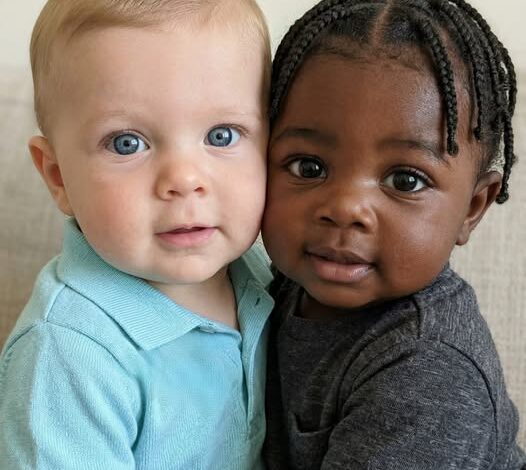
When my wife gave birth to twin boys with completely different skin tones, I thought for one terrifying moment that my entire life had split apart without warning. Standing in that hospital room under harsh fluorescent lights, exhausted after hours of labor and fear, I stared at our newborn sons and felt reality stop behaving the way I understood it should. One baby looked unmistakably like me — pale skin, soft features, light eyes beginning to blink open against the brightness of the room. The other had darker skin, tiny curls already visible against his head, and features so different that my mind immediately began searching desperately for explanations I didn’t want to believe.
But before I even saw them clearly, Anna had already understood what was coming.
“Don’t look,” she whispered weakly from the hospital bed.
At first, I thought she meant she was embarrassed or frightened after the delivery. She was crying hard enough to shake, exhausted beyond words after hours of labor. But then she repeated it.
“Please,” she begged. “Don’t look at them like that.”
That sentence followed me for years afterward.
Because she already knew.
Not what the doctors would eventually explain.
Not the genetics.
Not the science.
She knew what people would assume.
And she knew the look my face must have carried in that moment before I even realized it myself.
Anna and I had spent nearly six years trying to become parents. By the time this pregnancy survived past the dangerous early months, hope itself felt fragile enough to break if we touched it too quickly. We had survived miscarriages that hollowed us out emotionally in ways nobody around us fully understood. Friends tried comforting us with phrases like “everything happens for a reason” while we quietly learned how grief can live inside ordinary routines.
Pregnancy after loss changes people.
It teaches you not to celebrate too soon.
Not to trust happiness fully.
Not to assume tomorrow arrives safely.
So when this pregnancy finally held, we treated it almost reverently. We whispered about baby names instead of announcing them loudly. We delayed decorating the nursery because part of us feared tempting fate. Every appointment felt less exciting than terrifying.
But slowly, cautiously, hope returned anyway.
And then the twins arrived.
Two cries.
Two tiny lives.
Two boys we thought would finally close the years of pain behind us.
Instead, the delivery room transformed into confusion almost instantly.
I remember staring at them while my thoughts collapsed into panic so quickly I could barely hear the nurses speaking anymore. My brain kept trying to force the image into something explainable:
lighting,
swelling,
mistake,
confusion.
But nothing changed.
Anna kept crying.
“I swear to you,” she whispered repeatedly, “I didn’t do anything.”
The strange thing is that despite my shock, I believed her almost immediately.
Not because I understood what I was seeing.
But because I knew her.
Really knew her.
Infertility either destroys marriages or strips them down to their most honest form. Anna and I had already survived years of disappointment together, nights spent grieving silently beside each other because words no longer helped. I knew her fear. Her loyalty. Her exhaustion. Her heart.
And somewhere underneath the chaos of that hospital room, instinct told me this was not betrayal.
It was something else.
The hospital ordered every possible test.
Hours turned into days of waiting while specialists spoke carefully outside our room. Nurses avoided direct eye contact sometimes, clearly trying not to intrude on what they assumed must be a devastating situation. Family members visited carrying flowers and cautious expressions, pretending not to notice the tension filling the room.
The uncertainty became its own kind of torture.
Then finally, the results came back.
Both boys were biologically mine.
Every test confirmed it repeatedly.
No affair.
No second father.
No hidden scandal.
Just genetics behaving in a way so statistically rare that even some medical staff seemed fascinated by it.
The genetic specialist explained that inherited traits tied to ancestry can sometimes surface unpredictably in siblings, especially in families carrying mixed-race lineage several generations back. Different combinations of genetic expression can produce children with dramatically different skin tones and features despite sharing the same biological parents.
Scientifically, the explanation was straightforward enough.
Emotionally, it solved almost nothing.
Because the world outside the hospital did not care about genetics.
It cared about appearances.
And appearances immediately became public property.
At first, the reactions were subtle enough to ignore.
Cashiers staring too long.
Whispers in waiting rooms.
Confused pauses when people looked from one twin to the other.
Then the comments began.
At a pediatrician appointment, another mother casually asked Anna whether the boys had “different fathers.”
At daycare, someone joked loudly about “complicated family trees.”
Even strangers in grocery stores felt entitled to ask invasive questions as though our children existed for public curiosity.
I watched Anna shrink under it slowly.
Every comment carved something out of her confidence.
Every stare reminded her that people viewed her motherhood as suspicious before they viewed it as sacred.
She stopped making eye contact with strangers.
Stopped volunteering information.
Stopped correcting assumptions entirely after a while because exhaustion replaced outrage.
Some nights I’d wake up and find her sitting beside the twins’ crib in darkness just watching them sleep.
As if she needed proof they were still safe.
“They’re beautiful,” I told her constantly.
“I know,” she’d whisper back.
But the sadness in her voice always lingered.
The boys themselves, thankfully, grew untouched by the ugliness surrounding them. Children don’t inherit shame naturally; adults teach it. To each other, they were simply brothers. They fought over toys, built blanket forts, laughed hysterically at cartoons, and climbed into our bed every Saturday morning demanding pancakes.
They belonged together effortlessly.
The world was what struggled.
Then, after the boys turned three, everything changed again.
I came home one evening and found Anna sitting silently at the kitchen table holding printed emails and old family letters.
Her face looked drained of color.
“I can’t keep protecting them anymore,” she said quietly.
I sat down beside her.
“What happened?”
She slid the papers toward me.
And suddenly, the entire story rearranged itself.
The messages were between members of her extended family — conversations stretching back years discussing something they treated almost like a family scandal:
a mixed-race grandmother hidden deliberately from public conversation for decades.
Photographs buried.
Stories erased.
Relationships rewritten.
Anna’s family had always known their lineage carried Black ancestry.
They simply decided silence was easier.
And when our sons were born visibly reflecting that ancestry in dramatically different ways, they panicked.
Not because Anna had done anything wrong.
Because the truth they buried had resurfaced publicly.
My hands shook while reading one message from an aunt:
“If people ask questions, it’s better not to explain too much.”
Another read:
“They’ll assume what they want anyway.”
And perhaps the worst:
“Don’t ruin your marriage trying to force complicated history onto him.”
I looked at Anna completely stunned.
“You knew?”
Tears filled her eyes instantly.
“Not fully,” she admitted. “Only pieces. Rumors. Hints nobody would explain clearly.”
Then finally:
“They told me it would be easier if people blamed me.”
That sentence made something inside me go cold.
Because for years she carried humiliation, suspicion, and judgment almost entirely alone while the people who could have protected her chose silence instead.
Not to protect us.
To protect themselves.
Weeks later, we met again with genetic specialists who explained everything in greater detail. The phenomenon itself, while rare, was medically documented. Genetic inheritance is not a clean visual formula. Traits from previous generations can remain hidden for decades before appearing unexpectedly in descendants.
Nothing about our children was unnatural.
Nothing scandalous existed except people’s inability to understand complexity.
But by then, the emotional damage had already happened.
I confronted Anna’s family shortly afterward.
Not angrily.
Not dramatically.
I simply told them we would no longer participate in silence built from shame.
I told them our sons would grow up understanding every part of who they were — openly, proudly, and without apology.
And if anyone in the family could not handle that truth, they would lose access to our lives entirely.
Not as punishment.
As protection.
Months later, during a family gathering, someone inevitably asked the question again.
The same question we’d heard disguised in dozens of different forms over the years.
“So…” an older relative said awkwardly while glancing between the twins, “which one is actually yours?”
The room went completely silent.
I looked across the table at my sons laughing together completely unaware that adults still struggled to understand something they themselves never questioned.
Then I answered calmly.
“Both of them.”
The relative shifted uncomfortably.
“I just meant—”
“I know what you meant,” I said quietly.
Then I looked directly at my boys again.
“They’ve both been mine since the moment they arrived.”
No anger.
No shame.
No need to defend ourselves anymore.
Just truth.
Under the table, Anna’s hand found mine.
And for the first time in years, it wasn’t trembling.
Because eventually, after enough pain, enough explanations, enough surviving other people’s assumptions, something inside us changed:
we stopped trying to earn understanding from people committed to misunderstanding us.
The boys are older now.
Different in appearance still.
Different in personality too.
One inherited my stubbornness.
The other inherited Anna’s quiet sensitivity.
But they share the same laugh.
The same loyalty to each other.
The same certainty that they belong fully within this family.
And maybe that’s the real lesson hidden beneath all the confusion and judgment:
love does not become less real because other people fail to recognize it immediately.
Sometimes truth simply arrives in forms the world was not prepared to understand.
And sometimes the bravest thing a family can do is refuse to let ignorance rewrite their story into something smaller than what it really is.