I Brought Nana’s Heavy 18-Karat Gold Heirloom Earrings to a Pawn Shop to Pay My Mortgage – The Appraiser’s One Sentence Left Me Trembling in the Middle of the Store

I walked into that pawn shop believing I was about to lose the last piece of my grandmother I still had left.
Not emotionally.
Literally.
At that point, survival had stripped sentimentality down to a luxury I could no longer afford. The earrings weren’t just jewelry anymore. They were rent money. Medication money. Grocery money. The kind of money that determines whether your children sleep peacefully or overhear whispered panic through bedroom walls.
Still, my hands shook the entire drive there.
Because grief attaches itself to objects in strange ways.
A sweater becomes a voice.
A recipe card becomes a memory.
A pair of earrings becomes the last surviving proof that someone once loved you before life became difficult.
I’m twenty-nine years old, a single mother of three, and for the past two years my entire existence has felt like trying to hold together a collapsing roof with my bare hands.
My husband left one morning without warning.
No dramatic fight.
No long explanation.
No final conversation worth remembering.
Just absence.
One day we were discussing school schedules and groceries, and the next he was building a different life somewhere else like ours had simply expired naturally.
Since then, everything has been survival math.
Bills.
Doctor appointments.
School pickups.
Late-night budgeting sessions that always ended the same way: not enough.
Then my youngest son got sick.
And suddenly the word “survival” stopped sounding dramatic.
It became literal.
Hospital visits multiplied. Prescriptions stacked up. I took out loans I knew were dangerous because what else was I supposed to do? Every parent eventually reaches that terrifying place where logic becomes secondary to desperation.
You stop thinking about long-term consequences once your child’s health enters the equation.
Then last month, I lost my job.
Over the phone.
A woman I barely knew read from what sounded like a prepared script while I sat frozen at my kitchen table staring at unpaid notices spread around a half-empty cereal bowl.
“We’re downsizing.”
That was it.
Years of work reduced to one sanitized sentence.
Afterward, I sat there for almost an hour unable to move while my coffee went cold beside me. It felt strangely humiliating how quickly life can dismantle itself. One moment you’re struggling but functioning, and the next you’re calculating which utility can survive being shut off first.
That night I opened the old cedar box in my closet.
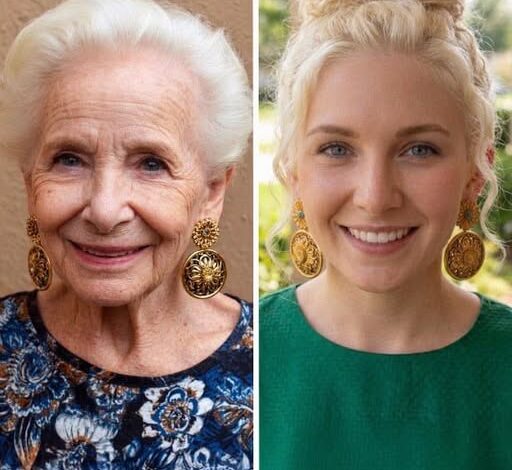
My grandmother’s earrings rested inside exactly where she left them years earlier.
Gold.
Elegant.
Old-fashioned in a way modern jewelry never quite is anymore.
I remember touching them carefully while grief rose unexpectedly in my throat.
My grandmother—Nana—used to wear them during holidays. Christmas dinners. Church services. Birthdays. As a child, I thought they made her look glamorous in a quiet, untouchable way.
After she died, they came to me.
Not because I was the oldest grandchild.
Not because they were expensive.
Because apparently, she specifically asked for me to have them.
At the time, I thought it was sentimental.
Standing there in my dark bedroom years later, I wondered if maybe it was practical instead.
The next morning, I wrapped them carefully and drove to the pawn shop.
The place looked exactly how sadness feels.
Dim lighting.
Dusty glass cases.
Shelves filled with abandoned versions of other people’s emergencies.
Wedding rings.
Old guitars.
Power tools.
Forgotten heirlooms carrying stories nobody asks about anymore.
The man behind the counter looked older, maybe late seventies, with silver hair and tired but alert eyes.
“What can I help you with?” he asked gently.
I placed the earrings onto the counter trying not to look emotional about it.
“I need to sell these.”
He nodded professionally at first.
Then he picked one up.
Everything changed after that.
At first, it was subtle.
His hands slowed.
His expression shifted almost imperceptibly.
Then he turned the earring over carefully beneath the light and suddenly went completely still.
Actually still.
Like someone listening to a memory arriving from very far away.
“Where did you get these?” he asked quietly.
“My grandmother.”
“What was her name?”
I told him.
And something in his face broke open instantly.
Without speaking, he reached beneath the counter and pulled out an old photograph.
Then he slid it toward me.
I stopped breathing.
There was my grandmother.
Young.
Beautiful.
Laughing.
Not the careful older woman I remembered from childhood, but someone vibrant and deeply alive in a way I had never seen before.
And beside her stood the man behind the counter.
Decades younger, but unmistakably him.
My grandmother was wearing the earrings.
My entire body went cold.
“Who are you?” I whispered.
He looked at the photo for a long moment before answering.
“My name is Walter.”
Then after a pause heavy enough to change the room entirely:
“And I’ve been waiting a very long time for someone from her family to walk through that door.”
I genuinely didn’t know what to say.
Walter picked up one earring again and pointed toward a tiny stamped mark near the clasp I had never noticed before.
“I made these,” he said softly. “When I was apprenticing.”
I stared at him.
“For her?”
He nodded once.
“She was supposed to marry me.”
The sentence landed like a stone dropped into deep water.
Not because of bitterness.
There wasn’t any.
Only tenderness.
Old tenderness.
The kind that survives long after life changes shape around it.
“We loved each other,” he continued quietly. “The real kind. The kind you build futures around. But life had other plans.”
I thought about my grandfather suddenly.
About family history.
About how many lives exist before we arrive in them.
“She married someone else,” I said carefully.
“She did,” Walter agreed softly. “But some people remain important even after the story changes.”
Then he reached into a drawer and pulled out a folded paper yellowed slightly with age.
My grandmother’s handwriting covered the front instantly recognizable even after all these years.
Inside was an address.
Her married name.
And one final sentence underneath:
If one of mine ever comes to you in need, do not turn them away.
I felt tears rise immediately.
“Why would she write this?”
Walter smiled sadly.
“Because she knew me.”
That answer somehow explained everything and nothing at all.
I broke apart after that.
Not dramatically.
Not elegantly.
Just exhausted honesty spilling out faster than I could stop it.
I told him about my son.
The medical bills.
The loans.
The job loss.
The foreclosure notices arriving in bright red envelopes that felt increasingly impossible to ignore.
Walter listened without interrupting once.
No pity.
No judgment.
Just attention.
Real attention.
When I finally stopped talking, embarrassed by how much emotion had escaped me in front of a stranger, he nodded slowly.
“You’re not alone,” he said.
That sentence nearly destroyed me more than anything else.
Because when people struggle long enough, isolation becomes part of survival. You stop expecting rescue. Stop expecting softness. Stop believing anyone will step into the mess beside you willingly.
“I still need the money,” I admitted quietly, looking at the earrings.
Walter shook his head gently.
“Selling them isn’t your only option.”
What happened next wasn’t miraculous.
That’s important.
Nobody suddenly erased my problems overnight.
No secret fortune appeared.
No magical solution descended from nowhere.
Instead, Walter made phone calls.
Careful, practical phone calls.
He connected me with a lawyer named Denise who specialized in emergency housing protections and medical debt negotiation. She explained things clearly for the first time in months. No confusing legal jargon. No talking down to me.
Walter made tea while paperwork spread across the counter between us.
They helped pause the foreclosure process.
Negotiated portions of the medical debt.
Connected me to emergency assistance programs I didn’t even know existed because exhausted people rarely have time to research survival resources properly.
By the time I left the shop that evening, nothing had been magically fixed.
But the pressure had shifted enough for me to breathe again.
And sometimes breathing again is the beginning of everything.
Over the following weeks, I started visiting Walter regularly.
At first to update him.
Then to bring coffee.
Then simply because sitting in that quiet shop somehow made the world feel less hostile for an hour.
My children started coming too.
Walter told them stories about my grandmother I had never heard before. Not tragic stories. Human ones. Stories about how loudly she laughed. How stubborn she was. How she once nearly ruined a dinner trying to impress someone with a recipe she absolutely could not cook.
For the first time, she stopped feeling like a distant family photograph.
She felt alive again.
One afternoon my daughter asked Walter why he kept the photograph all these years.
He looked toward the earrings resting inside their velvet box before answering.
“Because some people leave fingerprints on your soul,” he said softly. “Even after they’re gone.”
I think about that sentence often now.
Especially when life still feels uncertain.
Because things are still hard sometimes.
My son still has appointments.
Money still disappears too quickly.
Exhaustion still lives inside me more often than I’d like.
But the panic has softened.
And every now and then, I take out the earrings and study the tiny stamped mark Walter showed me near the clasp.
A hidden signature.
A quiet connection surviving decades unnoticed.
All this time, I thought my grandmother left me jewelry.
What she actually left behind was something far stranger and more valuable:
a thread.
One she trusted would hold if life ever unraveled badly enough.
And somehow, impossibly, it did.
Not because gold saved me.
Not because money fixed everything.
But because love—real love, honest love—sometimes continues protecting people long after the people themselves are gone.
And now, for the first time in years, I finally understand what Nana meant when she told me once, very quietly:
“These will take care of you someday.”
I thought she meant they were valuable.
She meant they carried kindness forward.
And when life finally broke me open enough to need it—
that kindness found its way home.
:::