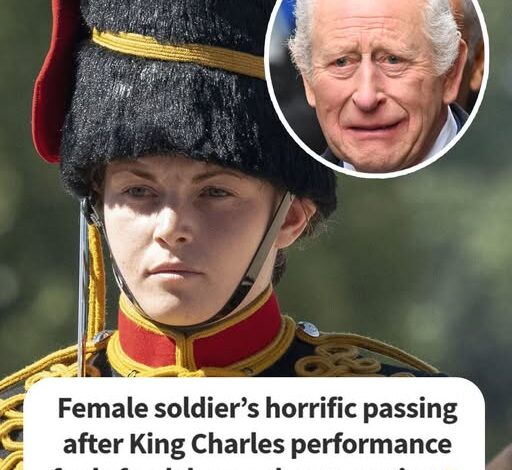
Female soldier’s horrific death after King Charles performance fuels fresh horse show scrutiny

What was meant to symbolize discipline, continuity, and national pride became, in a matter of seconds, a scene of irreversible grief.
The ceremony unfolded with the familiar precision Britain’s royal traditions are known for:
polished boots striking pavement in rhythm,
horses moving in trained formation,
carriages gleaming beneath public attention,
crowds watching with the reverence reserved for rituals older than living memory.
Among those riders was Lance Bombardier Ciara “Sully” Sullivan.
Young.
Respected.
Deeply committed to the role she carried.
To spectators, she appeared exactly as generations of ceremonial soldiers before her had appeared — composed beneath uniform and protocol, part of a spectacle designed to project stability and continuity through pageantry. But behind every polished tradition stands a human being balancing skill, pressure, instinct, and risk in real time.
And on that day, something went catastrophically wrong.
As King Charles and senior members of the royal family continued observing the ceremony, unaware initially of the full severity unfolding nearby, the event transformed from ritual into emergency almost instantly. The very qualities that make ceremonial military displays appear effortless to the public — precision, timing, rigid structure — can also make accidents unfold with terrifying speed once control breaks.
A horse startled.
A carriage shifted.
Visibility narrowed.
Seconds disappeared.
Then came impact, confusion, shouting, movement breaking protocol as soldiers and responders rushed toward disaster while stunned crowds struggled to understand what they were witnessing.
For the institution, the moment represented an unthinkable rupture in ceremonial order.
For Sully’s family, it became something far more devastating:
the last ordinary morning before life divided permanently into before and after.
In the days since her death, tributes have painted a portrait strikingly different from the formal image many spectators saw from a distance. Friends and fellow soldiers describe not merely a skilled rider, but someone whose presence changed the emotional atmosphere around her:
steady,
kind,
funny in quiet moments,
generous with nervous recruits,
disciplined without arrogance.
The nickname “Sully” appears repeatedly in memories now, carrying warmth impossible to capture through rank alone. Colleagues remember long training days made easier by her encouragement. Younger soldiers describe someone who led not through intimidation, but through competence and calm.
That combination earns enormous respect inside military culture.
Especially ceremonial units, where perfection is demanded publicly while the physical and psychological strain behind the scenes often remains invisible to outsiders.
Because beneath the polished uniforms and royal symbolism lies difficult, dangerous work. Horses remain unpredictable animals no matter how refined the ceremony surrounding them becomes. Carriages carry enormous weight and limited maneuverability. Visibility inside traditional uniforms can be restricted. Riders must maintain composure beneath intense scrutiny while operating inside rigid formations where tiny errors can escalate rapidly.
Tradition creates beauty partly through control.
But control is never absolute.
Now, grief has widened into public questioning.
Not disrespect toward Sully’s service.
The opposite.
People asking hard questions often do so precisely because her death feels too meaningful to absorb quietly without change. Military historians, safety experts, critics of ceremonial pageantry, and ordinary citizens alike have begun examining whether longstanding traditions are adequately balancing symbolism against modern safety realities.
Questions once considered uncomfortable now feel unavoidable:
Are some ceremonial vehicles outdated beyond reasonable risk?
Do traditional uniforms compromise visibility or mobility?
Are emergency response protocols sufficient?
Has spectacle gradually been prioritized over practical safety adaptations?
These conversations carry emotional tension because institutions built on tradition often resist rapid change instinctively. Ceremonies derive part of their power from continuity — the sense that participants move exactly as predecessors moved centuries earlier.
But continuity can become dangerous if reverence for history prevents honest evaluation of preventable risk.
That is the dilemma now confronting both military leadership and the public imagination surrounding royal ceremony itself.
How much danger is acceptable in the preservation of tradition?
Every military role carries risk, of course. Soldiers understand that intimately. Yet many people now question whether ceremonial duties — especially those performed before crowds and cameras rather than battlefields — should demand exposure to hazards potentially reduced through modernization.
Sully’s death transformed those concerns from abstract debate into human reality.
And human reality changes conversations permanently.
Because now there is a face attached to the questions.
A family attached to the grief.
Friends attached to the silence left behind in barracks, stables, and training grounds where her absence will linger long after headlines fade.
Somewhere, fellow riders are still preparing horses each morning while carrying fresh fear beneath practiced professionalism. Ceremonial precision becomes emotionally harder after tragedy because everyone suddenly remembers how thin the line between spectacle and catastrophe truly is.
Meanwhile, the public continues processing the unsettling contradiction at the center of the event:
a young woman died upholding a tradition designed partly to symbolize national strength and continuity.
That irony cuts deeply.
Especially because Sully herself appears to have believed sincerely in the work. By all accounts, she loved riding. Loved service. Loved being part of something larger than herself. Her death was not the result of indifference or reluctance. It emerged from devotion colliding with risk in the worst possible way.
That makes the loss harder, not easier.
Because institutions often struggle most when tragedy strikes their most dedicated people.
Still, amid the grief and controversy, another emotional truth keeps surfacing repeatedly in tributes:
Sully mattered far beyond the circumstances of her death.
Friends remember her laugh.
Her patience.
Her quiet leadership.
The way she reassured others under pressure even when carrying her own exhaustion.
Those details matter because tragedy can flatten people into symbols too quickly. News stories reduce lives to accidents, ranks, timelines. Loved ones fight desperately against that reduction afterward.
They want the world to remember the whole person:
not only the final moment,
but the thousands of ordinary moments that came before it.
A daughter.
A friend.
A soldier.
A rider who climbed into the saddle again and again because she believed in what she was doing.
Now her death leaves Britain facing an uncomfortable but necessary question:
when does honoring tradition require changing it?
Perhaps the most meaningful tribute will not be preserving everything exactly as it was the day Sully died.
Perhaps it will be ensuring no future soldier must face the same preventable danger in silence simply because “that’s how it has always been done.”
Because traditions survive longest not when they refuse change entirely —
but when they value the lives carrying them forward enough to evolve.
And somewhere beneath the uniforms, ceremonies, royal symbolism, and public debate remains the simplest truth of all:
a young woman went to work doing something she loved,
and did not come home.
Everything else begins there.