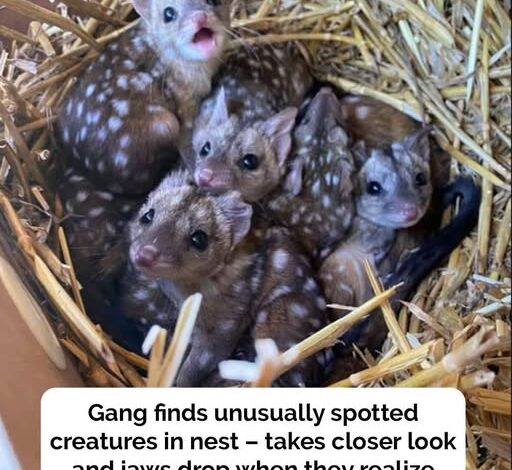
For generations, the western quoll stood as a sobering symbol of how fragile even the most resilient wildlife can be. Once roaming vast stretches of mainland Australia, this distinctive, cat-sized marsupial predator gradually disappeared from much of its historic range, its spotted coat becoming a memory rather than a familiar sight in the bush.
Its decline did not happen overnight.
Years of habitat loss steadily reduced the places where quolls could hunt and raise their young. Introduced predators, particularly foxes and feral cats, placed relentless pressure on already struggling populations. Poisoning campaigns and trapping, often aimed at protecting livestock or controlling other species, added yet another obstacle to the quoll’s survival. One threat alone might have been manageable. Together, they pushed the species to the brink across large parts of the continent.
Eventually, the western quoll vanished from many landscapes where it had once played a vital ecological role.
For countless Australians, it became an animal known only through faded photographs, museum displays, wildlife books, and stories passed down by older generations. First Nations custodians, whose knowledge of Country stretches back thousands of years, remembered the quoll as a familiar part of the landscape, even as younger generations grew up in places where it no longer existed.
Its absence changed more than the species itself.
As a native predator, the western quoll helps regulate populations of insects, reptiles, birds, and small mammals. Every ecosystem depends on a delicate balance between predators and prey, and when one important piece disappears, the effects often ripple far beyond what is immediately visible. The loss of a single species can quietly reshape entire landscapes.
But conservation is not only about documenting decline.
Sometimes, it is about writing a different ending.
At Mt Gibson Wildlife Sanctuary in Western Australia, conservationists set out to do something that once seemed almost impossible: return the western quoll to a place where it could once again thrive. It was an ambitious undertaking that required years of planning, habitat management, predator control, and careful scientific monitoring before the first animals were ever released.
There were no guarantees.
Reintroducing a species is one of conservation’s greatest challenges. Animals must adapt to unfamiliar surroundings, find food, avoid danger, establish territories, and, most importantly, reproduce successfully. Many carefully planned projects never reach that final milestone.
Which is why the latest discovery has generated such excitement.
After months of patient observation, ecologists found exactly what they had been hoping—but scarcely daring—to expect.
Tiny quoll joeys nestled safely inside their mothers’ pouches.
For conservation teams, that simple discovery meant everything.
It confirmed that the released animals were not merely surviving.
They were building the next generation.
The young quolls represent more than individual births. They signal that the habitat is providing what the species needs to establish a self-sustaining population. Adults are successfully finding mates, raising offspring, and reclaiming ecological roles that had been absent from the landscape for decades.
Researchers have also observed the animals behaving just as healthy wild quolls should.
They are exploring new territory.
Hunting for prey.
Establishing home ranges.
Interacting naturally with their environment rather than simply existing within it.
These are encouraging signs that the species is becoming part of the ecosystem once again instead of relying solely on human intervention.
The achievement reflects years of dedication by ecologists, wildlife managers, volunteers, researchers, and First Nations partners whose knowledge and stewardship continue to play an important role in conservation efforts across Australia. Successful wildlife recovery rarely happens quickly. It is built through countless hours of monitoring, data collection, habitat restoration, and patient problem-solving, often with progress measured in years rather than weeks.
Each new litter is therefore far more than a scientific milestone.
It is evidence that restoration is possible.
In a world where stories of extinction often dominate environmental headlines, the return of the western quoll offers something increasingly valuable: hope grounded in evidence rather than optimism alone.
It demonstrates that damaged ecosystems can recover when habitats are protected, invasive predators are carefully managed, and long-term conservation receives sustained support.
Of course, the work is far from finished.
The future of the western quoll will depend on continued monitoring, ongoing habitat protection, and careful management to ensure the recovering population remains healthy. Conservation is rarely a single victory—it is an enduring commitment that requires vigilance long after the headlines fade.
Still, the sight of those tiny spotted joeys tucked safely inside their mothers’ pouches represents something profoundly meaningful.
It is a reminder that extinction is not always inevitable.
That thoughtful conservation can reverse decades of decline.
And that when people choose restoration over exploitation, patience over neglect, and protection over destruction, nature often proves remarkably capable of healing itself.
For the western quoll, the journey back is still unfolding.
But with every successful birth, every healthy young animal venturing into the bush, and every new generation taking its place in the wild, an ancient Australian predator is reclaiming the landscape it once called home.
And with its return, the ecosystem grows just a little stronger, one quiet step—and one tiny pouch at a time.