MIA SOLD HER FAVORITE TOY TO SAVE HER FRIEND BUT THE TRUTH ABOUT CHLOE PARENTS BROUGHT THE SCHOOL TO A STANDSTILL

The principal’s office stayed quiet long after Mia finished speaking.
Not awkward quiet.
Not angry quiet.
The kind of silence that appears when adults suddenly realize a child has just exposed something uncomfortable about them.
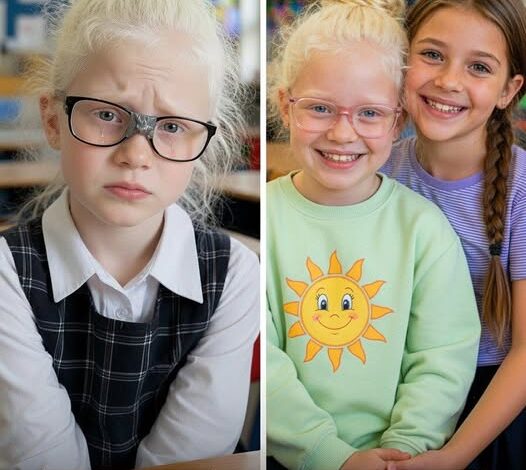
Chloe’s father sat rigid beside his wife, staring down at the cracked glasses lying on the desk between them like evidence from a trial nobody expected to attend. Gray duct tape still wrapped around the center of the frames. What was meant to become a lesson about responsibility had transformed into public humiliation visible to every child in school.
And now another little girl had sold her most treasured possessions trying to repair the damage.
Mia shifted nervously beside me.
“Am I in trouble?” she whispered.
My heart nearly collapsed hearing that.
Because somehow, after giving away the thing she loved most to protect a crying friend, she still worried she had done something wrong.
I pulled her gently against my side.
“No, baby,” I said softly. “You’re not in trouble.”
Across the office, Chloe suddenly burst into tears again.
Not embarrassed tears this time.
Relieved ones.
“I told Mia we were poor because I didn’t want her to know my parents were doing this on purpose,” she admitted shakily.
Her mother covered her mouth immediately.
“Oh, sweetheart…”
But Chloe kept going.
“Everybody kept laughing at me. They called me ‘duct tape girl.’”
Her father closed his eyes briefly like the words physically hurt.
Children rarely understand how deeply humiliation can settle into another child’s identity. Adults forget too sometimes. What feels like “teaching responsibility” at home can become social devastation once carried into classrooms full of kids desperate not to become targets themselves.
The principal finally cleared her throat carefully.
“I think everyone here had good intentions,” she began diplomatically.
“No,” Chloe’s father interrupted quietly. “I think my daughter was humiliated publicly because I cared more about making a point than understanding consequences.”
The honesty surprised everyone.
Especially Chloe.
Parents apologizing sincerely to children remains strangely rare in this world. Adults often defend decisions long after realizing they caused harm because admitting mistakes feels too vulnerable.
But sitting there in that office, watching his daughter cry beside a pair of taped glasses another little girl sacrificed her treasures to replace, something inside him had clearly shifted.
Chloe’s mother turned toward Mia slowly.
“You sold your entire Lego collection?”
Mia nodded once.
Those Legos had been everything to her.
Birthday sets.
Christmas castles.
Tiny figures she organized obsessively by color and series.
Hours and hours of imaginary cities spread across our apartment floor because we couldn’t afford vacations or expensive entertainment.
When money is tight, children attach deeper meaning to the few things fully theirs.
And Mia gave hers away without hesitation.
“Why?” Chloe’s mother whispered emotionally.
Mia looked genuinely confused by the question.
“Because Chloe was crying alone in the bathroom.”
That was it.
No speech about generosity.
No expectation of reward.
Just simple empathy.
A child seeing another child hurting and deciding the pain mattered more than possessions.
The principal wiped at her eyes discreetly.
I sat there stunned by my own daughter all over again.
Because when you spend years struggling financially as a parent, guilt becomes part of your bloodstream. You constantly measure yourself against what other families can provide:
better schools,
newer clothes,
vacations,
sports camps,
easier lives.
You worry your child notices every limitation even when they smile through it.
But in that office, something became painfully clear:
Mia had been learning from our struggles in ways I never intended.
Not bitterness.
Not envy.
Compassion.
The meeting ended differently than anyone expected.
No punishment.
No anger.
Only adults quietly confronting themselves.
As we prepared to leave, Chloe suddenly hugged Mia tightly.
“I’m sorry I lied,” she whispered.
Mia hugged her back immediately.
“It’s okay.”
Simple.
Instant.
Children often forgive faster than adults because they have not yet built entire identities around pride.
Outside the school, Mia slipped her hand into mine while we walked toward the bus stop.
“Are Chloe’s parents mad at me?”
“No.”
“Really?”
“Really.”
She seemed relieved.
Then, after several blocks of silence, she asked softly:
“Did I do the wrong thing selling my Legos without asking?”
There it was.
The question I had been dreading.
Not because I wanted to scold her.
Because parenthood becomes complicated when your child behaves more selflessly than most adults.
I stopped walking and crouched beside her carefully.
“You should always tell me before selling important things,” I said gently.
She nodded immediately.
“But helping someone who’s hurting?” I touched her cheek softly. “That part was beautiful.”
Mia smiled then.
Small.
Shy.
The same smile she used to give me after drawing pictures she secretly hoped I’d hang on the refrigerator.
That night, after she fell asleep, I sat alone in the living room staring at the empty corner where the Lego bin used to sit.
The absence felt enormous.
Not tragic.
Sacred somehow.
I remembered all the nights we built together on the apartment floor because going out cost too much money. Entire cities made from imagination instead of expensive entertainment. Tiny plastic worlds where Mia controlled everything:
the houses stayed standing,
families stayed kind,
problems always had solutions.
And now those pieces belonged to someone else because my daughter decided another little girl’s humiliation mattered more than her own happiness.
I cried quietly after that.
Not from sadness exactly.
From the overwhelming realization that children are always watching who we become during hardship.
Every time I stretched groceries creatively instead of complaining.
Every moment I shared what little we had with neighbors.
Every exhausted night I still reminded Mia to think about other people’s feelings.
Apparently she absorbed all of it.
Even the parts I thought were invisible.
Three days later, Chloe’s parents invited us to dinner.
I almost declined immediately.
People with money make me nervous.
Not because wealthy people are inherently cruel, but because poverty trains you to anticipate judgment everywhere:
your clothes,
your car,
your hesitation around expensive menus.
Walking into their home felt like entering another universe entirely.
The kitchen alone looked larger than my entire apartment.
But Chloe’s mother greeted us warmly enough that some of my anxiety softened almost immediately.
Meanwhile, Mia and Chloe disappeared upstairs laughing together before dinner even started.
Children recover quickly once shame leaves the room.
Over pasta and wine I could barely pronounce, Chloe’s father finally spoke carefully.
“I owe you an apology.”
I blinked.
“You don’t owe me anything.”
“Yes,” he said quietly. “I do.”
He looked down at his hands briefly before continuing.
“I grew up poor. Very poor. When Chloe kept losing expensive glasses, I thought teaching consequences mattered more than comfort.”
I stayed silent.
“But somewhere along the way,” he admitted, “I stopped noticing the difference between discipline and humiliation.”
The honesty in his voice reminded me painfully of something:
good parents can still deeply hurt their children while trying to prepare them for the world.
Fear disguises itself as wisdom surprisingly often.
Chloe’s mother reached across the table then and handed me a folder.
At first I thought it contained reimbursement paperwork for the Legos.
Instead, I found college savings documents.
I stared at them speechless.
“We wanted to do something meaningful for Mia,” she explained softly.
“You absolutely do not have to—”
“We know,” Chloe’s father interrupted gently. “That’s why we want to.”
My throat tightened immediately.
The account already contained more money than I had ever managed to save in years.
I looked at them completely overwhelmed.
“You barely know us.”
Chloe’s mother smiled sadly.
“No,” she said. “But your daughter reminded us who we want to raise ours to become.”
I cried in their dining room before I could stop myself.
Embarrassing, messy tears born from exhaustion and relief and years of carrying financial fear quietly alone.
“I’m sorry,” I whispered, wiping my face quickly.
“Please don’t apologize,” Chloe’s mother said immediately.
But apologizing had become instinct.
That is another thing poverty does to people:
it trains gratitude and shame to exist side by side until receiving kindness feels almost painful.
Later that evening, while the girls decorated cookies in the kitchen upstairs, Chloe’s father walked me onto the back patio.
“You know,” he said quietly, “when I heard another child bought my daughter glasses, my first reaction was anger.”
I nodded.
“I understand.”
“No,” he corrected gently. “I don’t think you do.”
He leaned against the railing heavily.
“I was embarrassed.”
The admission surprised me.
“Because some nine-year-old girl showed me more compassion in one afternoon than I showed my own daughter in weeks.”
The honesty of that stayed with me long afterward.
On the drive home, Mia fell asleep in the passenger seat clutching leftover cookies wrapped in foil.
Streetlights moved softly across her face while she slept.
And suddenly I remembered every moment I had ever felt like I was failing her:
discount clothes,
missed field trips,
birthdays smaller than her friends’.
I spent years believing motherhood was measured mostly through what I could materially provide.
But maybe children measure love differently.
Maybe they remember who listened.
Who shared.
Who remained gentle while struggling.
Maybe character forms less through abundance than through watching how people behave when abundance does not exist.
At home, I carried Mia carefully to bed.
Half-asleep, she whispered:
“Did Chloe smile tonight?”
“Yes.”
A sleepy little grin crossed her face.
“Good.”
Then she drifted back asleep immediately, completely at peace with trading her favorite possessions for someone else’s happiness.
I stood there beside her bed for a very long time afterward.
Parents spend so much energy trying to teach children right from wrong.
But occasionally, if we are lucky, our children reveal the lessons they learned by becoming better people than we ever expected.
The empty corner where the Legos once sat still catches my eye sometimes.
For a while, I thought it represented sacrifice.
Now I think it represents something else entirely.
Proof.
Proof that kindness can survive inside hard lives.
Proof that empathy does not require wealth.
Proof that even in a world increasingly shaped by selfishness, cruelty, and convenience, one little girl looked at another child crying in a school bathroom and decided:
I can help.
And then she did.