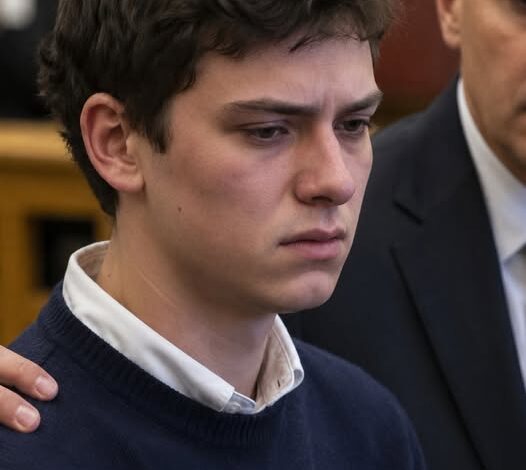
In the aftermath, the case refused to fade. It was replayed in news segments, classrooms, and living rooms, each retelling bending around the same impossible question: what should society do with a young person who has caused irrevocable harm? To some, the length of the sentence felt like the only language strong enough to speak to the gravity of the crime and the pain of the victims. To others, it looked like the legal system slamming a door on any possibility of transformation.
Yet the image that lingered was not the judge’s words, but the teenager’s final glance at his family. Their faces held grief, fear, and a love with nowhere to go. It was a stark reminder that punishment radiates outward, touching parents, siblings, and communities. In that fragile moment, the abstract debate over justice and mercy became deeply, unbearably human.
Long after the courtroom emptied, the case continued living inside the public imagination.
Some tragedies disappear quickly, swallowed by the endless churn of headlines and outrage cycles. This one did not. Something about it lodged itself into people’s minds and refused to loosen its grip. Perhaps it was the age of the accused. Perhaps it was the brutality of the crime itself. Or perhaps it was because the case forced society to confront a question with no answer clean enough to satisfy anyone:
what do we do when someone barely old enough to become a person fully has already destroyed another life forever?
Every retelling carried tension inside it.
News anchors discussed sentencing guidelines with carefully measured voices while images of yearbook photos flashed across screens. Legal analysts debated precedent and proportionality. Teachers referenced the case during ethics discussions. Parents brought it up quietly after dinner once children had gone upstairs.
Again and again, conversations circled the same emotional fault line:
justice versus mercy,
punishment versus rehabilitation,
accountability versus hope.
People divided sharply, yet many found themselves uncomfortable with their own certainty no matter which side they leaned toward.
For some, the sentence still seemed insufficient because no amount of prison time could restore what had been taken. Families burying loved ones do not experience closure the way movies pretend they do. Loss remains stubbornly physical:
empty bedrooms,
holidays reshaped permanently,
phone numbers still saved accidentally,
voices remembered suddenly in grocery stores and dreams.
To those grieving closest to the crime, harsh punishment often feels like the only remaining acknowledgment society can still offer. If the law responds too gently, it risks communicating that the suffering left behind somehow matters less than the future of the person who caused it.
That fear is understandable.
Pain naturally demands recognition.
Others looked at the teenager differently.
Not as innocent.
Not undeserving of accountability.
But unfinished.
A brain still developing.
A life not fully formed.
A human being who committed irreversible harm before emotional maturity itself had fully settled into place.
Those people feared something different:
that society increasingly confuses permanent condemnation with justice itself.
They questioned whether punishment without the possibility of transformation serves anyone beyond emotional retribution. They worried about a legal system that sometimes treats young offenders as simultaneously too immature to drink, vote responsibly, or rent cars—yet mature enough to be discarded forever once they commit monstrous acts.
Neither perspective erased the horror of the crime.
Neither perspective fully resolved the moral contradiction.
That is what made the case so haunting.
Everyone involved seemed trapped inside truths colliding against each other painfully:
the victims deserved justice,
the harm could never be undone,
the teenager caused it,
the teenager was still young,
society needed accountability,
society feared hopelessness too.
No sentence could untangle all those realities neatly.
Yet strangely, the moment people remembered most was not the verdict itself.
Not the judge speaking.
Not reporters crowding courthouse steps.
Not legal commentary afterward.
It was a glance.
One brief glance toward family before deputies led the teenager away.
That image spread because it carried something words could not fully explain. His mother looked shattered in a way grief rarely appears publicly unless people forget cameras are present. A sibling covered their mouth trying not to collapse. A father stared forward rigidly like someone physically holding himself upright through force alone.
And the teenager—still young enough to look frightened rather than hardened—turned toward them instinctively before disappearing through the side door.
For a second, the entire case stopped feeling ideological.
It became familial.
Human.
Painfully ordinary beneath the horror.
Because behind every criminal case exists another quieter tragedy people discuss less comfortably:
families who love someone capable of terrible things.
Society struggles with that reality emotionally because it complicates moral simplicity. People prefer clean categories:
victim,
villain,
monster,
innocent.
But families rarely experience loved ones in clean categories.
Parents remember scraped knees, bedtime stories, school concerts, fevers at three in the morning, tiny hands gripping theirs crossing streets. They carry entire emotional histories impossible to erase instantly even when confronted with horrifying truth.
Loving someone who has done something unforgivable creates a uniquely isolating form of grief.
Public sympathy evaporates quickly.
Shame arrives immediately.
People withdraw.
Neighbors stare differently.
Conversations become awkward or disappear entirely.
Yet love itself often remains stubbornly alive despite everything.
That contradiction unsettles outsiders deeply.
How can parents still cry for a child who caused devastation?
How can siblings still miss someone responsible for irreversible pain?
Because love does not always obey morality cleanly.
Families become emotionally trapped between accountability and attachment, forced to hold both simultaneously:
the reality of harm,
and the reality that the person responsible still belongs emotionally to them somehow.
The teenager’s final glance captured that impossible emotional territory in a single moment.
Not innocence.
Not absolution.
Attachment.
The courtroom itself reflected society’s larger struggle too. Victims’ relatives sat carrying unbearable grief while defense attorneys argued developmental psychology and rehabilitation potential. Prosecutors spoke about accountability. Psychologists discussed adolescent impulse control. Journalists scribbled notes trying to condense human devastation into coherent narratives before deadlines arrived.
Everyone searched desperately for language strong enough to contain the emotional weight of what happened.
But some events resist tidy explanation.
Especially crimes involving young people.
Youth unsettles punishment philosophically because adolescence exists in a morally unstable space. Teenagers are old enough to make choices, yet young enough to remain deeply unfinished psychologically. Capable of cruelty, recklessness, empathy, impulsiveness, growth, and catastrophic mistakes sometimes within the same hour.
Society wants certainty from courts because uncertainty feels dangerous.
But adolescence itself is uncertainty embodied.
That reality creates emotional discomfort no legal system resolves perfectly.
The case also forced people to confront broader fears about violence, alienation, and emotional disconnection among young people generally. Commentators searched endlessly for causes:
social media,
family instability,
mental health crises,
violent entertainment,
school environments,
access to weapons,
broken institutions.
Everyone wanted explanation because explanation creates the illusion of prevention.
If we can identify the cause, perhaps we can stop the next tragedy.
But human behavior rarely reduces neatly into single causes. Most devastating acts emerge from tangled combinations of personality, environment, trauma, impulsivity, emotional isolation, and opportunity intersecting disastrously at exactly the wrong moment.
That complexity frustrates public discourse because complexity denies emotional closure.
It is easier psychologically to imagine monsters than to accept ordinary human beings sometimes become capable of monstrous harm under certain conditions.
Yet the courtroom image endured precisely because it refused easy simplification.
A grieving family on one side.
Another grieving family on the other.
Different griefs.
Different losses.
Different forms of devastation radiating outward from the same irreversible event.
Punishment affected everyone in the room differently.
The victims’ loved ones carried absence.
The teenager’s family carried shame and separation.
Communities carried fear.
Classmates carried memory.
Teachers carried questions.
Jurors carried psychological residue from evidence they would never fully forget.
Violence never remains isolated to the direct act itself. It expands outward socially and emotionally through countless connected lives.
That expansion is what people sensed instinctively while watching coverage of the case unfold.
The teenager disappearing through courthouse doors represented more than one life ending symbolically. It represented futures collapsing across multiple families simultaneously.
The victims lost futures entirely.
The teenager lost freedom.
Parents lost certainty about who their child was.
Siblings lost normalcy.
Communities lost innocence about safety and youth itself.
No verdict could restore any of that.
Years from now, people may forget specific legal arguments from the trial. They may forget sentencing details or television commentary. But they will likely remember the emotional image instead:
a frightened young face turning toward family one final time before disappearing into a system designed both to punish and, perhaps uncertainly, to leave room for possible redemption someday.
That image lingers because it forces uncomfortable recognition.
Justice matters deeply.
Accountability matters deeply.
But even at the center of terrible acts, human beings remain emotionally connected to one another in ways punishment alone cannot fully erase.
And perhaps that is why the case stayed with people so long afterward.
Not because it offered clear answers.
Because it exposed how painfully difficult real justice becomes once abstract principles collide with actual human lives, actual grief, and actual love that survives even where many believe it no longer should.