The Mystery Object That Turned Out to Be Completely Ordinary
It started with something so small that most people would have ignored it.
I was sitting in my girlfriend’s room one afternoon while she finished getting ready. The television wasn’t on. My phone battery was nearly dead. There wasn’t much to do except wait.
So I did what most people do when they’re sitting alone in a quiet room.
I looked around.
Not snooping.
Not searching through drawers.
Just noticing the ordinary things that normally fade into the background.
A stack of books sat on a shelf near the window.
A half-empty coffee mug rested on a coaster.
A few notebooks were scattered across her desk.
Everything looked completely normal.
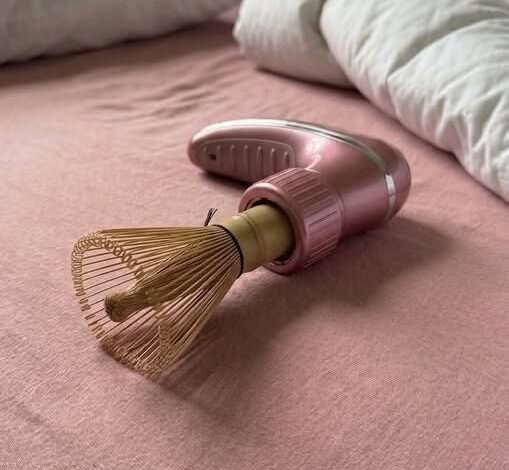
Then I noticed something I couldn’t identify.
At first glance, it looked almost like a miniature sculpture.
It had a sturdy handle attached to a strange arrangement of thin wire loops.
The handle appeared practical and functional.
The wire section looked delicate and unusual.
Together, the pieces formed an object that made absolutely no sense to me.
The longer I stared at it, the stranger it seemed.
I tried matching it to familiar objects.
It wasn’t a kitchen utensil I recognized.
It wasn’t makeup equipment.
It wasn’t part of a computer or electronic device.
There were no buttons.
No display.
No obvious moving parts.
No labels.
Nothing that immediately explained its purpose.
For some reason, that made it impossible to ignore.
Curiosity has a funny way of growing stronger the less information you have.
Within minutes, I was completely invested in solving a mystery that probably didn’t matter at all.
I carefully picked up the object and examined it from every angle.
The handle felt solid.
The wire loops felt flexible but intentional.
Clearly, somebody had designed it for a specific purpose.
The question was:
What purpose?
The possibilities started multiplying.
Maybe it belonged in a kitchen.
Maybe it was part of a hobby.
Maybe it was attached to another device that wasn’t present.
Maybe it was decorative.
Maybe it was some specialized tool I’d never encountered before.
The more theories I created, the less confident I became.
At one point I actually wondered if it was some kind of tiny modern art piece.
The truth turned out to be much simpler.
After comparing images online, I finally discovered what it was.
An electric matcha whisk.
That’s it.
Nothing mysterious.
Nothing unusual.
Nothing secret.
Just a small kitchen tool designed to mix powdered green tea into water.
The sturdy handle housed a small motor.
The wire loops were designed to break apart clumps of matcha and create a smooth, frothy drink.
The moment I learned its purpose, the entire design suddenly became obvious.
Every part made sense.
Every curve had a function.
Every detail served a purpose.
The mystery vanished instantly.
I laughed at myself.
For ten minutes I had transformed an ordinary kitchen appliance into some elaborate puzzle simply because I encountered it outside its normal context.
If I’d seen it sitting beside a tea set in a kitchen, I probably would have understood immediately.
But on a bedroom desk?
My brain couldn’t place it.
That should have been the end of the story.
Except a few days later, something remarkably similar happened again.
This time at my parents’ house.
My mother walked into the kitchen holding a strange metal object she’d found in one of my father’s drawers.
She placed it on the table.
“What do you think this is?”
I looked down.
Immediately, I knew we had another mystery.
The object appeared old.
Not damaged.
Not broken.
Just unfamiliar.
Its metal surfaces curved in unusual ways.
Certain parts appeared designed to move or attach to something.
Other sections looked decorative despite clearly serving some practical purpose.
It was the kind of object that seemed important without revealing why.
My mother and I spent nearly fifteen minutes examining it.
We turned it over.
Opened and closed various sections.
Tested different theories.
Nothing fit perfectly.
At first, we thought it might be a workshop tool.
Then we considered whether it belonged to an old appliance.
For a moment, my mother suggested it could be medical equipment.
Every guess seemed possible.
None seemed certain.
What made the puzzle particularly difficult was the object’s age.
Modern products often contain clues.
They have labels.
Buttons.
Screens.
Charging ports.
Logos.
Instructions.
Older tools frequently have none of those things.
They were designed for people who already understood their purpose.
No explanation required.
Decades later, when those routines disappear, the tools remain.
But the context is gone.
Eventually, we searched online and found the answer.
It was a vintage kitchen accessory.
A simple attachment designed to assist with food preparation.
Something that would have been instantly recognizable to previous generations.
Something millions of people had probably used without giving it a second thought.
Yet sitting alone in a drawer decades later, it looked like an artifact from another world.
Once again, the mystery dissolved the moment we learned the purpose.
The object hadn’t changed.
Only our understanding had changed.
That realization stayed with me.
Because both experiences followed the exact same pattern.
First came confusion.
Then speculation.
Then increasingly elaborate theories.
Finally, a surprisingly ordinary explanation.
The objects themselves were never mysterious.
What was missing was context.
And context changes everything.
A matcha whisk looks strange to someone who has never made matcha.
A vintage kitchen tool looks bizarre to someone who has never seen the appliance it belongs to.
The objects haven’t become mysterious.
We’ve simply become disconnected from the knowledge that once made them obvious.
It’s an interesting reminder of how the human mind works.
When we encounter something unfamiliar, we instinctively try to explain it.
Our brains search for patterns.
Connections.
Comparisons.
Anything that helps transform uncertainty into understanding.
Sometimes that process works beautifully.
Other times it leads us into wildly inaccurate conclusions.
Without context, even the most ordinary object can seem important, unusual, or suspicious.
A forgotten kitchen tool can resemble specialized equipment.
A household accessory can look like a scientific instrument.
A simple appliance attachment can appear completely alien.
The less information we have, the more imagination fills the gap.
That’s true far beyond mystery objects.
It’s true in everyday life.
People often misunderstand situations for the same reason.
They see only part of the picture.
They fill the missing pieces with assumptions.
Then those assumptions start feeling like facts.
The reality is usually much simpler.
Most mysteries become less mysterious once enough information is available.
Most strange things become ordinary once their purpose is understood.
That’s why context matters so much.
Context transforms confusion into clarity.
It converts puzzles into explanations.
It reveals the story behind what we’re seeing.
The matcha whisk wasn’t strange.
The vintage kitchen accessory wasn’t strange.
They only seemed strange because they had been separated from the environments that explained them.
And perhaps that’s the most interesting lesson of all.
Not every mystery has a dramatic answer.
Not every unknown object hides a secret.
Not every puzzle leads to a shocking discovery.
Sometimes the solution is simply learning something new.
Sometimes the answer is a cup of tea.
Sometimes it’s an old kitchen gadget.
And sometimes the only thing missing is context.