Mel Gibson’s son Milo is all grown up at 32, and fans can’t get over how much he resembles his father

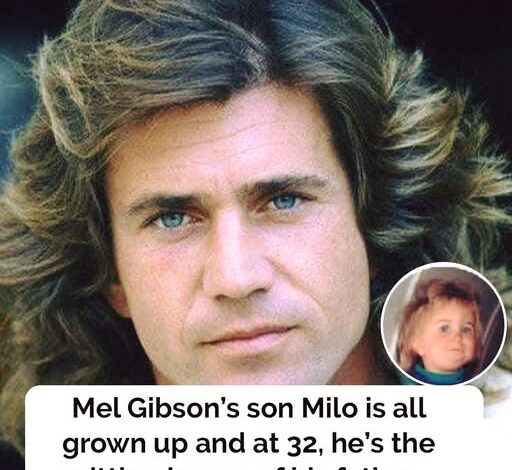
Mel Gibson built his career in an era when movie stars still felt larger than life.
Before social media flattened celebrity into constant visibility, before every interview became instant viral content dissected by strangers online, actors like Gibson existed with a kind of mythic distance around them. Audiences did not merely follow their careers; they projected entire ideas of masculinity, rebellion, charisma, and cinematic power onto them.
And few actors carried that weight more intensely than Mel Gibson during the height of his fame.
For decades, he stood at the center of some of the most recognizable films in modern cinema — action epics, war dramas, historical spectacles, and emotionally charged thrillers that helped define Hollywood across multiple generations. To audiences around the world, he became more than an actor. He became a presence:
the hardened survivor,
the reluctant hero,
the furious patriot,
the damaged man pushing forward through violence, grief, or impossible odds.
Yet behind all the cinematic scale existed a quieter reality that rarely received equal attention:
Mel Gibson was also the father of nine children.
That contrast has always made public fascination with the Gibson family unusually layered. Hollywood audiences know Mel as an icon shaped by fame, controversy, ambition, and artistic success. But his children inherited a far more complicated version of that legacy — one shaped not only by celebrity, but by expectation.
And among them, Milo Gibson may represent the most interesting balance between inheritance and individuality.
Because unlike many children born into Hollywood dynasties, Milo did not rush toward the spotlight immediately.
In fact, for years, he moved deliberately away from it.
That decision alone says something important.
Children of famous actors often grow up surrounded by invisible pressure. Even when families try protecting them, fame leaks into ordinary life. Last names become introductions before personalities have fully formed. Expectations arrive before identity does. People begin predicting futures for celebrity children long before those children understand themselves well enough to choose one.
Milo Gibson appeared determined to avoid becoming another easy Hollywood narrative.
Born in 1990 in Australia, he spent much of his childhood outside the most intense glare of entertainment culture. Although Mel Gibson’s fame expanded globally during those years, interviews suggest the family attempted to maintain relative privacy around the children whenever possible.
That privacy mattered.
Especially because Mel Gibson’s own life increasingly became divided between enormous professional success and equally enormous public scrutiny. Fame at that level creates strange emotional weather around families. Public perception shifts constantly. Headlines fluctuate between admiration and controversy. Children grow up aware that millions of strangers already carry opinions about someone they know simply as “Dad.”
Perhaps that explains why Milo initially pursued work far removed from Hollywood performance.
Before acting professionally, he reportedly held practical jobs, including work involving physical labor and ordinary routines disconnected from celebrity culture. Those years may seem unremarkable compared to red carpets and film premieres, but they likely shaped him more deeply than early fame would have.
Because ordinary work teaches people things fame often interrupts:
patience,
humility,
structure,
observation.
You meet people who do not care about your family name.
You learn how exhaustion feels outside glamour.
You experience life without constant applause or expectation.
Milo has spoken in interviews about how those experiences influenced his understanding of people and eventually his approach to acting itself. That perspective matters because strong performers often draw from observation more than performance. They notice how ordinary people speak when nervous, angry, ashamed, proud, or exhausted.
And perhaps growing up partly outside Hollywood gave Milo emotional texture many second-generation actors struggle to develop early.
Meanwhile, Mel Gibson’s own career continued evolving through dramatic phases.
His rise originally began in Australia after studying at the National Institute of Dramatic Art in Sydney — a training ground that sharpened his instincts long before global fame arrived. The success of Mad Max in 1979 changed everything almost immediately.
The film exploded internationally because it carried something raw and dangerous audiences had not fully seen before. Gibson’s screen presence combined physical intensity with emotional unpredictability in ways that translated powerfully across cultures. He looked simultaneously controlled and close to violence, charismatic yet volatile.
That energy became central to many of his most famous roles afterward.
Throughout the 1980s and 1990s, Gibson evolved from rising action star into one of Hollywood’s dominant leading men. Films like Lethal Weapon expanded his appeal massively because they balanced aggression with humor and emotional vulnerability. Audiences trusted him inside high-stakes stories because he made damaged characters feel believable rather than theatrical.
But acting alone did not satisfy him creatively for long.
That shift toward directing became one of the defining transitions of his career.
Many actors attempt directing eventually. Far fewer succeed convincingly. Gibson did because he possessed strong visual instincts and a willingness to embrace emotional intensity without softening it for comfort.
His version of filmmaking leaned unapologetically large:
big emotions,
big moral conflicts,
big historical stakes.
Braveheart became the clearest example of that approach.
When the film released in 1995, it did more than succeed commercially. It entered cultural memory almost immediately. Historical epics often fail because spectacle overwhelms humanity. Braveheart succeeded because Gibson anchored the enormous scale in personal grief, fury, sacrifice, and longing.
The film’s impact extended far beyond awards recognition.
Winning Best Picture and Best Director solidified Gibson’s reputation as more than a movie star experimenting behind the camera. He became recognized as a filmmaker capable of shaping emotionally overwhelming cinematic experiences audiences remembered for decades afterward.
And yet, artistic achievement rarely protects public figures permanently.
Over time, Gibson’s career became increasingly complicated by controversy, public incidents, and personal struggles that altered how audiences perceived him. Modern celebrity culture often reduces people into simplified categories:
hero,
villain,
genius,
failure.
But long careers rarely remain emotionally simple.
Gibson’s public image fractured over time into competing narratives:
brilliant filmmaker,
troubled celebrity,
controversial public figure,
dedicated father,
volatile personality.
The contradictions themselves became part of how audiences understood him.
And through all those fluctuations, his children grew older watching the world react to their father in dramatically shifting ways.
That context makes Milo’s gradual entrance into acting particularly interesting.
He did not emerge as a polished teenage celebrity immediately handed blockbuster roles. Instead, his transition into film felt slower and more cautious, almost observational. When he finally appeared in Hacksaw Ridge in 2016 — directed by his father — the moment carried symbolic weight beyond a simple casting decision.
For audiences, it represented generational overlap:
the veteran filmmaker and his son sharing the same creative space publicly for the first time.
Hacksaw Ridge itself also mattered because it marked a major professional comeback moment for Mel Gibson as director. The film received critical acclaim and multiple award nominations, reminding audiences of the cinematic power Gibson still possessed behind the camera.
For Milo, participating in that environment became an unusually intense introduction to professional filmmaking.
Not only was he entering Hollywood.
He was entering it through one of the most emotionally demanding war films of the decade under the direction of one of cinema’s most intense personalities — who also happened to be his father.
That dynamic could easily have overwhelmed someone less grounded.
Instead, Milo appeared to approach the opportunity pragmatically. Interviews afterward emphasized work ethic rather than entitlement. He consistently acknowledged his father’s influence while also insisting on building his own credibility independently.
That balancing act matters enormously for second-generation actors.
Because audiences often approach celebrity children skeptically. Every performance becomes filtered through assumptions about privilege, access, and inherited opportunity. Some viewers wait almost eagerly for signs that a famous child lacks authentic talent.
Milo seemed aware of that pressure from the beginning.
Rather than rushing toward major franchise visibility immediately, he accepted smaller films, supporting roles, and independent projects where he could accumulate experience gradually. Movies like All the Devil’s Men gave him leading opportunities without the crushing expectations attached to enormous studio productions.
That slower approach may ultimately help his career long term.
Hollywood changes rapidly now. Fame arrives instantly and disappears just as quickly. Actors who survive often do so by building sustainable craft quietly rather than chasing explosive visibility immediately.
Milo’s path appears closer to that model.
He has also explored modeling and other entertainment work, broadening his public presence carefully without relying entirely on his father’s reputation. Importantly, much media coverage surrounding him still emphasizes his efforts to establish separate identity rather than simply extending the Gibson legacy automatically.
That distinction reflects changing attitudes around celebrity families generally.
Audiences today remain fascinated by Hollywood dynasties, but they also increasingly value authenticity and individual effort. Being related to someone famous may open doors initially, but sustaining respect usually requires demonstrating actual commitment and capability independently.
Milo seems to understand that instinctively.
And perhaps that understanding comes partly from witnessing firsthand how unstable fame itself can become over time.
Because Mel Gibson’s career demonstrates both the heights and volatility of public life more dramatically than most actors’ journeys ever will. Few performers experience such extraordinary professional triumph alongside equally intense public controversy.
Watching that from close proximity likely shapes a person deeply.
It may explain why Milo’s public image often appears more restrained, more cautious, and less interested in spectacle than many younger Hollywood personalities.
Meanwhile, Mel Gibson himself continues occupying an unusual position within modern cinema.
He remains undeniably influential.
Still recognizable globally.
Still capable of attracting attention to projects.
Yet his legacy now exists inside complexity rather than uncomplicated admiration. Discussions about him inevitably involve both cinematic achievement and personal controversy simultaneously.
That duality reflects broader cultural shifts too.
Modern audiences increasingly struggle with separating art from artist, achievement from behavior, admiration from accountability. Figures like Gibson therefore become symbols within larger conversations about redemption, talent, fame, and public memory itself.
And through all of it, the Gibson family continues evolving publicly across generations.
Mel represents one era of Hollywood:
larger-than-life movie stardom,
physical charisma,
massive cinematic ambition.
Milo belongs to another:
slower career-building,
constant public scrutiny,
a more fragmented entertainment landscape where identity matters almost as much as performance itself.
Their careers intersect, but they are not identical stories.
That difference may ultimately become Milo Gibson’s greatest advantage.
Because while he inherited a famous surname, he also inherited firsthand knowledge of fame’s instability. He watched what celebrity can build and what it can destroy. He saw both the rewards and emotional costs attached to public life.
That perspective often creates caution.
Sometimes wisdom too.
And perhaps that is the most interesting part of the Gibson family story now — not simply legacy, but adaptation.
One generation conquered Hollywood through explosive visibility and cinematic force.
The next seems more interested in moving carefully, earning credibility gradually, and shaping identity independently inside an industry far less forgiving than the one their parents entered decades earlier.
The spotlight still follows the Gibson name.
But the way Milo walks through that light suggests someone trying very carefully not to be consumed by it.