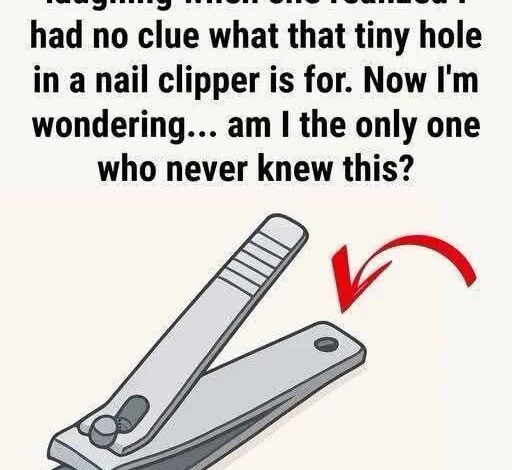
Most people have used a nail clipper hundreds of times without ever noticing one of its most deliberate features.
A tiny circular hole.
Small enough to ignore.
Simple enough to seem meaningless.
Yet that little opening carries a surprisingly practical history.
It wasn’t added for decoration.
It wasn’t included to make manufacturing easier.
And it certainly wasn’t an accident.
That hole was designed as a solution to a problem people faced every day: keeping track of something small enough to disappear at a moment’s notice.
Long before modern bathrooms filled every home and replacement items could be purchased with a few clicks, personal grooming tools were possessions people expected to keep for years. Losing one was inconvenient, sometimes expensive, and often frustrating.
The tiny hole solved that problem elegantly.
A string could be threaded through it.
A chain attached.
A hook secured.
The clipper could be hung beside a washbasin, attached to a key ring, stored on a cord, or fastened in a shared space where personal belongings were easily misplaced.
In boarding houses, military barracks, dormitories, communal washrooms, and crowded family homes, that simple feature helped ensure one small but important tool stayed exactly where its owner left it.
The idea was remarkably effective.
So effective, in fact, that it never needed replacing.
Over the decades, nearly everything around the nail clipper changed.
Materials evolved.
Packaging modernized.
Manufacturing improved.
Design trends came and went.
Yet that little circle remained.
Generation after generation continued using it without giving much thought to why it existed.
The people who first conceived it disappeared into history.
The original bathrooms where countless clippers once hung were remodeled, demolished, or forgotten.
Entire ways of life changed.
Still, the hole survived.
Because good design often outlasts the era that created it.
The best inventions aren’t always the most complicated.
Sometimes they’re so practical that people stop noticing them altogether.
That’s what makes this tiny feature so fascinating.
It represents a form of innovation that doesn’t seek attention.
It doesn’t advertise itself.
It doesn’t demand admiration.
It simply works.
Quietly.
Reliably.
Year after year.
And perhaps that’s the lesson hidden inside such an ordinary object.
Real ingenuity isn’t always found in dramatic breakthroughs or revolutionary technology.
Sometimes it’s found in a small detail that solves a simple problem so well that no one ever feels the need to improve it.
A tiny hole.
A practical purpose.
A design that endured for generations.
Proof that the most successful ideas are often the ones we barely notice at all.
Because sometimes the difference between losing something important and keeping it close is nothing more than a small opening in a piece of steel.
And sometimes that’s enough to stand the test of time.