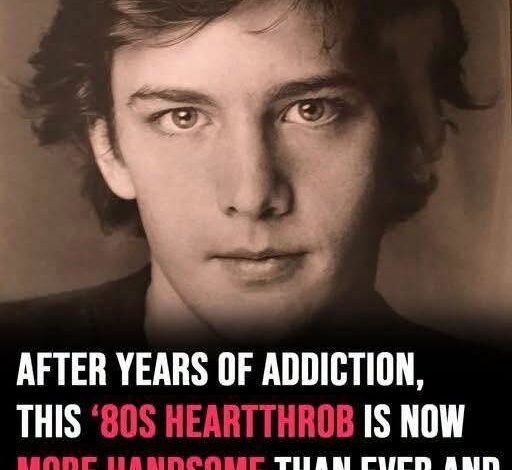
To millions of teenagers in the 1980s, he seemed to have the perfect life.
His face covered magazine racks, bedroom walls, and movie posters across the country. With tousled dark hair, thoughtful eyes, and an effortless charm, he became one of Hollywood’s defining heartthrobs, playing sensitive outsiders and reluctant romantics who felt genuine in an era filled with larger-than-life characters.
Fans saw confidence.
They saw fame.
They saw a young actor living every dream imaginable.
What they couldn’t see was the loneliness, insecurity, and addiction quietly growing behind the scenes.
Long before he became a member of the famous “Brat Pack,” Andrew McCarthy was simply a kid growing up in Westfield, New Jersey. Born in 1962 as the third of four brothers, he came from a family far removed from Hollywood. His mother worked for a newspaper, while his father built a career in investments and finance.
Nothing about his childhood suggested he was destined for movie stardom.
Yet from an early age, acting fascinated him.
School, however, was another story.
McCarthy has openly admitted that he never felt as though he truly belonged.
“I just felt sort of very lonely at school,” he once recalled. “I just didn’t feel like I belonged there.”
After graduating from high school, he enrolled at New York University to study acting. It seemed like the obvious next step.
It didn’t last.
Years later, McCarthy admitted he simply stopped attending classes.
“I didn’t really go,” he said with characteristic honesty.
Eventually, the university expelled him.
At the time, it could have looked like the end of his ambitions.
Instead, it became the beginning.
Only weeks after leaving NYU, McCarthy noticed an open casting call advertised for a new film titled Class. Hundreds of hopeful young actors lined up to audition, and after waiting for hours alongside nearly 500 others, he was called back.
The opportunity changed his life almost overnight.
One week he was a struggling student with an uncertain future.
The next, he was starring opposite acclaimed actress Jacqueline Bisset.
Looking back on that surreal experience years later, McCarthy joked that he suddenly found himself filming romantic scenes with one of Hollywood’s biggest stars and realized he must be doing something right.
Ironically, NYU later invited him to return, suggesting his work on the film could count as independent study if he paid his tuition.
He declined.
His career was already taking off.
Success arrived quickly.
Following Class, McCarthy became one of the defining young actors of the decade with standout roles in St. Elmo’s Fire, Pretty in Pink, Mannequin, and later Weekend at Bernie’s. His quiet, understated performances distinguished him from many of his contemporaries, and audiences connected deeply with the vulnerability he brought to the screen.
When he starred opposite Molly Ringwald in Pretty in Pink, his status as a teen idol was firmly established.
But fame came with baggage.
McCarthy found himself grouped with fellow young actors including Rob Lowe, Emilio Estevez, Judd Nelson, Demi Moore, and Ally Sheedy under a label the media eagerly embraced: the “Brat Pack.”
Although the nickname became part of Hollywood history, McCarthy has often spoken about how uncomfortable he felt with it. He never believed it accurately reflected who he was and disliked the assumptions people made about the group.
Privately, he was fighting battles few people recognized.
While audiences admired the thoughtful young man they saw on screen, alcohol was quietly becoming an increasingly important part of his life.
What began as social drinking gradually evolved into dependence.
In interviews and in his memoir, Brat: An ’80s Story, McCarthy has reflected candidly on those years, acknowledging that neither he nor many people around him fully understood how serious the problem had become.
Ironically, some of his most celebrated performances were filmed while he was struggling intensely.
Speaking with ABC’s 20/20, he revealed that during the filming of Pretty in Pink, he spent much of the production severely hungover.
Viewers interpreted his subdued performance as sensitivity and emotional depth.
In reality, he was simply trying to get through the day.
Alcohol, he later admitted, became something much larger than a habit.
It became protection.
“If I was frightened,” he explained, “it gave me courage.”
For someone naturally shy and introverted, drinking temporarily created feelings of confidence and control he struggled to find elsewhere.
Eventually, however, those temporary solutions stopped working.
By the late 1980s, McCarthy recognized he could no longer continue living the way he had been.
Just before filming Weekend at Bernie’s, he stopped drinking.
For a while, he remained sober by withdrawing almost entirely from social life.
Unlike many people, solitude wasn’t frightening to him.
In fact, it felt natural.
“I’m very comfortable being alone,” he later reflected. “I’ve always been comfortable being alone.”
But recovery rarely follows a straight path.
While working overseas, a seemingly harmless offer of a beer reopened old temptations. The experience reminded him how easily addiction could return, even after months of progress.
The years that followed became some of the hardest of his life.
He later described them as painful and largely lost to addiction. One particularly devastating morning, after another night of heavy drinking, he found himself collapsed on a bathroom floor, overcome by illness and despair.
It became impossible to deny what alcohol had taken from him.
At just 29 years old, McCarthy made the decision that changed everything.
He entered rehabilitation.
He completed detoxification.
Most importantly, he committed himself to building a life without alcohol or drugs.
Recovery transformed more than his health.
It transformed his priorities.
Rather than chasing Hollywood parties and constant publicity, McCarthy gradually stepped away from the celebrity lifestyle. He discovered fulfillment in quieter pursuits, developing a successful second career behind the camera as a television director.
Today, his directing credits include acclaimed series such as Orange Is the New Black, Gossip Girl, The Blacklist, and many others.
Yet filmmaking isn’t his only passion.
Travel became another unexpected chapter.
As a writer, McCarthy earned recognition as Travel Journalist of the Year in 2010 and has contributed to respected publications including National Geographic Traveler and Men’s Journal. For him, acting and travel writing are connected by a common purpose.
Both are forms of storytelling.
Both invite curiosity.
Both encourage deeper observation of the world.
He has often said traveling makes him feel more present, more aware, and more open to experience.
His personal life also found greater stability.
After reconnecting with his former college sweetheart, Carol Schneider, the two married in 1999 and welcomed a son, Sam, before eventually divorcing. In 2011, McCarthy married Irish writer and director Dolores Rice, with whom he shares two children.
Today, family occupies a place far more important than celebrity.
Looking back on the films that made him famous, McCarthy speaks with appreciation rather than nostalgia.
He understands what those movies mean to audiences who grew up watching them, even if he no longer defines himself by that chapter of his career.
Fans continue celebrating him online, praising not only the roles that made them fall in love with his performances decades ago but also the grace with which he has aged and evolved.
Yet perhaps Andrew McCarthy’s greatest achievement has little to do with Hollywood.
It lies in the life he rebuilt.
He transformed personal struggles into wisdom, fame into perspective, and addiction into a story of recovery that continues to inspire others.
The shy young man who once felt overwhelmed by attention eventually discovered something far more valuable than stardom.
He found peace.
And nearly four decades after first capturing the hearts of moviegoers around the world, that quiet resilience may be the most remarkable role he has ever played.