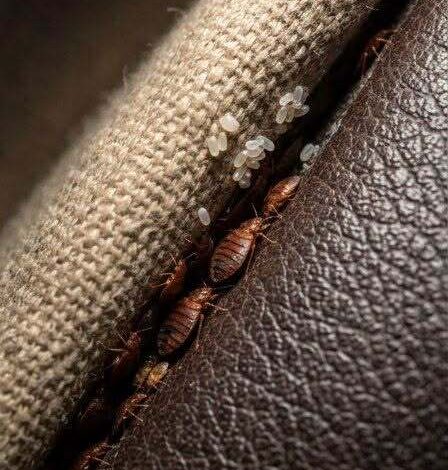
The moment I saw it, my stomach dropped.
It was tiny. Almost insignificant.
A dark speck no larger than a seed, resting quietly on the fabric of my couch.
Yet somehow, in the space of a few seconds, that tiny object managed to hijack my entire afternoon.
I froze.
Completely froze.
I stared at it without touching it, as though the slightest movement might trigger something catastrophic. My pulse quickened. My thoughts raced ahead of reality. Every article, video, forum post, and horror story I had ever encountered about bed bugs came flooding back into my mind with astonishing speed.
It was incredible how quickly a single unexplained object could transform a peaceful home into the setting of a personal nightmare.
For years, I had absorbed warnings about infestations.
Stories of people throwing away furniture.
Stories of entire apartments needing treatment.
Stories of sleepless nights, endless inspections, and thousands of dollars spent trying to eliminate an invisible enemy.
I had read about the psychological toll.
The paranoia.
The anxiety.
The constant feeling that something might be crawling on you.
The fear that follows people long after the infestation itself is gone.
Now, staring at that tiny dark speck, all those stories suddenly felt much closer than they ever had before.
What if this was the beginning?
What if I had missed the signs?
What if the problem had already spread throughout the house?
My imagination immediately began building a case against me.
I thought about every itch I had experienced over the past few weeks.
Every random red mark.
Every unexplained scratch.
Every moment I had absentmindedly rubbed my leg or arm without giving it a second thought.
Events that had seemed completely ordinary only hours earlier suddenly acquired new significance.
The mosquito bite on my ankle.
The small mark on my calf.
The time I woke up with an itch on my shoulder.
The occasional sensation that something was crawling on my skin.
At the time, I had blamed dry air.
Stress.
Laundry detergent.
Seasonal allergies.
Normal life.
Now my brain was busy rewriting history.
Suddenly, every minor irritation became potential evidence.
Every forgotten itch became a clue.
Every unexplained mark became part of a larger mystery.
The more I thought about it, the more convincing the story became.
That is the strange thing about fear.
When fear takes hold, it rarely arrives alone.
It recruits memory.
It recruits imagination.
It recruits every uncertain detail from the past and forces them into a narrative that feels frighteningly plausible.
Within minutes, I had mentally transformed a tiny speck on a couch cushion into the first sign of a full-scale infestation.
And the worst part?
The story felt completely reasonable.
Fear often does.
I finally gathered the courage to pick it up.
Holding it between my fingers felt strangely dramatic.
Objectively, it was just a tiny dark fragment.
Yet my nervous system treated it like hazardous material.
I examined it closely.
Turned it over.
Studied its shape.
Tried to determine whether it looked remotely similar to the countless bed bug photographs I had seen online.
The answer wasn’t immediately obvious.
And uncertainty, as always, created room for imagination.
I carried it to better lighting.
Examined it again.
Zoomed in with my phone’s camera.
Compared it against images online.
Then compared it again.
And again.
The more I looked, the less certain I became.
One photograph seemed similar.
The next looked completely different.
One angle convinced me I had found a bed bug.
Another angle convinced me I had not.
I found myself trapped in a cycle familiar to anyone who has ever searched symptoms online.
Every answer created three new questions.
Every comparison generated fresh uncertainty.
The investigation expanded.
If there was one bug, there could be more.
At least, that was what my anxious brain insisted.
So I began searching.
First the couch.
Then the cushions.
Then every seam.
Then every fold of fabric.
The inspection became increasingly thorough.
Cushions were removed.
Blankets were shaken out.
Furniture was pulled away from walls.
Flashlights appeared.
My living room slowly transformed into a crime scene investigation.
I checked places I had never checked before.
Corners.
Crevices.
Undersides.
Hidden spaces.
Anywhere a problem might be lurking.
The process consumed hours.
At first, every shadow looked suspicious.
Every tiny particle demanded attention.
Every speck of dust seemed potentially sinister.
Fear has a remarkable ability to alter perception.
When you are worried about something, your brain becomes highly efficient at finding evidence that supports the worry.
Dust becomes suspicious.
Lint becomes suspicious.
Tiny imperfections become suspicious.
Ordinary objects begin looking extraordinary.
The search continued.
I examined every visible surface.
Every hidden seam.
Every crack and crevice.
I looked for stains.
I looked for shells.
I looked for eggs.
I looked for movement.
I looked for anything that would confirm the terrifying scenario my imagination had already constructed.
But something unexpected happened.
I found nothing.
Absolutely nothing.
No additional bugs.
No signs of activity.
No evidence of infestation.
No hidden colony waiting beneath the cushions.
Nothing.
The couch was clean.
The surrounding furniture was clean.
The room was clean.
The evidence simply wasn’t there.
At first, I wasn’t relieved.
I was suspicious.
Surely I had missed something.
Surely the problem was hiding.
Surely one more inspection would reveal the truth.
So I searched again.
And again.
And again.
The result remained the same.
Nothing.
Eventually, reality began doing what reality often does.
It quietly challenged the story fear had created.
The longer I searched, the more obvious the truth became.
The tiny speck had become important only because I had assigned importance to it.
The object itself was insignificant.
The anxiety surrounding it was enormous.
Those were two very different things.
Gradually, fear began losing its grip.
Curiosity replaced panic.
Logic replaced assumption.
Evidence replaced imagination.
For the first time all afternoon, I allowed myself to consider a simpler explanation.
What if this wasn’t a bed bug at all?
What if it was simply debris?
A fragment of dirt.
A piece of plant material.
An ordinary speck that had somehow found its way onto the couch.
The possibility felt almost embarrassingly obvious.
Yet anxiety had prevented me from considering it earlier.
Fear narrows vision.
It encourages dramatic explanations while ignoring mundane ones.
The realization was both comforting and humbling.
Hours earlier, I had mentally prepared for an infestation.
I had imagined treatment plans.
Replacement furniture.
Weeks of stress.
Endless cleaning.
Potential expenses.
All because of a single unexplained speck.
Now, sitting in the same room, surrounded by the same furniture, I could finally see how dramatically my imagination had outrun the facts.
The couch had not changed.
The house had not changed.
Only my interpretation had changed.
That understanding brought an unexpected sense of peace.
The relief wasn’t merely about discovering there were no bed bugs.
It was deeper than that.
It was the realization that fear had been telling a story unsupported by evidence.
And once evidence entered the conversation, the story fell apart.
There is something profoundly reassuring about that.
Modern life often fills our minds with worst-case scenarios.
We read warnings.
We consume alarming headlines.
We hear horror stories.
We learn about rare disasters and unusual problems.
While that information can be useful, it also has a way of lingering in the background, waiting for an opportunity to surface.
A tiny trigger.
A strange symptom.
An unexplained object.
A moment of uncertainty.
Suddenly, all those fears come rushing forward.
What happened that afternoon wasn’t really about a couch.
Or a bug.
Or a random speck of debris.
It was about how easily the mind can transform uncertainty into catastrophe.
It was about the stories we tell ourselves when we lack information.
And it was about the importance of pausing long enough to let evidence speak.
By evening, the couch looked exactly as it had that morning.
The room felt the same.
The house felt the same.
Yet I felt different.
Calmer.
More grounded.
More aware of how quickly anxiety can distort perception.
The tiny dark speck that had seemed so threatening hours earlier no longer carried any power.
It was simply what it had always been.
A small object.
Nothing more.
The real discovery that day wasn’t hidden inside a couch cushion.
It was hidden inside my own reaction.
I learned how quickly fear can expand.
How convincingly imagination can operate.
How easily ordinary events can become sources of unnecessary distress.
Most importantly, I learned that peace often returns the moment we stop assuming and start investigating.
The greatest relief wasn’t finding a clean couch.
It wasn’t confirming the absence of bed bugs.
It wasn’t even proving my fears wrong.
The greatest relief was realizing that my home remained exactly what it had always been:
A safe place.
A comfortable place.
A place where I could relax without constantly searching for hidden dangers.
And as the evening sunlight faded through the windows, I found myself laughing at the entire experience.
Not because the fear had been irrational.
It had felt very real.
But because a tiny, lifeless speck had managed to teach me something unexpectedly valuable:
Sometimes the scariest thing in the room isn’t what we find.
It’s the story we create before we know what we’ve found.