The Haunting Sixty Year Secret Hidden In A Dusty Shoebox That Changed A Dying Grandmothers Final Hours Forever

The steady rhythm of a hospital heart monitor has a cruel way of reducing life to numbers and sound. Every beep feels temporary. Every silence between them feels dangerous. For two long weeks, that mechanical ticking blended with the soft rain against the window beside my grandmother Eleanor’s hospital bed, becoming the soundtrack to what doctors quietly warned would likely be the final chapter of her life. They spoke carefully, gently, using the practiced softness medical professionals develop when they no longer have hopeful answers left to offer. Days, maybe weeks if her body kept fighting. No miracles promised. No false certainty. Just time slipping steadily forward while everyone pretended not to count it. :contentReference[oaicite:0]{index=0}
The room itself became strangely suspended outside ordinary life.
Family members came and went carrying coffee cups and exhausted smiles. Nurses adjusted medications beneath dim lighting while speaking in hushed voices. Flowers arrived from relatives who suddenly remembered how fragile time really is. Yet despite the sadness hanging constantly in the air, Eleanor somehow remained calm in a way the rest of us could not manage. She seemed less frightened of dying than we were of losing her.
Most afternoons, we escaped reality the only way we knew how: through memory.
We spread old photo albums across the blanket covering her legs and spent hours wandering through the past together. The pages smelled faintly of dust and age, each photograph carrying tiny frozen worlds inside it — birthdays, graduations, family vacations, Christmas mornings, faces both familiar and long gone. For brief moments, the hospital room disappeared entirely while Eleanor narrated stories from decades I had never seen except through fading photographs. :contentReference[oaicite:1]{index=1}
Then one evening, everything changed because of a single picture.
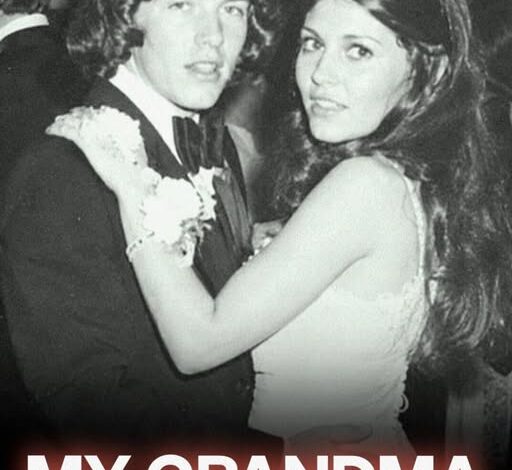
Her frail hand suddenly stopped on a heavily yellowed black-and-white photograph tucked carefully into one corner of an album dated 1962. I watched her expression shift immediately. The exhaustion illness had carved into her face seemed to loosen for a moment beneath something softer, younger, almost luminous. She traced one finger slowly across the image of a teenage boy standing beside her beneath the bleachers at what looked like a school dance.
“Henry,” she whispered.
The name barely rose above the sound of rain.
But the way she said it carried sixty years inside it. :contentReference[oaicite:2]{index=2}
I leaned closer instinctively while she stared at the photograph as though the decades between then and now had briefly disappeared. Her voice turned quiet and distant, the way people sound when memory overtakes the present completely. She told me Henry had been her first love — the real one, she emphasized softly, with a small sad smile.
Not a childish crush.
Not temporary infatuation.
Love.
The kind that rearranges your life permanently even if it doesn’t survive.
I was stunned.
In all my years with Eleanor, through every family gathering and holiday story, I had never once heard his name mentioned. She had spent over fifty years married to my grandfather, raising children, building a family, surviving ordinary joys and heartbreaks together. Yet somehow beneath all those decades, another story had remained hidden quietly inside her the entire time. :contentReference[oaicite:3]{index=3}
That night she told me everything.
She and Henry met when they were fifteen years old and became inseparable almost immediately. They walked to school together every morning. He carried her books home even when she argued she could manage herself. He made her laugh so hard during chemistry class once that they were both thrown out by the teacher. She described late summer evenings sitting on porch swings, sharing milkshakes at tiny diners, and dancing together at their high school prom long after everyone else had already gone home.
When she talked about him, illness seemed to loosen its grip for a little while.
Her eyes brightened.
Her voice regained warmth.
I realized I was hearing not just stories, but pieces of herself buried for decades beneath responsibility, marriage, motherhood, and time itself.
Then her expression changed.
Because the story did not end happily.
After graduation, life intervened the way it often cruelly does with young love. Their families moved to different countries within months of one another. At first they wrote letters constantly, pages filled with longing and promises about the future. But over time, the letters slowed. Then stopped completely.
Eleanor spent sixty years believing Henry had forgotten her. :contentReference[oaicite:4]{index=4}
As she admitted this quietly through tears, something inside me broke.
Because even after an entire lifetime, even after marriage and children and grandchildren, some part of her still carried the wound of believing her first love had simply disappeared without explanation.
“I never stopped wondering,” she whispered.
That sentence haunted me all night.
And by morning, I had made a decision.
I was going to find him.
No matter how impossible it seemed. :contentReference[oaicite:5]{index=5}
The hospital hallway became my headquarters over the next several days. While Eleanor slept, I sat beneath fluorescent lights with my laptop open, combing through school registries, old census records, obituary databases, and forgotten online archives searching for any trace of a Henry connected to her graduating class. Most searches led nowhere. Phone numbers were disconnected. Addresses outdated. Records incomplete.
Still, I kept going.
Something about the urgency of her regret made stopping feel unbearable.
The next morning, I called her former high school directly and pleaded with the administration office until one compassionate receptionist finally took pity on me and quietly provided several old leads she technically probably shouldn’t have shared. I spent hours dialing numbers, introducing myself to confused strangers, chasing fragments of information across decades. :contentReference[oaicite:6]{index=6}
Then my mother found out.
And suddenly the search became something else entirely.
The moment she saw the notebooks filled with names and phone numbers beside Eleanor’s bed, panic flashed across her face so violently it startled me. When I explained what I was trying to do — reunite Eleanor with Henry before time ran out — my mother reacted with immediate fury.
She demanded I stop.
Not calmly.
Not reasonably.
Desperately.
Her voice shook with an intensity I had never heard before as she insisted I was digging into things better left buried. She claimed reviving old memories would only hurt Eleanor more during her final days.
But beneath the anger, I saw something worse.
Fear. :contentReference[oaicite:7]{index=7}
Real fear.
And suddenly I understood my mother wasn’t trying to protect Eleanor from disappointment.
She was protecting a secret.
Three days later, the truth finally shattered open.
I found my mother sitting cross-legged on her bedroom floor beside an old dusty shoebox, trembling so hard she could barely speak. Tears streaked her face before she finally confessed everything in fragments.
Decades earlier, while my grandfather was dying, he made her promise something.
A terrible promise.
He admitted Eleanor had once loved another man deeply and confessed he feared losing her emotionally if she ever discovered that man had continued loving her all along. He convinced my mother that protecting Eleanor meant protecting the marriage and family built afterward.
Then my mother opened the shoebox.
Inside sat dozens upon dozens of yellowed envelopes. :contentReference[oaicite:8]{index=8}
Every single one addressed to Eleanor.
Every single one written in the same elegant handwriting.
Henry never stopped writing.
For nearly forty years, letters arrived regularly — birthdays, holidays, anniversaries, ordinary Tuesdays. Some envelopes remained unopened entirely. Others had been secretly read and hidden away by my grandfather before my mother inherited the burden of continuing the lie after his death.
Henry spent his entire life trying to reach her.
And Eleanor spent hers believing she had been forgotten.
The realization felt physically sickening.
Then my mother handed me the newest envelope.
Two years old.
Still unanswered.
Henry’s return address sat printed clearly in the corner only two hours away. :contentReference[oaicite:9]{index=9}
I left immediately.
The drive felt surreal, fueled by adrenaline and heartbreak and fury over all the lost time stolen from both of them. When I finally reached the small suburban house attached to the return address, my hands were shaking too badly to knock properly.
An elderly man answered the door slowly.
Thin.
Gentle-eyed.
Fragile in the way old age makes people fragile.
I showed him the photograph.
The moment he saw Eleanor’s face, he gasped softly and whispered her name like a prayer. :contentReference[oaicite:10]{index=10}
The next morning, with the help of hospital staff, I wheeled Henry quietly into Eleanor’s room.
I will never forget what happened next for the rest of my life.
At first, her eyes fluttered open in confusion. Then they focused fully on him.
And suddenly sixty years vanished.
Her entire face transformed.
Not metaphorically.
Literally.
Joy moved through her so completely that for one impossible moment she no longer looked sick at all. Henry began crying openly almost immediately, apologizing over and over for never finding her sooner while clutching her hand like someone terrified to let go again.
I pulled out my phone and quietly played Unchained Melody — their song from prom night all those decades earlier. :contentReference[oaicite:11]{index=11}
Then something extraordinary happened.
With trembling determination, Henry slowly stood and held out his hand, asking Eleanor for the dance they never got to finish.
Together, supported gently by nurses and family members, they swayed beside the hospital bed while tears filled the room around them. Their foreheads rested together. Their eyes closed. And somehow, despite the oxygen tubes and hospital machines and failing bodies, they looked exactly like two teenagers finding each other again after being lost for an entire lifetime. :contentReference[oaicite:12]{index=12}
My mother stood quietly in the doorway crying harder than anyone.
At one point she whispered an apology through sobs, but Eleanor simply squeezed her hand gently and said there was nothing left to forgive now that Henry was finally home.
Three days later, Eleanor died peacefully.
A sixty-year-old love letter rested against her heart.
And for the first time in decades, she no longer believed she had been forgotten.