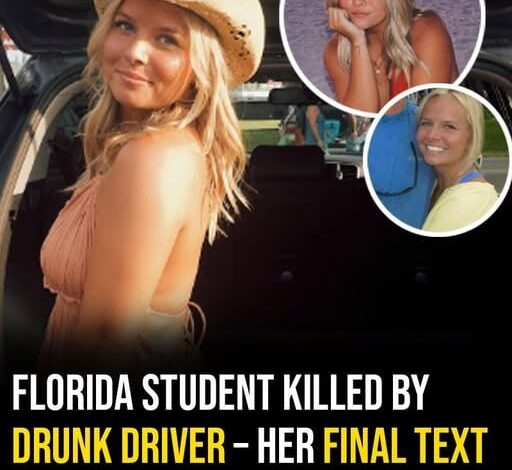
Lauryn Akey’s final drive home was never supposed to become a story.
It was supposed to disappear into the thousands of ordinary journeys that fill a lifetime—one more set of headlights moving through the darkness, one more person returning home after a celebration, one more promise that would be fulfilled exactly as expected.
There was nothing extraordinary about the plan.
A friend’s wedding had come to an end.
The music had faded.
Guests had begun making their way home.
Conversations that had stretched late into the evening were winding down.
The kind of night that leaves people tired, happy, and looking forward to sleeping in their own bed.
Lauryn was simply heading home.
Like countless others do every day.
A quick stop for gas.
A brief message to family.
A reassurance that she was on her way.
The sort of text people send without a second thought.
Simple.
Routine.
Comforting.
“I’ll be home soon.”
Those words carried no sense of danger.
No warning.
No indication that they would become the final message loved ones would ever receive from her.
At that moment, her future still seemed wide open.
There were plans waiting.
Goals still in progress.
Dreams still moving closer.
People often speak about potential after tragedy strikes, but in Lauryn’s case, potential was not an abstract concept.
It was visible.
Tangible.
Already taking shape.
She was pursuing a nursing career, working steadily toward a profession built around helping others. Those who knew her say the path fit her perfectly.
Not because it promised stability.
Not because it offered opportunity.
But because it reflected who she already was.
Compassionate.
Dependable.
Patient.
The kind of person who naturally moved toward people who needed support.
The kind of person who listened when others spoke.
The kind of person who remembered details.
The kind of person who showed up.
That phrase appears repeatedly in conversations about Lauryn.
She showed up.
For friends.
For family.
For coworkers.
For classmates.
For people going through difficult moments.
Some individuals leave an impression through dramatic gestures.
Others leave one through consistency.
Lauryn belonged to the second group.
She made ordinary days better.
Not through grand acts.
But through presence.
A conversation.
A text message.
A willingness to help.
A reminder that someone cared.
These things rarely generate headlines.
Yet they often become the qualities people miss most after someone is gone.
Because when grief arrives, it is usually not the extraordinary moments that hurt the most.
It is the ordinary ones.
The calls that no longer come.
The messages that no longer arrive.
The familiar voice that suddenly falls silent.
The realization that the person who always showed up no longer can.
That reality has become painfully familiar to those who loved Lauryn.
In the weeks since the crash on Interstate 75, her family, friends, and community have found themselves navigating a landscape that feels almost impossible to understand.
Grief alone is overwhelming.
Grief mixed with unanswered questions becomes something even heavier.
Because this tragedy did not emerge from illness.
It did not come after years of preparation.
It did not arrive with time to say goodbye.
It came suddenly.
Violently.
Unexpectedly.
A wrong-way crash.
A chain of events that transformed an ordinary drive home into a catastrophe.
The details have become the focus of an ongoing investigation.
Authorities continue examining the circumstances that led to the collision.
Investigators are reviewing timelines.
Gathering evidence.
Reconstructing decisions.
As more information emerges, attention has increasingly focused on questions surrounding impairment and reports of an earlier collision.
Questions that inevitably lead people toward a painful possibility.
Could this have been prevented?
It is a question that follows many tragedies involving impaired driving.
And it is one of the most agonizing questions imaginable.
Because unlike accidents caused by mechanical failures or unavoidable circumstances, impaired-driving crashes often carry a different emotional weight.
They introduce the idea of choice.
A decision made.
A warning ignored.
An opportunity missed.
The possibility that events could have unfolded differently.
That possibility creates anger.
Not because anger heals.
But because anger often becomes grief’s first companion.
Friends and family members searching for meaning naturally focus on the decisions that preceded the crash.
The choices.
The actions.
The moments where intervention may have been possible.
The warning signs that, in hindsight, seem impossible to ignore.
Yet hindsight is cruelly clear in ways real life rarely is.
What appears obvious after tragedy often looked uncertain before it.
Still, the questions remain.
And they matter.
Not only because of accountability.
But because understanding what happened may help prevent similar tragedies in the future.
For Lauryn’s loved ones, however, no investigation can provide the answer they truly want.
No courtroom can restore what was lost.
No legal proceeding can reverse a single moment.
No verdict can place her back behind the wheel heading safely home.
The justice system serves important purposes.
Accountability matters.
Truth matters.
Responsibility matters.
Yet even perfect accountability cannot erase absence.
That is the reality families confront after devastating loss.
The legal story and the personal story become separate things.
One seeks answers.
The other seeks someone who cannot return.
In the aftermath, communities often struggle with a shattered sense of safety.
Driving is one of the most common activities people perform.
Millions of individuals climb into vehicles every day with little hesitation.
The act feels routine.
Predictable.
Almost automatic.
Most journeys end exactly as expected.
Which is why tragedies like this resonate so deeply.
They remind people how fragile normality can be.
A person can do everything right.
Wear a seatbelt.
Follow traffic laws.
Drive responsibly.
And still find themselves caught in circumstances beyond their control.
That realization is difficult to accept.
Because human beings prefer believing safety can be guaranteed through careful behavior.
Most of the time, responsible choices significantly reduce risk.
But they cannot eliminate it entirely.
For Lauryn’s community, that awareness has become painfully personal.
People who knew her now travel roads she once drove.
Pass places she once visited.
Attend gatherings where her absence feels impossible to ignore.
Each reminder reinforces the same reality.
She should still be here.
That sentence appears again and again whenever people speak about sudden loss.
She should still be here.
Not because it changes anything.
Because it remains true.
She should still be planning her future.
Still pursuing her nursing career.
Still texting friends.
Still making ordinary days brighter.
Still creating memories.
Still building a life.
Instead, those possibilities now exist only in imagination.
The future she was working toward ended before she had the chance to reach it.
That is what makes stories like hers so devastating.
Not simply the life that was lived.
But the life that remains unfinished.
The milestones still ahead.
The dreams still forming.
The years that should have existed.
When people talk about impaired driving, statistics often dominate the conversation.
Numbers.
Percentages.
Fatalities.
Reports.
Data matters.
It helps policymakers understand trends.
It guides prevention efforts.
It informs public awareness campaigns.
But statistics can sometimes create distance.
They risk turning human lives into abstract figures.
Lauryn’s story reminds people what those numbers actually represent.
A daughter.
A friend.
A future nurse.
A person with plans.
A person with people who loved her.
A person whose absence now echoes through countless lives.
Every impaired-driving fatality contains a similar truth.
The damage extends far beyond the immediate collision.
Families change forever.
Friendships are interrupted.
Communities lose people who mattered.
Future accomplishments disappear.
Entire life stories stop mid-sentence.
The impact spreads outward like ripples.
Far beyond what any crash report can fully capture.
Today, those who knew Lauryn continue carrying memories.
Not because memories replace a person.
They do not.
But because memories become one of the few things tragedy cannot take away.
They remember her kindness.
Her determination.
Her willingness to help.
Her ability to make people feel seen.
The ordinary moments that now feel extraordinary.
The conversations that seemed routine at the time.
The laughter.
The encouragement.
The simple acts of care.
Those memories remain.
And perhaps that is why her absence feels so powerful.
Because absence only hurts when presence mattered.
And Lauryn’s presence clearly mattered.
It mattered to friends.
It mattered to family.
It mattered to classmates.
It mattered to everyone fortunate enough to know her.
Long after investigations conclude and legal proceedings end, that truth will remain.
The crash may define the final chapter of her story.
But it does not define her life.
Her life is defined by the people she helped.
The relationships she built.
The future she was striving toward.
And the love she left behind.
For those who continue grieving, the hardest reality is also the simplest.
No verdict can undo what happened.
No sentence can restore what was lost.
No explanation can fully satisfy the questions left behind.
What remains is memory.
Love.
And the painful understanding that one person’s decision can alter countless lives forever.
In that sense, Lauryn’s absence speaks louder than any courtroom ever could.
Because while legal outcomes measure responsibility, absence measures loss.
And the loss she leaves behind is impossible to calculate.
It lives in empty chairs.
Unanswered texts.
Missed milestones.
And in the hearts of everyone still wishing that simple drive home had remained exactly what it was supposed to be:
Forgettable.