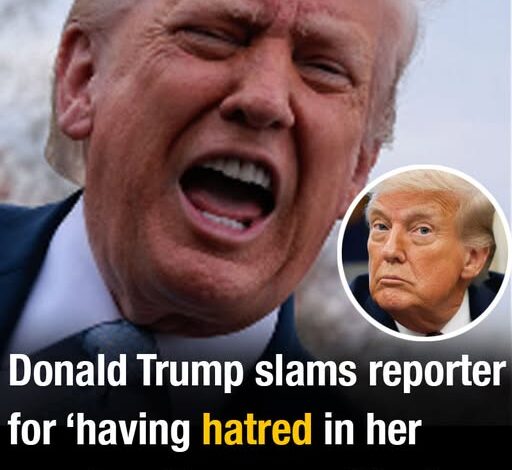
The Question Trump Didn’t Want to Answer
The tension was visible long before anyone spoke.
Inside the Oval Office, cameras lined the room.
Reporters shifted in their seats.
Staff members stood nearby.
Officials watched carefully.
The atmosphere carried the familiar electricity that accompanies high-profile exchanges between powerful political figures and the journalists tasked with questioning them.
Everyone present understood the stakes.
Not necessarily because of the policy issue itself.
Because of what these moments often reveal.
Sometimes the most important part of a political confrontation isn’t the answer.
It’s the effort to avoid one.
And on this particular day, what began as a straightforward question quickly evolved into something much larger.
A clash over power.
A clash over accountability.
A clash over who controls the conversation.
At the center stood Kaitlan Collins.
And across from her stood Donald Trump.
What followed would become another chapter in a relationship defined by confrontation, persistence, and competing understandings of what public accountability should look like.
A Question About Money
The original question was not especially complicated.
At least on the surface.
Collins sought clarity regarding a controversial Department of Justice fund reportedly containing approximately $1.8 billion.
Questions had circulated about its future.
Questions had circulated about oversight.
Questions had circulated about who might ultimately benefit from its distribution.
As is often the case in Washington, what appeared technical carried enormous political implications.
Large sums of public money attract scrutiny.
They always have.
They always will.
The role of journalism, ideally, is to ask where that money goes.
Who controls it.
Who benefits from it.
And whether taxpayers deserve greater transparency.
Those questions are not inherently partisan.
Nor are they unusual.
Every administration faces them.
Every president eventually encounters uncomfortable inquiries regarding spending, priorities, and decision-making.
Yet certain questions create visible discomfort.
And observers quickly sensed that this was one of them.
When the Focus Shifted
Instead of immediately addressing the substance of the inquiry, attention began drifting elsewhere.
Away from policy.
Away from accountability.
Away from the details surrounding the fund.
Toward the person asking the question.
It is a familiar tactic in modern political communication.
Rather than confronting an argument directly, shift attention toward the individual presenting it.
Examine motives.
Question intentions.
Challenge credibility.
Create a spectacle large enough that the original issue becomes secondary.
Within moments, the exchange moved in that direction.
Comments emerged regarding Collins herself.
Her demeanor.
Her expression.
Her attitude.
Her supposed feelings toward the president.
The conversation ceased being primarily about public funds.
It became personal.
This transformation is increasingly common in contemporary politics.
The individual asking the question becomes the story.
The question itself fades into the background.
And often, that shift serves a purpose.
Because answering difficult questions requires engagement.
Attacking the questioner requires only performance.
The Power of Refusing the Script
Political confrontations often follow predictable patterns.
One side escalates.
The other side responds.
Voices rise.
Emotions intensify.
The exchange generates headlines.
Everyone retreats further into existing political camps.
But something notable happened during this particular interaction.
Collins largely refused the script being offered to her.
She did not match insult with insult.
She did not attempt to dominate the room.
She did not transform the encounter into a personal feud.
Instead, she returned repeatedly to the same place.
The question.
What was happening to the fund?
Where was the money going?
Who would oversee it?
Would there be transparency?
The persistence itself became significant.
Because in environments designed to create distraction, focus becomes a form of resistance.
The more the conversation drifted toward personalities, the more striking it became that she continued redirecting attention toward policy.
That contrast shaped much of the public reaction afterward.
Supporters and critics interpreted the moment differently.
Yet many observers agreed on one point.
The exchange revealed competing priorities.
One side appeared interested in controlling the narrative.
The other appeared interested in maintaining the question.
A Pattern Larger Than One Moment
To understand why the encounter generated such discussion, it helps to place it within a broader context.
For years, critics have argued that Trump frequently responds to challenging questions by targeting the individuals presenting them.
Particularly women.
Throughout his political career, numerous public confrontations have followed similar patterns.
Journalists.
Political opponents.
Former employees.
Accusers.
Public officials.
Many have described experiences in which policy disagreements quickly became personal attacks.
The language varies.
The circumstances vary.
The individuals vary.
Yet critics argue the underlying strategy remains remarkably consistent.
Shift attention.
Personalize conflict.
Undermine credibility.
Transform scrutiny into spectacle.
Supporters reject this characterization.
Many view Trump’s approach as a response to what they perceive as hostile media environments and unfair treatment.
They argue that aggressive questioning frequently deserves aggressive pushback.
To them, such exchanges represent a politician refusing to submit to adversarial press narratives.
This disagreement forms part of a larger national debate.
One extending far beyond any single press conference.
What should the relationship between political leaders and journalists look like?
Where does accountability end and antagonism begin?
When does scrutiny become hostility?
When does criticism become avoidance?
Americans increasingly answer those questions differently.
The Role of the Press
Whether one admires journalists or distrusts them, democratic systems traditionally rely upon questioning.
Governments possess enormous power.
That power influences laws.
Budgets.
Military decisions.
Public services.
Regulatory actions.
Economic policy.
Virtually every aspect of civic life.
Journalists serve as intermediaries between government institutions and the public.
Ideally, they gather information citizens cannot easily obtain themselves.
They ask questions.
Verify claims.
Challenge inconsistencies.
Seek explanations.
The process is imperfect.
Journalism is imperfect.
Reporters make mistakes.
Organizations make mistakes.
Bias exists.
Errors occur.
Yet the underlying principle remains important.
Power requires scrutiny.
Not because every accusation is valid.
Because accountability becomes impossible without inquiry.
That reality helps explain why confrontations between political leaders and reporters often generate attention disproportionate to the immediate topic.
People understand intuitively that something larger is being tested.
The willingness to answer.
The willingness to ask.
The willingness to tolerate uncomfortable exchanges.
The Politics of Personalization
Modern political communication increasingly rewards conflict.
Social media accelerates this trend.
Television amplifies it.
Algorithms prioritize engagement.
Engagement often favors outrage.
As a result, substantive discussions frequently struggle to compete with personal drama.
A debate about funding mechanisms may attract limited attention.
A confrontation between public figures can dominate headlines for days.
Political professionals understand this dynamic.
Many exploit it intentionally.
By transforming policy disputes into personal conflicts, complex issues become easier to communicate.
The downside is equally obvious.
Important questions sometimes disappear beneath the spectacle.
The audience remembers the argument.
Not the subject.
The insult.
Not the policy.
The confrontation.
Not the consequence.
This is why some observers viewed Collins’ persistence as noteworthy.
Not because it resolved the underlying issue.
Because it repeatedly redirected attention toward it.
The Unanswered Question
Long after the exchange concluded, one reality remained.
The original question still existed.
The controversy surrounding the fund remained.
The concerns regarding oversight remained.
The public interest in transparency remained.
Political confrontations often produce winners and losers in the eyes of supporters.
Media commentators analyze body language.
Tone.
Strategy.
Messaging.
Yet beneath all of that, practical questions continue waiting for answers.
Where is the money going?
Who controls it?
Who benefits?
What safeguards exist?
Those questions matter regardless of political affiliation.
They matter regardless of personal feelings toward journalists.
They matter regardless of personal feelings toward presidents.
Because public accountability ultimately concerns information.
Not personalities.
A Moment That Reflects a Larger Choice
Perhaps the most revealing aspect of the exchange is how clearly it illustrated a broader tension within contemporary politics.
Increasingly, public life offers two competing models of leadership.
One prioritizes explanation.
The other prioritizes confrontation.
One responds to scrutiny through information.
The other responds through conflict.
Reality is rarely absolute.
Most leaders engage in both approaches at different moments.
Most journalists do as well.
Yet the distinction remains important.
Because democratic systems depend upon a continuing conversation between those who exercise power and those tasked with questioning it.
That conversation is often uncomfortable.
Sometimes messy.
Occasionally hostile.
But its existence matters.
The Oval Office exchange did not settle debates about journalism.
It did not settle debates about Donald Trump.
It did not settle debates about media bias or political accountability.
What it did accomplish was something simpler.
It exposed the tension directly.
A reporter asking a question.
A president resisting it.
An audience deciding for itself what mattered most.
The personalities.
Or the answer.
And in the end, that may be the most significant lesson from the encounter.
Not who won the exchange.
Not who delivered the sharper line.
But whether public attention remained focused on the issue that started the confrontation in the first place.
Because political spectacle is temporary.
Accountability is supposed to be permanent.
And the difference between the two often determines whether difficult questions ever receive answers at all.