I Lost My Baby at 17 and Walked Out of the Hospital Empty-Handed—Until a Nurse Came Back Into My Life

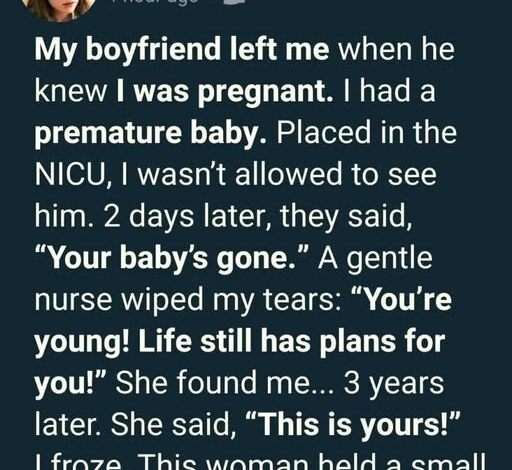
Years later, I still remember the way her hand rested on my shoulder.
Not because it was dramatic.
Not because she said something magical.
Because she stayed.
In a moment when everyone else seemed focused on moving forward, on paperwork, on procedures, on the next patient waiting behind another curtain, she stayed.
At seventeen, that felt enormous.
I didn’t know then how many people disappear when grief becomes inconvenient.
How quickly phone calls stop.
How often promises fade.
How lonely survival can become.
For a long time, I moved through life like someone carrying a secret weight.
People saw me working.
Smiling.
Functioning.
They assumed I was okay.
What they didn’t see were the nights.
The empty apartment.
The dreams that always ended in a hospital room.
The way I still caught myself calculating how old my son would be.
Four.
Five.
Six.
Each birthday arriving only in my imagination.
When I started nursing school, I discovered something unexpected.
Pain recognizes pain.
Not in a dramatic way.
In small ways.
The nervous father pacing a waiting room.
The exhausted mother pretending she wasn’t scared.
The teenager trying desperately to look brave.
I recognized all of them.
Because once you’ve sat in the dark yourself, you start noticing who else is trying to find the light.
During my second year as a nurse, a young girl arrived in the maternity ward.
She couldn’t have been older than sixteen.
Terrified.
Alone.
Her boyfriend had disappeared.
Her parents weren’t speaking to her.
She spent most of the evening staring at the floor.
Every time someone asked a question, she answered in one-word sentences.
I knew that look.
I had worn it once.
After my shift ended, I sat beside her for a while.
Not because it was required.
Because someone had once done the same for me.
“You don’t have to be brave every second,” I told her.
The words slipped out before I thought about them.
She looked at me.
Really looked at me.
For the first time all night.
Then she started crying.
And I sat there with her.
The same way someone had once sat with me.
That became the pattern of my life.
Not grand gestures.
Small ones.
Holding a hand.
Listening longer than necessary.
Remembering a patient’s name.
Returning when I said I would.
The things that seem insignificant until you’re the person who needs them.
One afternoon, several years after becoming a nurse, I received a call.
The number was familiar.
The nurse.
My nurse.
The woman who had changed everything.
Her voice sounded different.
Weaker.
Older.
“Could you come by after work?”
The question immediately worried me.
Of course, I said yes.
I found her sitting on the porch of a small white house outside town.
The same gentle eyes.
The same calm smile.
But time had touched her.
Age had softened her movements.
Illness had taken some of her strength.
We sat together watching the sun settle across the trees.
For a while, neither of us spoke.
Then she handed me a folder.
“What is this?”
“Open it.”
Inside were documents.
Foundation records.
Scholarship paperwork.
Letters.
Dozens of them.
Some from young mothers.
Some from former students.
Some from nurses.
Teachers.
Social workers.
People whose lives had been touched by the scholarship fund she created years ago.
I looked up at her.
Confused.
“What am I looking at?”
She smiled.
“My retirement.”
I laughed softly.
“This looks like work.”
“It is.”
Then she reached over and squeezed my hand.
“I want you to take over.”
The world seemed to stop for a second.
“What?”
“The fund.”
I stared at her.
“No.”
She laughed.
“That’s exactly what I said when they asked me.”
“I can’t.”
“Yes, you can.”
I shook my head.
“There are people far more qualified.”
“Maybe.”
Her voice remained gentle.
“But they aren’t you.”
The tears arrived unexpectedly.
Because suddenly I understood.
This wasn’t about administration.
Or paperwork.
Or scholarships.
It was about continuity.
One act of kindness becoming another.
A chain extending farther than either of us could see.
The nurse who comforted a grieving teenager.
The teenager who became a nurse.
The nurse who comforted another frightened girl.
And on and on.
Lives touching lives.
Not because anyone planned it.
Because compassion tends to travel.
Years later, after she passed away peacefully in her sleep, I found myself standing before a room full of scholarship recipients.
Young women.
Scared women.
Determined women.
Women trying to build futures from difficult beginnings.
I looked out at them and saw pieces of my younger self everywhere.
The uncertainty.
The courage.
The exhaustion.
The hope.
Behind me hung a framed photograph.
The same photograph she had handed me outside the grocery store all those years ago.
Seventeen years old.
Heartbroken.
Lost.
But still standing.
I took a breath.
Then I told them the truth.
“People will tell you that strength means never falling apart.”
The room was silent.
“They’re wrong.”
I smiled.
“Strength is getting up afterward.”
Several women wiped tears from their eyes.
So did I.
Because the photograph had never been about tragedy.
It had never been about loss.
It was evidence.
Proof that the worst day of your life does not get the final word.
Proof that survival is sometimes enough.
Proof that kindness can echo across decades.
And proof that even when life breaks your heart, it can still leave room for something beautiful to grow afterward.
Every morning, that photograph still hangs on the wall of my clinic.
Patients ask about it sometimes.
They assume it’s a nursing-school picture.
Or a family photograph.
I usually just smile.
Because the real story isn’t about me.
It’s about a nurse who chose to stay beside a grieving girl.
And a grieving girl who eventually learned how to stay beside others.
The loss never disappeared.
Some losses don’t.
I still think about my son.
I always will.
But grief stopped being the end of the story.
It became part of the reason the story continued.
And whenever I pass that photograph, I remember something the nurse once told me when I believed my life was over.
Life still has plans for you.
Back then, I didn’t believe her.
Now I do.