My Mom Cooked Meals for a Homeless Man Who Lived Behind Our House for 20 Years – The Day After Her Passing, He Took My Hands in His and Said Something That Changed My Life

For most of my life, I believed my mother was hiding something from me.
Every evening, no matter the weather, she carried a plate of food to the far corner of our backyard. She would disappear for a few minutes behind the old fence line and return with red eyes and a forced smile she never quite managed to make convincing.
When I was younger, I thought she was simply being kind to someone down on their luck.
As I got older, my assumptions became darker.
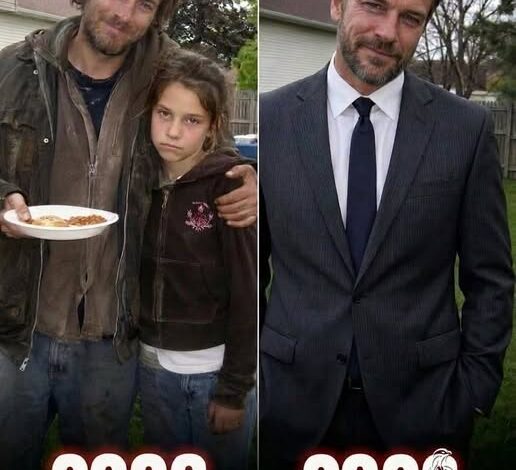
The man living in the tarp-covered shelter beyond our property seemed to exist in a world separate from ours. He was quiet, withdrawn, and rarely looked anyone directly in the eye. His clothes were worn. His beard was overgrown. He appeared only occasionally, usually at dusk, and always vanished again before anyone could ask questions.
Yet my mother never missed a meal.
Not once.
She made sure he had food even when money was tight.
She worried about him during storms.
She left blankets when winter temperatures dropped.
And every time I asked who he was, her answer remained frustratingly vague.
“Just someone who needs help.”
That was all she would say.
Over the years, resentment slowly took root inside me.
Not because she helped him.
Because of the way she protected him.
There were times when I felt she cared more about that stranger than she did about herself.
Sometimes even more than she cared about us.
I hated myself for thinking it, but the thought kept returning.
Who was this man?
Why did he matter so much?
Why did she look heartbroken every time she came back from seeing him?
The mystery followed me for years.
Then one evening, everything changed.
It started with an old locket.
My mother rarely took it off. It hung around her neck every day of my life. The small silver pendant had become such a familiar part of her that I barely noticed it anymore.
But that night, while helping her clean out some old boxes, the clasp broke.
The locket fell open.
Inside was a faded photograph.
Two children.
A little girl and a boy.
The boy had a crooked smile and a split lip.
His arm was wrapped protectively around the girl.
I pointed at the picture.
“Who’s that?”
The color drained from my mother’s face.
For several seconds she simply stared.
Then she snapped the locket shut.
Too quickly.
Too carefully.
And in that moment, I knew.
Whatever secret she’d been carrying was connected to that photograph.
Connected to that boy.
Connected to the man behind the fence.
The truth came out days later.
And when it did, it shattered everything I thought I knew.
The man my mother had spent twenty years feeding wasn’t a stranger.
He wasn’t an old friend.
He wasn’t someone she’d taken pity on.
He was her brother.
Victor.
The brother she had been ordered to erase.
The brother everyone else pretended didn’t exist.
The brother whose name had been removed from family conversations so completely that I had grown up never knowing he was part of our blood.
The revelation hit me like a physical blow.
I stared at my mother, unable to process what she was saying.
Victor?
The man living in a tarp shelter?
The man everyone ignored?
That was my uncle?
My mother’s voice trembled as she told me the story.
As children, they had been inseparable.
Victor was older by a few years.
When neighborhood kids picked fights with her, he stepped in.
When winter winds cut through their thin jackets, he wrapped his coat around her shoulders and walked home shivering beside her.
When food was scarce, he often claimed he wasn’t hungry so she could eat more.
The boy in the photograph wasn’t just her brother.
He had been her protector.
Her best friend.
Her safe place.
Tears streamed down her face as she described him.
And for the first time, I understood why she looked broken every time she returned from seeing him.
Because every meal she carried wasn’t charity.
It was love.
A lifetime of love.
Then she told me about Mark.
My uncle.
The man everyone respected.
The man who always seemed concerned about family reputation.
The man who claimed he was only looking out for everyone.
The truth was far uglier.
Years earlier, when Victor’s life spiraled into poverty and hardship, Mark decided he was an embarrassment.
A stain on the family’s image.
Someone who needed to disappear.
But outright abandoning Victor would have looked cruel.
So Mark created an impossible choice.
My mother could continue helping her brother.
But only if she did it quietly.
Secretly.
As though he no longer belonged to the family.
As though he wasn’t blood.
As though he didn’t matter.
Fear did the rest.
Mark threatened consequences.
Threatened relationships.
Threatened stability.
Threatened to destroy what little security my mother still had.
And so she made the most painful bargain of her life.
She kept Victor alive.
But she was forced to pretend he was nothing to her.
For twenty years she carried that burden alone.
Twenty years of delivering food in secret.
Twenty years of protecting her brother while pretending she wasn’t.
Twenty years of swallowing grief every single day.
The realization crushed me.
All those years, I had misunderstood her.
I thought her secrecy meant betrayal.
I thought her silence meant she was choosing someone else over us.
In reality, she had been protecting the only family she had left.
And doing it at tremendous personal cost.
The worst part was realizing how completely Mark had succeeded.
He hadn’t just isolated Victor.
He had manipulated all of us.
He had turned shame into a weapon.
He had convinced people that exile was justified.
That abandonment was necessary.
That family loyalty had limits.
For years, nobody challenged him.
Nobody questioned the story.
Until the truth finally surfaced.
And when it did, everything unraveled.
Relatives who had spent decades believing Victor wanted nothing to do with the family learned what had actually happened.
The lies.
The threats.
The manipulation.
The deliberate cruelty.
One by one, people stopped defending Mark.
For the first time in years, he looked small.
Not powerful.
Not respected.
Just exposed.
He tried to deny it.
Then justify it.
Then minimize it.
But the damage was done.
The truth was finally stronger than the fear.
That evening, after everyone left, I found Victor sitting alone behind the fence.
The tarp above him flapped softly in the evening breeze.
His few belongings sat stacked neatly around him.
The place looked less like a shelter and more like a monument to loneliness.
When he saw me approaching, he lowered his eyes.
As though he expected rejection.
As though he had become accustomed to it.
I carried a bowl of soup in my hands.
The same way my mother had carried hundreds before me.
For a moment, neither of us spoke.
Then I held the bowl out.
He accepted it carefully.
Almost cautiously.
As if he wasn’t sure he was allowed.
I swallowed hard.
Then I said the words that should have been spoken years ago.
“You don’t have to eat out here anymore.”
He looked up.
Confused.
I pointed toward the house.
Toward the warm light glowing through the kitchen windows.
Toward my mother waiting inside.
“Come home.”
His eyes immediately filled with tears.
For a second, I thought he might refuse.
Not because he didn’t want to come.
Because he had spent so many years believing he didn’t belong.
Then his shoulders began to shake.
And for the first time since I’d known him, he cried openly.
So did my mother.
So did I.
That night, three bowls sat on the kitchen table.
Not two.
Not one hidden outside in the dark.
Three.
Victor sat beside my mother.
Not behind a fence.
Not under a tarp.
Not in exile.
At the table where family belonged.
The room felt different somehow.
Lighter.
Warmer.
As though a door long sealed shut had finally been opened.
For twenty years, my mother had carried this story alone.
She had fed it.
Protected it.
Mourned it.
Hidden it.
That night, she no longer had to.
The secret came inside.
The truth came inside.
And most importantly…
Her brother came inside.
For the first time in two decades, Victor wasn’t a ghost living at the edge of our lives.
He was family again.
And as we sat together sharing soup beneath the warm kitchen light, I realized something that would stay with me forever:
Love can survive years of silence.
It can survive fear.
It can survive shame.
It can even survive exile.
All it needs is one person willing to open the door and say the words that should have been spoken long ago.
Welcome home.