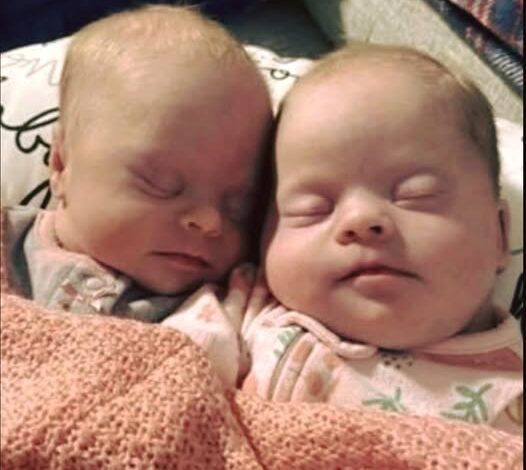
Some pregnancies change a family.
Others stop entire rooms.
When Savannah Combs first learned she was carrying twins, the news already belonged to the category doctors describe carefully because statistics alone make people pause. Identical twins occur far less frequently than fraternal twins, and even among twin pregnancies, certain combinations become medically uncommon enough that specialists monitor them with heightened attention from the beginning.
But Savannah’s pregnancy did not stop at “rare.”
It moved into territory many healthcare professionals encounter only a handful of times — or never — during their entire careers.
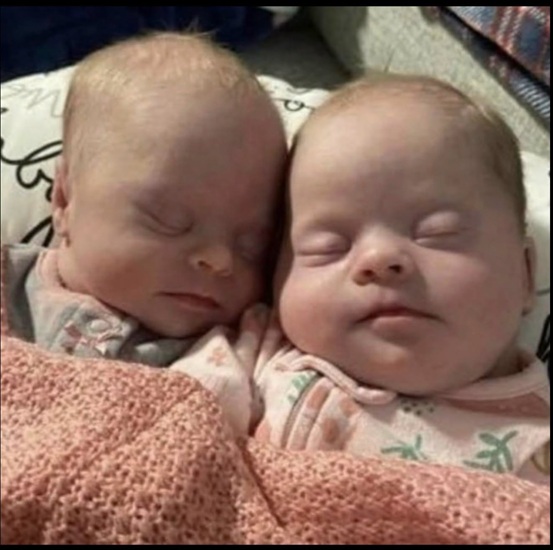
Doctors eventually confirmed that both identical twins had Down syndrome.
That combination made the pregnancy extraordinarily unusual medically. Identical twins already represent a relatively uncommon biological event. Identical twins sharing the same chromosomal condition pushed the case into a category rare enough to attract significant medical interest and close observation throughout the pregnancy.
Yet statistics alone never fully capture the emotional reality of news like that.
Behind every rare diagnosis sits an ordinary human moment:
a woman in a doctor’s office,
someone staring at ultrasound images,
silence settling differently after certain words enter the room.
For Savannah and her husband Justin Ackerman, the pregnancy immediately became more than anticipation. It became uncertainty layered with responsibility, fear mixed with love before the children had even arrived.
People often romanticize parental strength afterward, once stories spread online and headlines simplify emotional complexity into inspiration. But real courage rarely begins as confidence.
Usually it begins as confusion.
Questions.
Long nights.
Internet searches.
Medical terminology spoken too quickly.
Statistics delivered in careful tones.
Conversations between exhausted people trying to sound brave for one another.
Savannah has spoken openly about parts of that emotional process, including the reality that doctors explained the significant medical risks involved. The twins faced elevated complications not only because of Down syndrome, but because the pregnancy itself carried additional risks associated with monochorionic-diamniotic twins — commonly called “mo-di twins.”
That phrase sounds technical and distant until you understand what it means physically.
The girls shared one placenta while developing inside separate amniotic sacs.
Pregnancies involving shared placentas require close monitoring because complications can emerge suddenly. Blood flow issues, unequal nutrient distribution, premature labor, and developmental concerns all become more likely. Doctors therefore watch these pregnancies intensely, often scheduling frequent ultrasounds and consultations simply because conditions can change rapidly.
Savannah’s pregnancy existed at the intersection of multiple high-risk factors simultaneously.
And still, beneath all the medical language, there remained something deeply ordinary too:
two parents preparing to meet their daughters.
That emotional contradiction runs through many complicated pregnancies. Families move between clinical environments and deeply personal hopes constantly. One moment involves specialists discussing chromosomal abnormalities and neonatal outcomes. The next involves choosing names, imagining faces, or wondering whether the babies will inherit someone’s smile.
Human beings continue loving even while afraid.
Perhaps especially then.
As Savannah shared pieces of her journey online, public attention grew quickly. Social media has transformed private medical experiences into communal narratives in ways previous generations never experienced. Pregnancies once navigated quietly inside families now unfold before audiences capable of both extraordinary kindness and astonishing cruelty simultaneously.
Savannah encountered both.
Many people responded with encouragement, prayers, empathy, and admiration for her openness. Parents of children with Down syndrome reached out sharing their own experiences. Families discussed milestone delays, therapies, joys, frustrations, and the emotional realities outsiders rarely understand properly.
But the internet rarely allows vulnerable stories to exist without judgment.
Some commenters questioned her decision to continue the pregnancy after learning the diagnosis. Others framed disability itself as tragedy rather than humanity. The criticism reflected broader cultural discomfort around prenatal diagnoses and disabilities generally — discomfort often rooted less in medical reality than in fear, misunderstanding, and assumptions about quality of life.
Savannah responded consistently and directly.
Not theatrically.
Not with polished activism.
With maternal certainty.
Her daughters deserved dignity.
Their lives carried value.
Their diagnosis did not erase their humanity.
That distinction became central to her public voice afterward.
Because children with disabilities often encounter a world eager to define them entirely through limitation before recognizing personality, individuality, humor, affection, intelligence, or joy. Parents frequently become translators between their children and a society conditioned to reduce complex human beings into medical categories first.
Savannah seemed determined to resist that reduction from the beginning.
Then the twins arrived early.
Very early.
Kennadi Rue and McKenzi Ackerman were born on May 12, 2021, at approximately twenty-nine weeks gestation. Premature births at that stage require immediate intensive medical intervention because babies born that early still need substantial support simply to survive and stabilize physically.
The neonatal intensive care unit became the twins’ first world.
NICUs carry a particular emotional atmosphere unlike almost anywhere else in medicine. Machines hum constantly. Lights stay low. Parents learn to interpret monitors, oxygen levels, feeding tubes, alarms, and medical terminology while balancing hope against fear hour by hour.
Tiny bodies fight enormous battles there.
Premature infants often look heartbreakingly fragile at first:
translucent skin,
impossibly small fingers,
lungs still learning strength.
Parents stand beside incubators trying to bond through wires and medical equipment while pretending not to panic every time a monitor changes rhythm.
Savannah and Justin spent weeks inside that environment waiting for their daughters to grow stronger.
That waiting changes people.
Life inside NICUs operates differently than ordinary time. Progress becomes measured in ounces gained, stable breathing patterns, successful feedings, improved oxygen levels. Victories that healthy full-term parents never think about become emotionally overwhelming:
a baby maintaining temperature independently,
breathing without assistance,
opening eyes longer,
finally being strong enough to go home.
Eventually, after weeks of medical support and monitoring, Kennadi and McKenzi became healthy enough to leave the hospital.
That moment likely felt less triumphant than surreal.
Parents carrying premature infants home often describe overwhelming gratitude mixed with terror. Hospitals contain professionals, monitors, emergency systems. Home contains responsibility alone. Suddenly every feeding, every sound, every hour of sleep becomes your job entirely.
And Savannah was now raising not only premature twins, but twins with Down syndrome — children who might develop differently, require additional therapies, and move through milestones according to timelines the world often misunderstands impatiently.
That misunderstanding became another subject she addressed publicly.
Developmental differences do not mean absence of growth.
Children with Down syndrome learn,
laugh,
communicate,
play,
love,
develop personalities,
build relationships,
and experience life richly — often simply on timelines differing from standardized expectations.
Savannah repeatedly emphasized that reality online.
Her updates about the girls focused not solely on diagnoses, but on daily life:
expressions,
behaviors,
progress,
small victories,
funny moments,
sibling dynamics,
the emotional texture of raising children rather than managing conditions.
That distinction matters deeply.
Because disability narratives often become flattened publicly into either tragedy or inspiration, leaving little room for ordinary humanity in between. Real life is more complicated. Parenting children with special needs includes joy, exhaustion, frustration, laughter, paperwork, therapies, fear, pride, routines, setbacks, affection, and countless ordinary moments existing alongside medical realities.
Savannah’s posts resonated partly because they showed that ordinariness.
The twins were not abstract symbols.
They were children.
Children who developed favorite activities.
Children with distinct personalities despite being identical twins.
Children capable of mischief, affection, stubbornness, curiosity, and emotional connection beyond diagnosis.
As public attention expanded, so did conversations surrounding disability awareness more broadly.
Many viewers unfamiliar with Down syndrome encountered the story through emotional reaction first. Some expressed surprise seeing the twins active, expressive, and joyful because media representations of disabilities often remain limited or outdated. Others began discussing prenatal counseling, medical ethics, social support systems, and the assumptions families confront after diagnoses.
Stories like Savannah’s therefore operate on multiple levels simultaneously:
personal,
medical,
social,
cultural.
At the center remains one family navigating daily life.
Around that center swirl broader debates about disability, acceptance, parental choice, healthcare, and societal perception.
And through all of it, Savannah continued emphasizing something remarkably simple:
her daughters are worthy exactly as they are.
Not because they overcame Down syndrome.
Not because their story went viral.
Not because strangers online found them inspirational.
Because they are human beings deserving love and dignity inherently.
That message sounds obvious morally.
Yet society still struggles to live by it consistently.
Children with disabilities often encounter lowered expectations before they speak their first words. Parents must advocate constantly:
in schools,
medical systems,
social environments,
public spaces,
online conversations.
Exhaustion becomes part of the emotional landscape.
Still, Savannah’s public presence rarely centers bitterness. Instead, her updates often reflect patience and determination grounded in everyday motherhood. She documents milestones carefully because milestones achieved after uncertainty carry different emotional weight.
A word spoken.
A step taken.
A skill learned.
These moments become celebrations not because the children are defined by limitation, but because parents who have spent months or years fearing worst-case scenarios understand progress differently than most people do.
The internet, predictably, continues reacting intensely to the family.
Some viewers remain fascinated by the statistical rarity of identical twins with Down syndrome. Others focus on the girls themselves — their personalities, appearances, growth, and family interactions. Many simply respond emotionally to the visible bond between Savannah and her daughters.
And perhaps that emotional response reveals the deepest truth underneath the story.
For all the medical complexity, public debate, online criticism, and statistical rarity surrounding the pregnancy, what ultimately resonates most is something fundamentally human:
a mother refusing to let the world define her children before they have the chance to define themselves.
That refusal carries quiet power.
Because the world often moves quickly to categorize people according to diagnoses, limitations, or probabilities. Savannah consistently pushes against that instinct by presenting her daughters first as individuals — children with lives unfolding in real time rather than symbols existing for public interpretation.
Kennadi and McKenzi continue growing now beneath the watchful attention of both family and internet audiences.
They are still very young.
Still developing.
Still becoming themselves.
And perhaps years from now, the most meaningful part of this story will not be how statistically rare their birth was.
It will be that, despite fear, criticism, medical uncertainty, and public scrutiny, they entered a family determined from the beginning to meet them first with love rather than limitation.
Sometimes that changes everything about the life a child grows into believing they deserve.